Facet Joint Syndrome: Relieving Impingement of the Lumbar Spine
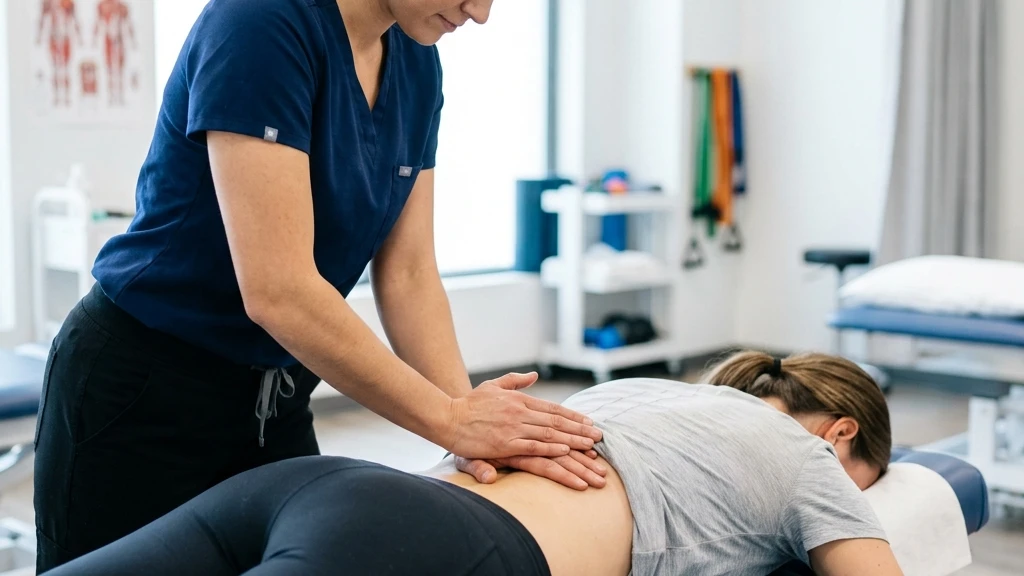
"If your lumbar facet joints are inflamed, bending backward is like crushing a pair of nutcrackers directly onto a fresh walnut—creating a sharp, bone-on-bone pinch in your lower back."
If you experience a sharp, localized pinch in your lower back when you stand tall to reach for a high shelf, or if walking downhill triggers a deep, aching pain that resolves the moment you sit down and bend forward, you are likely dealing with joint compression. This condition is known in clinical orthopedics as facet joint syndrome.
Your facet joints are the bony connectors located at the back of each vertebra, responsible for guiding spinal motion and preventing excessive twisting. When the cushioning discs between your vertebrae lose height, these joints are forced to bear excess weight—leading to cartilage degradation and painful bony contact.
Resolving this lumbar facet impingement requires a shift away from extension-based movements, focusing instead on targeted facet joint exercises that open the joint spaces and soothe the compressed nerves.
The Anatomy of Impingement: Disc Collapse and Joint Grind
To understand why extension movements trigger pain, we must look at the mechanics of the posterior spine. In a healthy back, the spinal discs bear 80% of the axial load, while the facet joints support the remaining 20%.
Facet joint arthropathy accounts for up to 15% to 45% of cases of chronic lower back pain. Up to 70% of patients with degenerative disc disease develop secondary facet joint syndrome due to disc height loss.
As disc height collapses, the weight distribution shifts dramatically to the rear joints:
- Load Multiplication: Bending backward (extension) increases the compression force on the facet joints by up to 200%.
- Nerve Compression: The narrow openings (foramens) where spinal nerves exit shrink by up to 20% during extension, pinching the nerve roots.
- Flexion Decompression: Bending forward (flexion) opens the joint spaces by over 15%, providing immediate mechanical decompression.
This mechanical reality explains why standing or walking worsens your pain, while sitting or leaning forward on a shopping cart brings immediate relief. Standard back stretches that involve backward bending are highly dangerous when these joints are inflamed.
Why Cobra Stretches and Back Bends Are Aggravating Your Pain
When patients feel lower back tightness, their natural reaction is to perform backward bending stretches like the yoga Cobra pose. They push their chests up in an attempt to stretch their abdominal wall and relieve the spasm.
My decisive clinical opinion is that performing extension back bends when your facet joints are inflamed is a critical orthopedic error—it jams the arthritic joint surfaces together, worsening the local nerve impingement. The muscles spasm as a protective mechanism to prevent you from extension. To successfully relieve lower back joint pain, you must temporarily adopt flexion-biased exercises and build the core strength needed to prevent hyperextension during standing.
This flexion-biased decompression is highly aligned with clinical spinal stenosis exercises. Once the acute inflammation subsides, you must address any underlying anterior pelvic tilt to ensure your pelvis stays in a neutral, load-reducing alignment.
The Patient: Arthur, a 58-year-old construction foreman, presented with sharp, right-sided lower back pain that made standing at work sites for over 15 minutes a painful ordeal.
The Mistake: Arthur was performing extension exercises and receiving high-velocity spinal adjustments that provided only fleeting relief before his pain returned.
The Solution: We stopped all extension work, initiated flexion-biased core stability training, and coached him in active posterior pelvic tilting.
The Outcome: Within 4 weeks, Arthur experienced a 90% pain reduction and returned to full work shifts with zero joint pinching.
Three Flexion-Biased Exercises for Facet Joint Decompression
To open your facet joints, reduce nerve compression, and eliminate lower back pinching, perform these three clinical exercises daily:
-
1The Double Knee-to-Chest Decompression Lie flat on your back on a comfortable mat. Slowly pull one knee toward your chest, followed by the other. Hug your knees firmly with both hands, pulling them gently toward your shoulders until you feel a comfortable stretch in your lower back. This flexion position expands the facet joint spaces, relieving pressure on the nerves. Hold for 30 seconds, breathe deeply, and repeat 4 times.
-
2The Posterior Pelvic Tilt (Floor-Assisted) Lie on your back with knees bent and feet flat on the floor. You will notice a natural curve/gap under your lower back. Slowly contract your lower abdominals and tilt your pelvis backward, pressing your lower back flat against the floor. Squeeze your lower abs throughout the motion. Hold this flat position for 6 seconds, then release. Perform 3 sets of 12 repetitions. This trains the muscles needed to tilt your pelvis, preventing facet impingement while standing.
-
3The Child's Pose with Side Walk Kneel on the floor, sit your hips back onto your heels, and reach your arms forward on the floor, lowering your chest. Once in this position, slowly walk both hands 6 inches to the left until you feel a deep stretch on the right side of your lower back. Hold for 20 seconds, then walk your hands to the right. This targets unilateral facet joint impingement, stretching the compressed tissues. For long-term core support, follow this with multifidus muscle strengthening.
Reclaiming Joint Freedom
Your spinal joints are built to guide movement, not to serve as weight-bearing shock absorbers. When disc height collapses, you must adapt your movement patterns to protect the rear facet joints from friction and impingement.
By prioritizing flexion-biased exercises, practicing posterior pelvic tilts, and building deep core stability, you can open your joint spaces, eliminate sharp pinching, and walk with complete, pain-free freedom.
Irushi Abeywardhana
Senior Physiotherapist & Founder of Physio Pulse. Senior Clinical Physiotherapist passionate about blending advanced movement science with functional resilience.
Medical Disclaimer
The information provided by AyurPhysio is for general educational and informational purposes only. It is not intended as a substitute for professional medical advice, diagnosis, or treatment. Always seek the advice of your physician or other qualified health providers with any questions you may have regarding a medical condition. Never disregard professional medical advice or delay in seeking it because of something you have read on this website.
Trending Guides
Luka Modrić's Daily Routine: Low-Impact Resistance Training and Midfield Longevity
4 min readHarry Kane's Daily Routine: Hamstring Preservation and Anti-Inflammatory Nutrition
4 min readKarim Benzema's Daily Routine: Cupping Therapy (Hijama) and HIIT Conditioning
4 min readNeymar Jr.'s Daily Routine: Joint Stabilization and Hyperbaric Oxygen Therapy
4 min readMohamed Salah's Daily Routine: Early Morning Conditioning and Hyperbaric Recovery
4 min readWeekly Wellness
Don't miss the next guide
Get holistic health tips and new guides delivered to your inbox.
Related Healing Guides
View All Guides →
Hyperlordosis: Tailoring Exercise Programs to Reduce Lumbar Shear Stress

Morning Lower Back Stiffness: The Biomechanical Causes and Quick, Safe Fixes