Hyperlordosis: Tailoring Exercise Programs to Reduce Lumbar Shear Stress
"If your pelvis is tilted forward like a bucket tipping water onto your toes, your lower back is forced to act like a suspension bridge with loose cables. It will sag, compress, and eventually ache under the weight of your upper body."
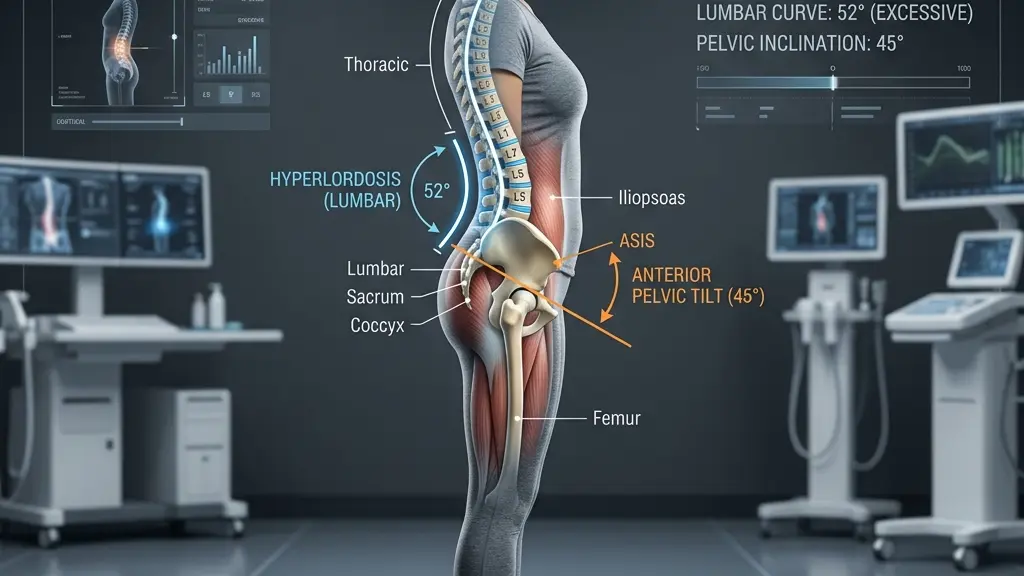
In fitness and bodybuilding, a pronounced arch in the lower back is often viewed as a sign of athletic posture. However, in the biomechanics lab, an exaggerated lumbar curve—known clinically as hyperlordosis—presents a serious mechanical challenge. This structural alignment shifts the body's center of mass forward, forcing the lumbar joints to bear excessive loads.
For individuals with hyperlordosis, standing, walking, or lifting weights often triggers a deep, pinching pain in the lower back. Standard fitness advice recommends simply stretching the lower back or performing sit-ups. Unfortunately, these generic solutions do not address the pelvic tilt that drives the curve, leaving the spinal joints irritated.
To resolve this alignment issue, your rehab must target the muscular imbalances around the pelvis. By implementing progressive hyperlordosis rehab exercises, you can correct the tilt and stabilize the lower back. This clinical guide breaks down pelvic mechanics and details how to construct an exercise program to reduce lumbar shear.
The Biomechanics of Lumbar Shear: Pelvic Tilting
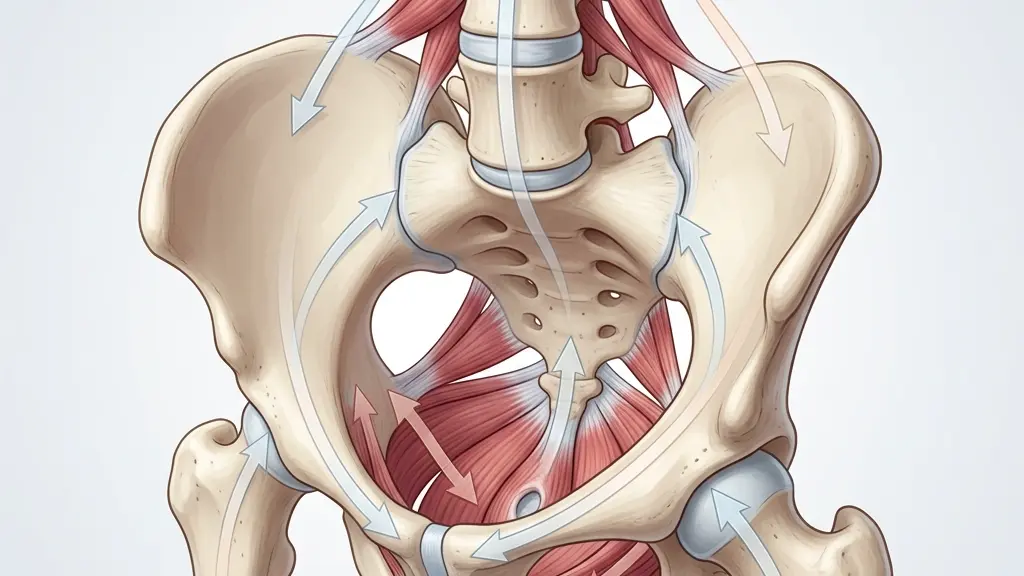
Hyperlordosis is heavily driven by a structural imbalance known as an anterior pelvic tilt. In this position, the front of the pelvis rotates forward and down, while the rear tilts upward. This forward rotation is caused by tight, overactive hip flexors and lower back extensors pulling against weak, elongated abdominals and gluteal muscles. This muscular imbalance is clinically termed lower crossed syndrome.
When the pelvis tilts forward, the lumbar vertebrae are forced to slide forward relative to one another. This sliding force is known as lumbar shear stress. Under normal alignment, the facet joints in the spine bear only 15% of your body weight. In a hyperlordotic spine, this load spikes to over 45%, compressing the joint capsules and narrowing the disc spaces.
Clinical statistics show that hyperlordosis increases facet joint compression by over 200%, leading to rapid wear and tear. Furthermore, stretching tight hip flexors passively without activating the stabilizing muscles fails to correct the tilt. To achieve a lasting excessive back arching fix, you must build active pelvic control.
The Patient: David, a 28-year-old weightlifter, suffered from localized lower back pain that flared up during standing and overhead presses.
The Mistake: David tried to fix his arch by stretching his lower back, but he continued to hyperextend his spine under heavy barbell loads.
The Solution: We put David on a lower crossed syndrome recovery program, teaching him to lock his pelvis using posterior tilts and RKC planks.
The Outcome: David corrected his anterior pelvic tilt, reduced his standing arch, and returned to pain-free lifting within 6 weeks.
Addressing the Muscle Imbalance: The Crossed Patterns
To correct an anterior pelvic tilt, you must stretch the short, overactive muscle groups while strengthening the long, underactive ones. This requires a targeted two-pronged approach.
First, stretch the tight hip flexors (iliopsoas and rectus femoris) and lumbar extensors (erector spinae). Second, strengthen the weak deep abdominals (transversus abdominis) and gluteal muscles (gluteus maximus). This combination acts as a pulley system, pulling the pelvis back into a neutral, balanced alignment.
Understanding how to correct anterior pelvic tilt allows you to design a focused rehab program. By addressing the root pelvic instability, you relieve the constant compression on your lumbar facet joints. Let's look at the specific steps to safely restructure your pelvic alignment.
Clinical parameters illustrating lumbar curve dynamics and load redistribution:
- 1Facet Joint Load SpikeAnterior pelvic tilt increases facet joint compression from a normal 15% to over 45% of body weight.
- 2Shear Force SpikeHyperlordosis causes lumbar shear forces to spike by 200%, irritating the joint capsules.
- 3Gluteal Activation BenefitStrengthening the glutes reduces pelvic forward tilt by 10 degrees, restoring spinal alignment.
- 4Abdominal Wall EngagementActivating the deep abdominals reduces lumbar extension forces during movement by 35%.
The Clinical Opinion: Engage the Glutes to Lock the Spine
"In my clinical practice, the most common mistake in treating hyperlordosis is stretching the hip flexors in a relaxed, passive position. When you stretch without locking your pelvis, your lower back simply arches further, worsening the shear stress. My clinical opinion is that you must engage your glutes and abdominals during every hip flexor stretch. Lock your pelvis in a posterior tilt first, then push forward to feel the stretch. This protects your facet joints and ensures you are targeting the correct muscles."
Targeted Rehab Exercises to Reduce Lumbar Shear
Perform this structured core and pelvic routine 3 to 4 times per week to correct hyperlordosis and restore a neutral spine.
Exercise 1: Posterior Pelvic Tilts (Mat Practice)
Lie on your back on a soft mat with your knees bent and feet flat on the floor. Inhale deeply. As you exhale, contract your lower abdominals and tilt your pelvis backward, pressing your lower back flat into the mat. Focus on using your abdominals and glutes, not your legs. Hold this flat position for 5 seconds, breathing normally, then relax. Perform 3 sets of 12 controlled repetitions.
Exercise 2: Half-Kneeling Active Hip Flexor Stretch
Kneel on your right knee, placing your left foot flat in front of you with both knees at 90 degrees. Squeeze your right glute muscle hard to tilt your pelvis backward. Engage your abdominals to lock your spine. Keeping this pelvic position, gently shift your weight forward an inch until you feel a stretch in the front of your hip. Do not let your lower back arch. Hold for 30 seconds. Perform 3 stretches per side.
Exercise 3: The RKC Plank (Active Core Lockout)
Get into a standard elbow plank position. Instead of holding it passively, squeeze your glutes as hard as possible and pull your pelvis into a posterior tilt. Pull your elbows toward your toes and your toes toward your elbows, creating maximum full-body muscle tension. Hold this high-intensity position for 10 to 15 seconds, focusing on breathing. Perform 4 sets, resting 45 seconds between sets.
Restoring Spinal Health
Correcting hyperlordosis requires consistency and mindfulness. By focusing on active pelvic control and glute strength, you can reduce lumbar shear stress and enjoy a strong, pain-free lower back.
For more posture guidelines, read our articles on causes of morning lower back stiffness and pelvic tilt correction exercises. To understand the impact of hip stability, read our analysis of gluteus medius conditioning. For spinal support reviews, see our evaluation of the best back braces.
Featured image attribution: A clinical anatomical visualization showing a patient standing with excessive lumbar curvature and anterior pelvic tilt. Prepared for AyurPhysio clinical reference.
Irushi Abeywardhana
Senior Physiotherapist & Founder of Physio Pulse. Senior Clinical Physiotherapist passionate about blending advanced movement science with functional resilience.
Medical Disclaimer
The information provided by AyurPhysio is for general educational and informational purposes only. It is not intended as a substitute for professional medical advice, diagnosis, or treatment. Always seek the advice of your physician or other qualified health providers with any questions you may have regarding a medical condition. Never disregard professional medical advice or delay in seeking it because of something you have read on this website.
Trending Guides
Luka Modrić's Daily Routine: Low-Impact Resistance Training and Midfield Longevity
4 min readHarry Kane's Daily Routine: Hamstring Preservation and Anti-Inflammatory Nutrition
4 min readKarim Benzema's Daily Routine: Cupping Therapy (Hijama) and HIIT Conditioning
4 min readNeymar Jr.'s Daily Routine: Joint Stabilization and Hyperbaric Oxygen Therapy
4 min readMohamed Salah's Daily Routine: Early Morning Conditioning and Hyperbaric Recovery
4 min readWeekly Wellness
Don't miss the next guide
Get holistic health tips and new guides delivered to your inbox.
Related Healing Guides
View All Guides →
Morning Lower Back Stiffness: The Biomechanical Causes and Quick, Safe Fixes
Spinal Stabilization Drills: Moving Beyond the Standard Plank for Dynamic Core Control