Spinal Stenosis: Flexion-Based Rehab Protocols for Pain-Free Walking
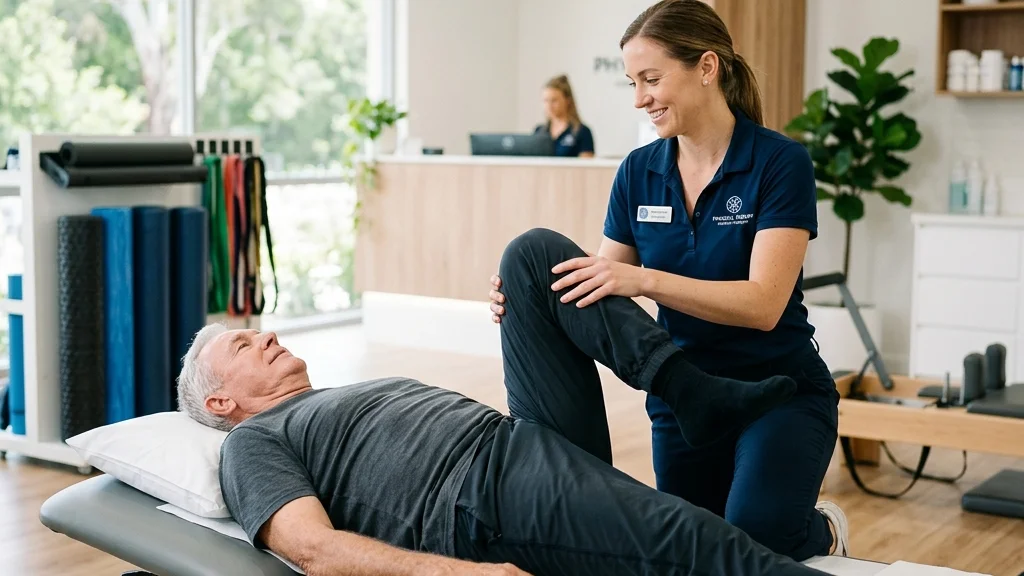
"If standing upright feels like a heavy wooden desk drawer being jammed shut on a delicate silk ribbon, your spine is telling you it has run out of space. Trying to force yourself to 'stand up straight' when you have spinal stenosis is not good posture—it is active nerve compression."
Walking through a supermarket should not feel like an endurance test. If you find yourself leaning over the shopping cart just to get relief from a dull, heavy ache in your calves and thighs, you are experiencing the classic symptoms of spinal stenosis. This condition, which involves the progressive narrowing of the spinal canal, creates a physical bottleneck for the nerves traveling down to your legs.
Many patients are told that their posture is to blame and that they need to pull their shoulders back and stand as tall as possible. However, if you have stenosis, standing tall actively narrows the very space your nerves need to survive. It is like trying to walk through a doorway that keeps shrinking with every single step you take.
To restore pain-free walking with stenosis, we must change our physical relationship with the lumbar spine. Instead of forcing extension, we must utilize strategic flexion to open up the spinal canal. By adopting targeted spinal stenosis flexion exercises, you can create natural decompression and walk without the constant threat of leg pain.
The Spatial Crisis: Why Extension Pinches
Spinal stenosis is primarily a spatial issue. As we age, wear and tear can cause the spinal discs to flatten, the joints to enlarge, and the ligaments to thicken. These changes crowd the central canal and the small exit doorways, known as the neural foramina, where nerve roots escape the spinal column.
When you stand up straight or walk down a gentle incline, your lower back naturally arches backward into extension. In a healthy spine, this is perfectly fine. But in a narrowed canal, extension reduces the foraminal volume by a significant margin, directly compressing the nerve roots and cutting off their blood supply.
This compression triggers neurogenic claudication—a combination of cramping, heaviness, and numbness that spreads into the legs. The moment you sit down or bend forward, you immediately increase the cross-sectional area of the canal, releasing the trapped nerves and restoring normal circulation.
My strong clinical opinion is that standard extension-based treatments, like the classic McKenzie extension press-ups, are highly inappropriate and often harmful for spinal stenosis patients. While extension is excellent for treating a posterior disc herniation by pushing the disc material forward, it does the exact opposite in stenosis.
Forcing extension on an arthritically narrowed canal is the mechanical equivalent of slamming a door on a pinched finger. We must completely abandon the myth that extension is always the answer for back pain. For stenosis, flexion is your primary medicine. Bending forward is not a weakness; it is your mechanical leverage to create immediate physical space.
The Williams Flexion Protocol: Restoring Space
In the 1930s, Dr. Paul Williams developed a series of exercises designed to reduce lumbar lordosis (the arch in the lower back) by strengthening the abdominal muscles and stretching the lower back extensors. Today, the Williams flexion protocol remains the cornerstone of conservative lumbar stenosis physical therapy.
By training the spine to stay in a slightly flexed or neutral position, we can prevent the pinched nerves that happen during walking. The goal is to build abdominal support and stretch out the tight muscles that pull the pelvis into an exaggerated arch.
Be extremely cautious with common yoga poses like the Cobra or Sphinx, which demand deep spinal extension. If a clinician or trainer tells you to arch your back to strengthen it, they are prescribing a protocol that will actively compress your nerves.
Always monitor your symptoms: if an exercise causes tingling or weakness to travel down into your thighs or calves, stop immediately. Your rehab should always focus on centralizing your comfort, not radiating your symptoms.
Three Essential Flexion Drills for Daily Relief
To open up your spinal canal and improve your walking capacity, integrate these three essential spinal decompression stretching drills into your morning and evening routines.
Lie on your back with your knees bent and feet flat on the floor. Tighten your stomach muscles and flatten your lower back completely against the floor, tilting your pelvis backward. Hold this position for 5 seconds, then relax. Perform 3 sets of 10 repetitions to build deep core control.
Lie on your back. Slowly bring one knee up to your chest, followed by the other. Hug your knees gently toward your chest until you feel a comfortable stretch in your lower back. Hold for 30 seconds, breathing deeply. Repeat 3 times to create passive space in the spinal canal.
Sit upright in a sturdy chair with your feet flat on the floor. Slowly bend forward, letting your head and torso drop down between your knees. Reach your hands down to touch the floor or your ankles. Hold this rounded position for 20 seconds, then slowly roll back up. Repeat 5 times.
If you find that your spinal compression is accompanied by a sharp shooting pain down one leg, you might also have a disc component. Explore our detailed guide on the McKenzie Method for Herniated Discs to understand how we differentiate these distinct spinal pathologies.
The Patient: Arthur, a 68-year-old retired mail carrier, was unable to walk more than 200 feet before severe leg heaviness and cramping forced him to sit down. He had been diagnosed with moderate lumbar spinal stenosis.
The Mistake: Arthur was told to walk with "perfect military posture," which kept his spine in constant extension and worsened his symptoms within minutes. He was also performing backward back bends, hoping to stretch his spine.
The Solution: We immediately stopped all backward bending and military posture drills. We introduced him to pelvic tilting, abdominal bracing, and taught him to walk with a very slight, active forward pelvic tilt to reduce lumbar arching.
The Outcome: Within four weeks, Arthur's walking tolerance increased from 200 feet to half a mile. By week eight, he was walking 1.5 miles pain-free with his walking group, proving that mechanical space is key to nerve health.
Building a Pain-Free Walking Pattern
Spinal stenosis does not mean you have to surrender your active lifestyle. By understanding the geometry of your spine and using flexion to your advantage, you can actively manage the spatial limitations of your joints.
If you want to build a stronger foundation to protect your spine, check out our core stability blueprint at Core Stability and Lower Back Prevention. Developing deep muscle control is the best way to maintain spinal alignment.
Focus on creating space, strengthen your abdominals, and listen to the feedback from your nerves. Bending forward is not a sign of defeat—it is your path back to the movement you love.
Irushi Abeywardhana
Senior Physiotherapist & Founder of Physio Pulse. Senior Clinical Physiotherapist passionate about blending advanced movement science with functional resilience.
Medical Disclaimer
The information provided by AyurPhysio is for general educational and informational purposes only. It is not intended as a substitute for professional medical advice, diagnosis, or treatment. Always seek the advice of your physician or other qualified health providers with any questions you may have regarding a medical condition. Never disregard professional medical advice or delay in seeking it because of something you have read on this website.
Trending Guides
Luka Modrić's Daily Routine: Low-Impact Resistance Training and Midfield Longevity
4 min readHarry Kane's Daily Routine: Hamstring Preservation and Anti-Inflammatory Nutrition
4 min readKarim Benzema's Daily Routine: Cupping Therapy (Hijama) and HIIT Conditioning
4 min readNeymar Jr.'s Daily Routine: Joint Stabilization and Hyperbaric Oxygen Therapy
4 min readMohamed Salah's Daily Routine: Early Morning Conditioning and Hyperbaric Recovery
4 min readWeekly Wellness
Don't miss the next guide
Get holistic health tips and new guides delivered to your inbox.
Related Healing Guides
View All Guides →
Hyperlordosis: Tailoring Exercise Programs to Reduce Lumbar Shear Stress
Morning Lower Back Stiffness: The Biomechanical Causes and Quick, Safe Fixes