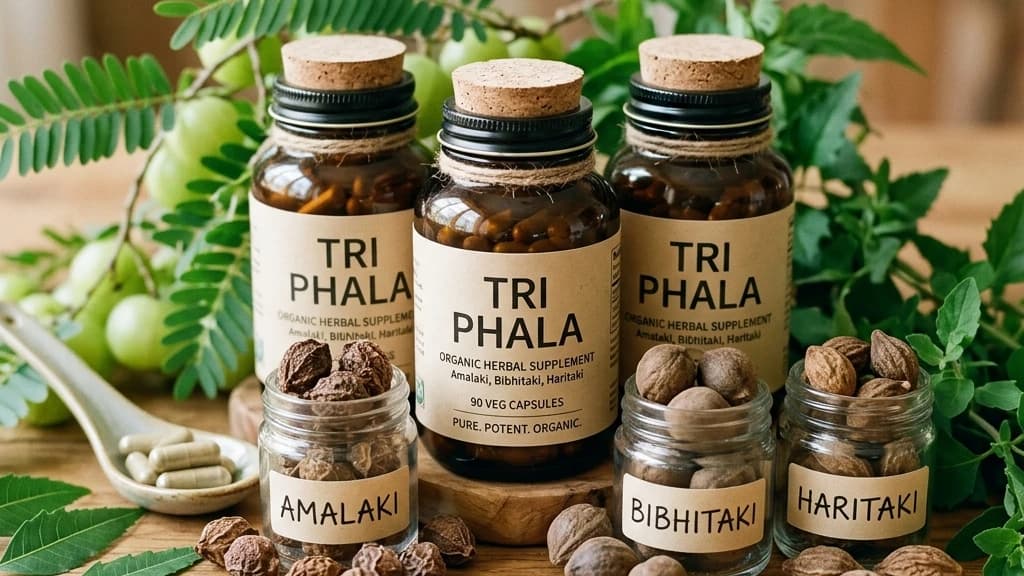
Triphala is a traditional Ayurvedic blend of three dried fruits: amalaki (Phyllanthus emblica, also called amla), bibhitaki (Terminalia bellirica) and haritaki (Terminalia chebula). It is sold as powder, capsules and tablets, usually for digestion and regularity. If you are looking for the best triphala supplement, the questions that matter most are whether the product has been independently tested for contaminants and whether triphala is suitable for you. This guide covers both. It does not rank brands.
Editorial correction, 17 November 2026: An earlier version of this page ranked five named brands with scores out of 100, described some as “heavy metal free”, and recommended them for cleansing and other health purposes. AyurPhysio has not tested any triphala product and cannot substantiate those scores or purity statements. We have removed the rankings, the purity claims and the product recommendations. No manufacturer has paid for or endorsed this guide, and it contains no affiliate links.
What human studies show, and what they do not
Triphala has a long history of traditional use. Modern evidence in people is much thinner than the marketing suggests.
- The trials are few, small and short. A systematic review of triphala's effects on blood lipids, blood sugar and body measurements concluded that it appeared safe over short periods and that long-term safety still needs study. That is a statement about limited data, not a confirmation of benefit.
- Constipation, the most common reason people buy it, is not well studied. In our search we found small, older studies with encouraging results but no high-quality review that establishes how well triphala works for constipation or how it compares with standard options.
- Laboratory and animal findings do not transfer directly to people. Many claims about antioxidant, anti-inflammatory or other effects come from studies in cells or animals.
The fair summary is that triphala may help some people with regularity, the evidence is preliminary, and no product can honestly promise more than that.
The main buying risk: contamination
For Ayurvedic products the most important quality issue is not strength. It is contamination with heavy metals.
The US National Center for Complementary and Integrative Health states that some Ayurvedic preparations contain lead, mercury or arsenic in amounts that can be toxic, and reports a survey in which a substantial share of people using Ayurvedic preparations had raised blood lead levels. The US Food and Drug Administration has warned about heavy-metal poisoning linked to certain Ayurvedic products, and notes that such products are generally not labelled as containing metals.
Two points keep this in proportion. Those warnings concern Ayurvedic products as a group, and the highest-risk products are traditional preparations that include metals or minerals on purpose. A plain three-fruit triphala does not have metals as an ingredient. But plants can take up metals from soil and water, and products can be contaminated in processing, so a fruit-only formula is not proof of a clean product. You cannot see, taste or smell the difference.
It also helps to know how supplements are regulated. In the United States, as the NIH Office of Dietary Supplements explains, supplements are not approved for safety or effectiveness before they are sold. The manufacturer is responsible for quality. Rules differ in other countries, so check how your own regulator treats herbal products.
What to check before you buy
- Independent testing for heavy metals. This is the single most useful thing to look for. A good seller can provide a certificate of analysis for the batch you are buying, from an outside laboratory, showing results for lead, arsenic, cadmium and mercury. “Tested for purity” on a label, with no report available, tells you little.
- A third-party quality seal. Seals from independent programmes show that a product was checked for what the label says it contains and for certain contaminants. The Office of Dietary Supplements notes that such seals do not mean a product is safe or effective. Few herbal products carry them, so their absence is common, but their presence is a real plus.
- “Organic” is not the same as tested. Organic certification is about how the plants were grown. It does not show that the finished product was tested for metals.
- A full ingredient list. It should name all three fruits, ideally with botanical names and the amount of each or of the blend per serving. Be cautious with “proprietary blends” that hide amounts, and with products that add laxative herbs such as senna without making that clear.
- A named manufacturer with contact details, a batch number and an expiry date.
- Powder, capsule or tablet. This is a matter of preference. Powder is cheaper and very bitter. Capsules and tablets are easier to take. We found no good evidence that one form works better.
- Where you buy. Buy from the manufacturer or an established retailer. Products bought from unknown online sellers or brought from abroad are harder to trace if something is wrong.
Claims to read carefully
- “Detox” and “colon cleanse”. These are marketing terms, not medical outcomes. Your liver and kidneys remove waste products without help from a supplement.
- “Clinically proven”. Ask which study, in whom, and whether it tested this product. Usually it did not.
- “Heavy metal free”. No plant product contains exactly zero. An honest seller shows measured levels against a stated limit.
- Weight loss, blood sugar or cholesterol claims. The human evidence is early and short-term. Do not use triphala in place of prescribed treatment.
Who should be careful
We do not suggest a dose. Follow the product label, and speak to a doctor or pharmacist first if any of the following apply.
- Pregnancy or breastfeeding. There is not enough safety information, so it is generally advised to avoid triphala.
- Children. Do not give herbal laxative products to children without medical advice.
- Regular medicines. Interactions between triphala and medicines have not been well studied. This matters most if you take medicines for diabetes or blood clotting, or any medicine where a steady level in the body is important.
- Bowel conditions, such as inflammatory bowel disease, or current diarrhoea.
- Planned surgery. Tell your surgical team about every supplement you take.
The most commonly reported side effects in studies are loose stools and stomach discomfort. Stop taking it if these occur.
When constipation needs a doctor, not a supplement
See a doctor promptly if you have blood in your stools, unexplained weight loss, a change in bowel habit lasting more than a few weeks, severe or persistent abdominal pain, vomiting, or constipation that began after starting a new medicine. Regular reliance on any laxative product, herbal or not, is also worth discussing with a doctor.
For ordinary occasional constipation, the usual first steps are more fibre from food, enough fluid and regular physical activity.
Bottom line
There is no product winner on this page. If you decide to try triphala, the best choice is a plain three-fruit product from a named manufacturer that will show you an independent heavy-metal test report for the batch. Price, organic labels and star ratings are poor substitutes for that report. Keep expectations modest, and treat symptoms that persist as a reason to see a doctor.
For more on judging pages like this one, see our guide on how to read a health-product review.
Sources and limitations
- National Center for Complementary and Integrative Health: Ayurvedic Medicine: In Depth. Supports the statements on metals in Ayurvedic preparations.
- US Food and Drug Administration: warning on heavy-metal poisoning associated with certain unapproved Ayurvedic products. Supports the regulatory warning.
- NIH Office of Dietary Supplements: Dietary Supplements: What You Need to Know. Supports the points on regulation and quality seals.
- Effects of Triphala on Lipid and Glucose Profiles and Anthropometric Parameters: A Systematic Review. Supports the summary of human trial evidence and short-term safety.
Sources were accessed on 17 November 2026. They do not compare commercial products. Our statements that constipation and drug interactions are not well studied reflect a limited search, not a formal review. The buying checklist is our editorial summary. This guide is not medical advice and has not been reviewed by a doctor or an Ayurvedic practitioner.
Medical Disclaimer
The information provided by AyurPhysio is for general educational and informational purposes only. It is not intended as a substitute for professional medical advice, diagnosis, or treatment. Always seek the advice of your physician or other qualified health providers with any questions you may have regarding a medical condition. Never disregard professional medical advice or delay in seeking it because of something you have read on this website.
Trending Guides
How to Read a Health-Product Review Without Being Misled
4 min readOne in Six Older Adults Faced Delayed Home Rehabilitation After Joint Replacement
3 min readCan Group Knee-Osteoarthritis Care Work by Video? A Small Trial Offers a Cautious Yes
3 min readBlended Digital Physiotherapy Was Not Better for Neck and Shoulder Pain in a 2026 Trial
3 min readPressure-Wave Therapy After Rotator-Cuff Repair: What a Small 2026 Trial Adds
3 min readWeekly Wellness
Don't miss the next guide
Get holistic health tips and new guides delivered to your inbox.
Related Healing Guides
View All Guides →How to Read a Health-Product Review Without Being Misled
Resistance Bands for Shoulder Rehab: A Buying Guide Without Rankings