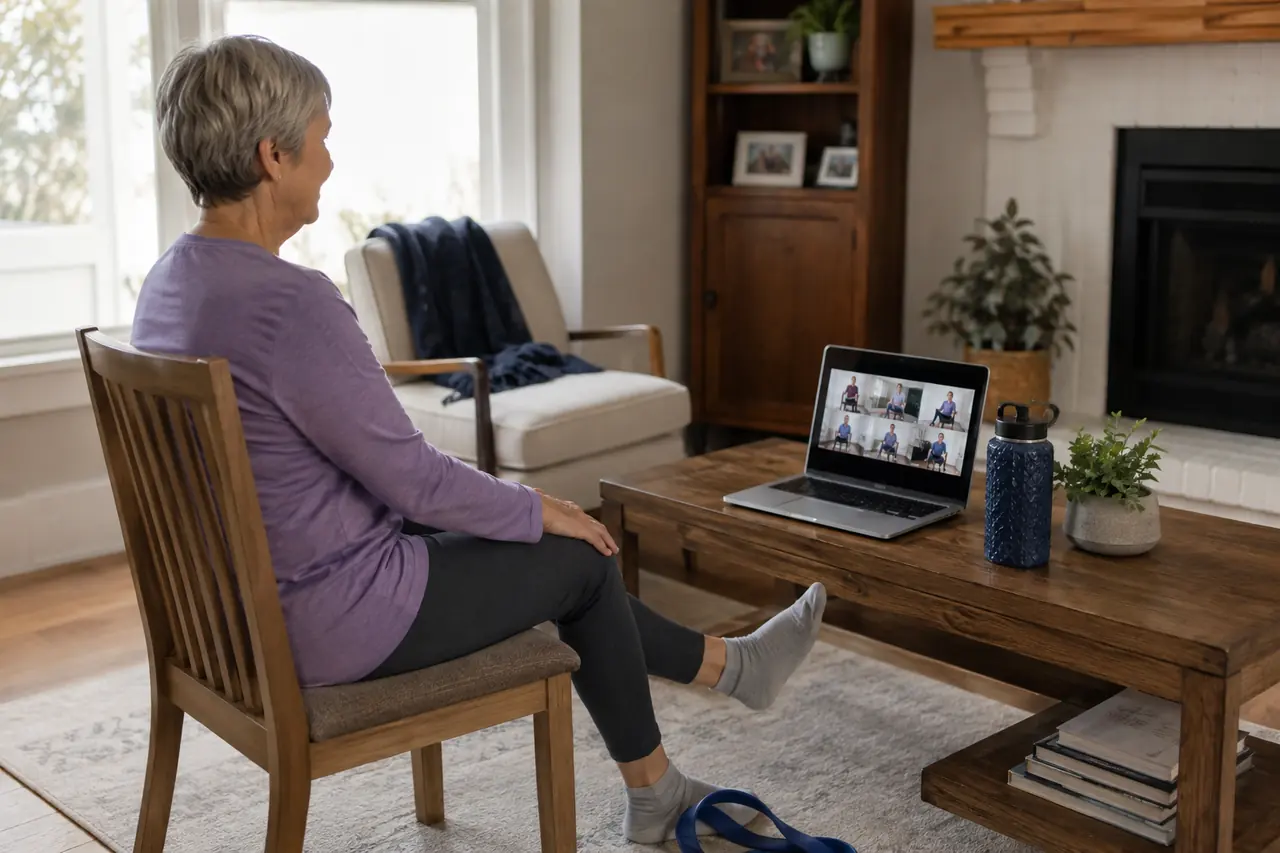
Travel, geography, work and caregiving can make in-person osteoarthritis programmes difficult to attend. A randomized trial appearing in the September 2026 issue of the Journal of Telemedicine and Telecare tested whether a group exercise-and-education programme delivered by video could achieve outcomes that were not meaningfully worse than in-person delivery.
What participants received
Twenty-two participants were assigned to attend the group programme in person and 22 by telehealth. The programme combined exercise therapy with education for people with knee osteoarthritis. Researchers evaluated a combined score covering pain, symptoms, activities of daily living and quality of life.
At three months, the estimated difference favoured telehealth by six points, with a confidence interval from two points worse to 15 points better. The lower end remained above the study’s predefined non-inferiority margin of minus 10 points. At 12 months, the estimated difference was zero, again with the interval remaining just above that margin.
Why a small non-inferiority trial needs care
A non-inferiority design asks whether a new delivery method is not unacceptably worse than an established one. It is not the same as proving both approaches are identical or that telehealth is superior. The margin chosen by researchers and the amount of missing follow-up data both affect interpretation.
Recruitment stopped in March 2020, leaving the study at 40% of its planned sample. That creates substantial uncertainty. The authors appropriately concluded that outcomes might not differ rather than claiming equivalence.
The conflict-of-interest statement also deserves visibility: several authors were involved in leading or training clinicians for the programme’s Australian implementation. A declared connection does not invalidate research, but readers should know about it.
What this means for access
The study supports continued investigation of video-delivered group care as an access option. Whether it works for a particular person can depend on technology, hearing and vision, home space, safety, confidence, exercise supervision and the ability to adapt activities. Remote delivery should be designed around those realities, not treated as a simple copy of an in-person class.
Questions to ask about remote care
- How will the clinician assess whether remote group exercise is suitable?
- Can exercises be adapted to my ability, space and equipment?
- What should I do if pain or another symptom changes during a session?
- What privacy protections apply to the video platform?
For broader context, see our overview of osteoarthritis and low-impact strengthening concepts. Individual exercise choices should be discussed with an appropriate professional.
Source
This article reports research and does not provide an exercise programme or assess whether telehealth is suitable for an individual.
Medical Disclaimer
The information provided by AyurPhysio is for general educational and informational purposes only. It is not intended as a substitute for professional medical advice, diagnosis, or treatment. Always seek the advice of your physician or other qualified health providers with any questions you may have regarding a medical condition. Never disregard professional medical advice or delay in seeking it because of something you have read on this website.
Trending Guides
How to Read a Health-Product Review Without Being Misled
4 min readOne in Six Older Adults Faced Delayed Home Rehabilitation After Joint Replacement
3 min readCan Group Knee-Osteoarthritis Care Work by Video? A Small Trial Offers a Cautious Yes
3 min readBlended Digital Physiotherapy Was Not Better for Neck and Shoulder Pain in a 2026 Trial
3 min readPressure-Wave Therapy After Rotator-Cuff Repair: What a Small 2026 Trial Adds
3 min readWeekly Wellness
Don't miss the next guide
Get holistic health tips and new guides delivered to your inbox.
Related Healing Guides
View All Guides →
One in Six Older Adults Faced Delayed Home Rehabilitation After Joint Replacement
Blended Digital Physiotherapy Was Not Better for Neck and Shoulder Pain in a 2026 Trial