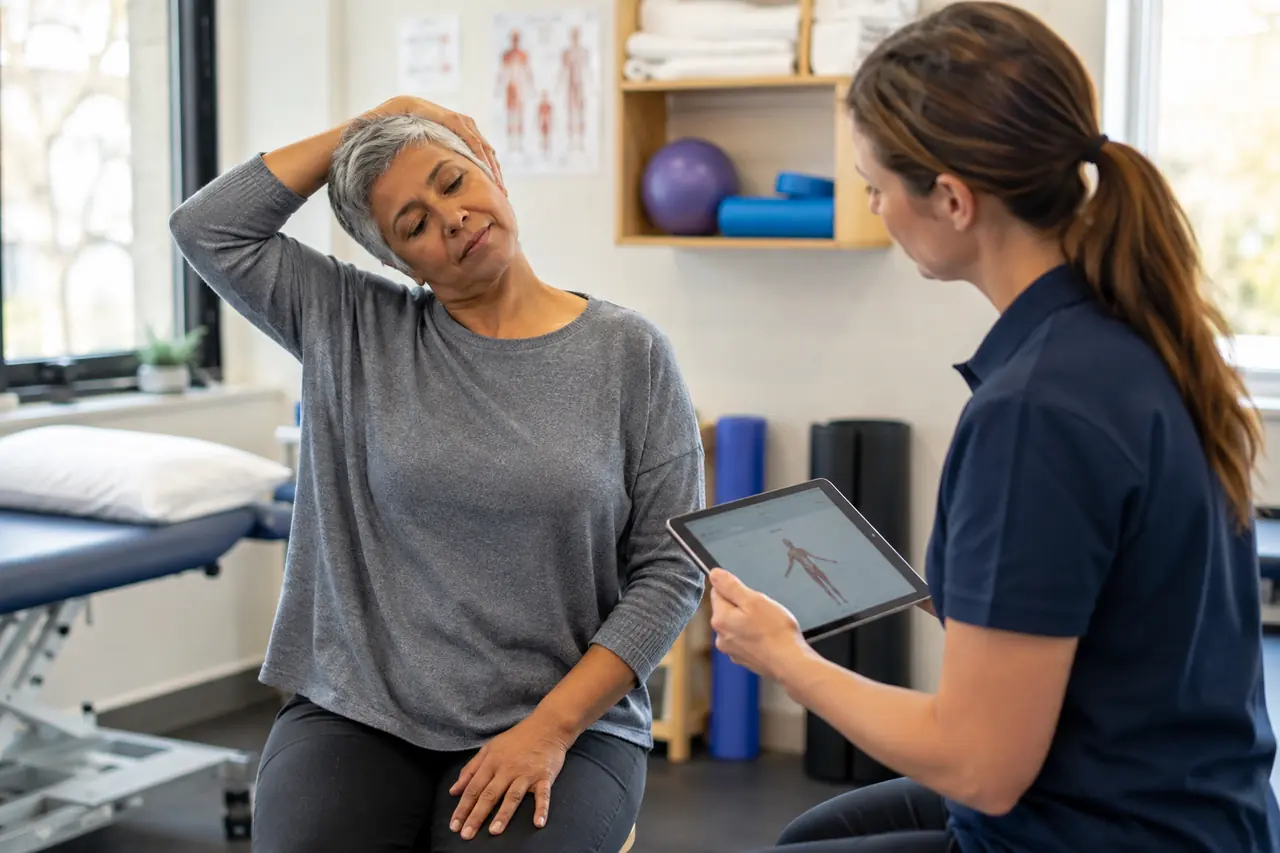
Digital tools are often presented as the inevitable next step in physiotherapy. A Dutch cluster-randomized trial published online on 25 May 2026 offers a more useful message: adding risk stratification and app-supported care did not produce better pain and disability outcomes than usual physiotherapy over nine months.
What “blended” meant in this study
The intervention was not an app acting alone. Physiotherapists used a prognostic tool to group patients by risk and a checklist to decide whether blended care was suitable. Eligible participants received app-based exercise modules; others received an equivalent paper workbook. Face-to-face physiotherapy remained part of the model.
Usual-care physiotherapists followed clinical guidelines without the study’s stratification and digital support. Across 24 Dutch practices, 139 people with neck or shoulder complaints enrolled, and 136 completed the first questionnaire.
What happened over nine months
Combined pain-and-disability scores decreased by 20.2 points in the blended group and 21.6 points in usual care. The adjusted difference was less than one point, with a confidence interval spanning possible benefit and harm. The prespecified analysis found no statistically significant difference over time.
An important practical detail was session use. The publication highlights that many participants were classified as low risk, and the blended approach may have delivered similar outcomes with fewer sessions in that subgroup. That possibility concerns efficiency rather than superior symptom relief and needs careful economic evaluation.
Why the uncertainty matters
The investigators had planned to recruit 238 people, but the COVID-19 pandemic disrupted recruitment. The smaller sample reduced the trial’s ability to detect a difference and may have introduced selection bias. A related economic evaluation later found small, uncertain differences in costs and health outcomes.
Digital care can still improve convenience, continuity or access for some patients. This trial simply warns against assuming that an app, algorithm or “personalized” label automatically improves clinical outcomes. The quality of the therapeutic relationship, suitability for remote tasks, accessibility and the content of care still matter.
Questions for evaluating a blended programme
- Which parts happen with a clinician, and which happen independently?
- Can the plan be adjusted if symptoms, confidence or access needs change?
- Does the platform protect health information and work with assistive technology?
- What outcome will show that the programme is useful for this patient?
If screen-based work contributes to long periods without movement, our desk break timer can help schedule self-chosen pauses. It does not provide exercises or treatment recommendations.
Sources
- van Tilburg ML, et al. Effectiveness of stratified blended physiotherapy versus usual physiotherapy for neck and shoulder pain. Published online 25 May 2026.
- van Tilburg ML, et al. Cost-effectiveness analysis of the same trial. Published online 25 July 2026.
This is an independent research summary, not a recommendation for or against digital physiotherapy.
Medical Disclaimer
The information provided by AyurPhysio is for general educational and informational purposes only. It is not intended as a substitute for professional medical advice, diagnosis, or treatment. Always seek the advice of your physician or other qualified health providers with any questions you may have regarding a medical condition. Never disregard professional medical advice or delay in seeking it because of something you have read on this website.
Trending Guides
How to Read a Health-Product Review Without Being Misled
4 min readOne in Six Older Adults Faced Delayed Home Rehabilitation After Joint Replacement
3 min readCan Group Knee-Osteoarthritis Care Work by Video? A Small Trial Offers a Cautious Yes
3 min readBlended Digital Physiotherapy Was Not Better for Neck and Shoulder Pain in a 2026 Trial
3 min readPressure-Wave Therapy After Rotator-Cuff Repair: What a Small 2026 Trial Adds
3 min readWeekly Wellness
Don't miss the next guide
Get holistic health tips and new guides delivered to your inbox.
Related Healing Guides
View All Guides →
One in Six Older Adults Faced Delayed Home Rehabilitation After Joint Replacement
Can Group Knee-Osteoarthritis Care Work by Video? A Small Trial Offers a Cautious Yes