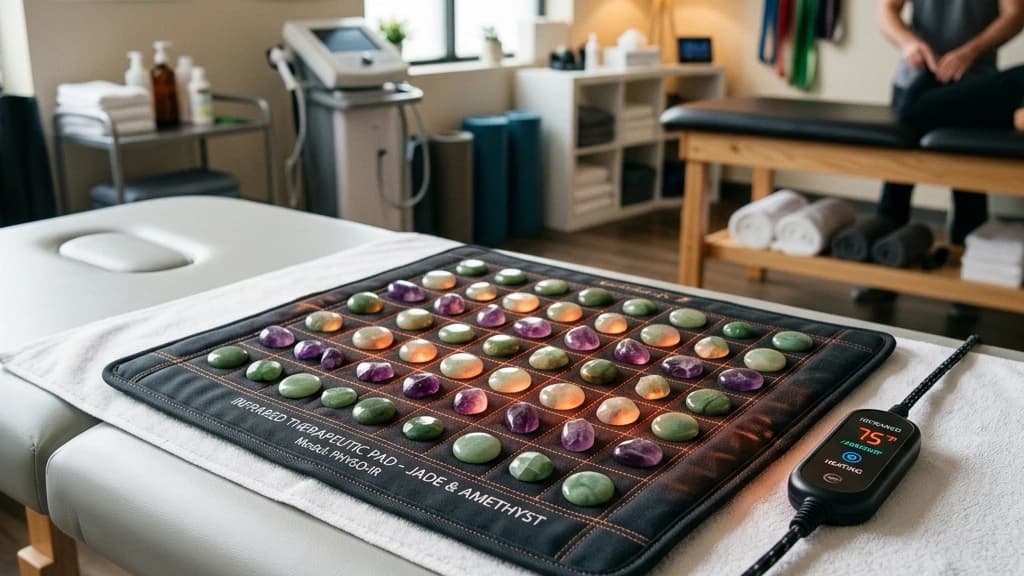
Far infrared heating pads, often sold with jade, tourmaline or amethyst stones, cost several times more than an ordinary electric heating pad. Sellers say the heat “penetrates deeper”. If you are trying to choose the best far infrared heating pad, the first question is whether the infrared part is worth paying for at all. This guide covers what research supports, what it does not, what to check before buying any heating pad, and how to use one safely. It does not rank products.
Editorial correction, 17 November 2026: An earlier version of this page ranked five named products with scores out of 100, quoted electromagnetic field readings for each, and described which medical conditions each one suited. AyurPhysio has not tested any heating pad, did not take those measurements and cannot substantiate the scores. We have removed the rankings, the readings and the product recommendations. No manufacturer has paid for or endorsed this guide, and it contains no affiliate links.
What research says about heat
Ordinary surface heat has reasonable support for one common problem: recent low back pain.
- A Cochrane review of superficial heat and cold for low back pain found moderate evidence that heat wrap therapy reduces pain and disability in people whose back pain has lasted less than three months. The review describes the effect as small and short-lived, and says the overall evidence base is limited.
- The American College of Physicians guideline on low back pain lists superficial heat among the non-drug options for acute or subacute low back pain. It also notes that most people with recent back pain improve over time whatever treatment they use.
Two limits follow. The benefit shown is short-term comfort, not a cure. And the studies mostly used continuous low-level heat wraps on recent back pain, so they tell us less about long-standing pain or other parts of the body.
What research says about far infrared
This is where the evidence thins out. In our search we did not find a trial that directly compares a far infrared heating pad with an ordinary heating pad at the same temperature. Without that comparison, there is no sound basis for saying that the infrared version relieves pain better.
A 2022 systematic review of infrared radiation for musculoskeletal conditions and chronic pain reached a favourable conclusion, but it rested on a small number of studies, several of them observational. Favourable results from weak studies are a reason for more research, not a reason to pay a premium.
Controlled trials of other far infrared products are a caution. In studies of infrared patches and similar devices, people who received a sham version often improved about as much as those who received the real one. Feeling better after using a product does not show that the infrared feature caused it.
Claims to read carefully
- “Penetrates deep into the muscle.” This is the central selling point and the one with the least support. Warmth from any heating pad is felt mainly in the skin and the tissue just beneath it. We found no good evidence that a far infrared pad produces better outcomes through deeper heating.
- Stones and “negative ions”. Jade, tourmaline and amethyst hold and spread heat, and some people like the weight and feel. We found no reliable evidence that the type of stone, or ions said to come from it, has any health effect.
- “Low EMF” or “zero EMF”. These figures are usually the seller's own and are rarely backed by an independent test report. If the point matters to you, ask for the report.
- “Detox”, “boosts immunity”, “improves circulation”. Heat makes skin blood vessels widen, which is why skin goes pink. That is not evidence of detoxification or of a medical benefit.
- “FDA registered” or “FDA cleared”. These terms do not mean the regulator has tested the product or confirmed that it works. Registration in particular is an administrative listing.
Is an ordinary heating pad enough?
For most people looking for short-term comfort from a stiff or aching back, the supported ingredient is gentle warmth, and an ordinary electric pad, a microwavable pack or a hot water bottle provides it. A far infrared stone mat is a reasonable purchase if you prefer its weight, size or feel and are happy with the price. It is not a reasonable purchase if the reason is an expectation of a stronger medical effect.
What to check before buying any heating pad
- Electrical safety certification. Look for the mark of a recognised testing body for your country on the product and its controller, not only in the advert.
- Automatic shut-off. Choose a pad that turns itself off after a set time, and check what that time is.
- Overheat protection stated in the manual.
- Temperature control. Several clearly marked settings are more useful than a high maximum. You should be able to choose a low setting.
- Size and weight. Stone mats can be heavy and stiff. They lie well on a bed or chair but do not wrap around a shoulder or knee.
- Cover and cleaning. A removable washable cover is practical.
- Warranty and returns. Confirm both in writing, and note who pays for return postage on a heavy item.
- The manual. Ask to see it before buying. A missing or vague manual is a warning sign.
Using a heating pad safely
Heating pads cause burns every year, usually through long contact at a temperature that does not feel dangerous.
- Do not sleep on or with a heating pad switched on.
- Keep a layer of fabric between the pad and your skin, and start on the lowest setting.
- Limit each session and check your skin. Stop if it becomes red, sore or blotchy.
- Do not use heat on numb skin. If you cannot feel temperature properly, you cannot tell when a pad is burning you.
- Watch for a lasting net-like brown or red pattern on the skin. Repeated heat exposure below burning temperature can cause a condition called erythema ab igne, and case reports describe it after regular heating pad use. If you notice it, stop using heat on that area and show it to a doctor.
- Do not use a damaged pad, and do not fold or sit on a pad that the manual says must lie flat.
Ask a doctor before using heat if
- you have diabetes, nerve damage or poor circulation, because reduced sensation raises the risk of burns;
- you are pregnant;
- the area is newly injured, swollen, hot or infected;
- you have a skin condition or broken skin over the area;
- the pad would be used by a child, or by an adult who cannot move away from it or report discomfort.
Heat is for comfort. Back pain with new leg weakness, numbness around the groin, or loss of bladder or bowel control needs urgent medical assessment. So does pain with fever, unexplained weight loss or a recent serious injury.
Bottom line
There is no product winner on this page. Gentle heat has modest, short-term support for recent low back pain. The extra claims made for far infrared pads and their stones are not supported by good comparative evidence. Buy on safety features, size, comfort and price, and treat any promise of deep healing with caution. For more on judging pages like this one, see our guide on how to read a health-product review and our companion guide to resistance bands for shoulder rehabilitation.
Sources and limitations
- Cochrane: Superficial heat or cold for low back pain. Supports the summary of heat wrap evidence.
- American College of Physicians: Noninvasive Treatments for Acute, Subacute, and Chronic Low Back Pain (2017). Supports the guideline summary.
- Infrared Radiation in the Management of Musculoskeletal Conditions and Chronic Pain: A Systematic Review (2022). Supports the description of the infrared evidence base.
- Erythema Ab Igne due to Heating Pad Use: A Case Report and Review. Supports the skin warning.
Sources were accessed on 17 November 2026. They support the statements about heat and infrared research, not any comparison of commercial products. Our statement that we found no direct trial of far infrared pads against ordinary pads reflects a limited search and is not a formal review. The buying checklist and safety points are our editorial summary of general product and safety knowledge. This guide is not medical advice and has not been medically reviewed.
Medical Disclaimer
The information provided by AyurPhysio is for general educational and informational purposes only. It is not intended as a substitute for professional medical advice, diagnosis, or treatment. Always seek the advice of your physician or other qualified health providers with any questions you may have regarding a medical condition. Never disregard professional medical advice or delay in seeking it because of something you have read on this website.
Trending Guides
How to Read a Health-Product Review Without Being Misled
4 min readOne in Six Older Adults Faced Delayed Home Rehabilitation After Joint Replacement
3 min readCan Group Knee-Osteoarthritis Care Work by Video? A Small Trial Offers a Cautious Yes
3 min readBlended Digital Physiotherapy Was Not Better for Neck and Shoulder Pain in a 2026 Trial
3 min readPressure-Wave Therapy After Rotator-Cuff Repair: What a Small 2026 Trial Adds
3 min readWeekly Wellness
Don't miss the next guide
Get holistic health tips and new guides delivered to your inbox.
Related Healing Guides
View All Guides →How to Read a Health-Product Review Without Being Misled
Resistance Bands for Shoulder Rehab: A Buying Guide Without Rankings