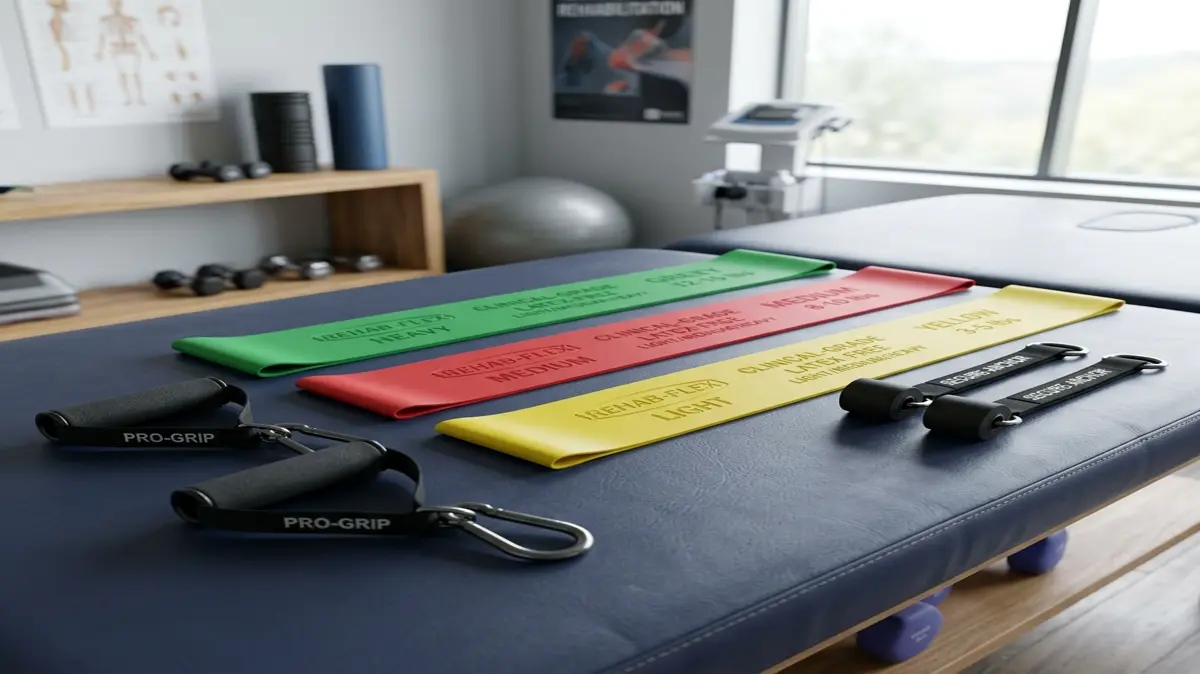
If you are looking for the best resistance bands for rotator cuff or shoulder rehabilitation, the useful question is which type of band suits the exercises you have been given, not which brand tops a list. This guide explains the main band types, what to check before you pay, how to use bands safely, and what clinical guidelines say about exercise for shoulder pain. It does not rank products.
Editorial correction, 16 November 2026: An earlier version of this page ranked five named products with scores out of 100 and referred to more than 3,000 patient surveys. We could not substantiate those scores or that survey, and AyurPhysio has not tested any resistance band. We have removed the rankings, the scores and the product recommendations. No manufacturer has paid for or endorsed this guide, and it contains no affiliate links.
What the evidence says, and what it does not
Exercise is well supported for the most common kind of shoulder pain. A 2025 clinical practice guideline published in the Journal of Orthopaedic and Sports Physical Therapy recommends an active rehabilitation exercise programme, which may include resistance training at various loads, as an initial treatment for adults with rotator cuff tendinopathy.
That recommendation is about exercise, not about equipment. Resistance can come from a band, a light dumbbell, a cable machine or body weight. The guidelines we reviewed do not say that bands work better than other tools, and they do not compare brands.
Research also has not settled the best exercise recipe. A 2025 scoping review in BMC Musculoskeletal Disorders notes that resistance exercise is recommended as a first-line treatment for rotator cuff related shoulder pain, but that the evidence on which prescription details work best is conflicting. In practice this means the right load and exercise are chosen for the individual.
So a band is simply a cheap, portable way to add resistance at home. That is a good reason to own one. It is not a reason to expect a particular product to fix a shoulder.
The main types of band
- Flat band. A thin, wide strip, sold in pre-cut lengths or on a roll. Used for rotation exercises, rows and pull-aparts at light resistance. This is the type most often handed out in clinics. It is cheap and easy to shorten or lengthen, but it can roll or dig into the hands.
- Tube with handles. A round rubber tube with a handle at each end, often sold with a door anchor. Used for rows, presses and anchored rotation. It is comfortable to grip, but the fixed length makes small changes in resistance harder.
- Mini loop. A short closed loop, about 25 to 30 cm long. Used for short-range exercises with the band around the wrists or forearms. It is too short for most rotation exercises that need an anchor.
- Long loop. A thick closed loop about a metre long. Used for assisted pull-ups and heavier strength work. It is usually far too strong for early shoulder rehabilitation.
For most home shoulder programmes, a long flat band or a light tube with a door anchor covers the common exercises. If a physiotherapist has given you a programme, ask which type they had in mind before buying.
What to check before you buy
- The lightest band in the set. Shoulder rotation exercises use small muscles and usually start with very light resistance. A set that begins at “medium” may be too strong. Look for a set with a clearly light option.
- Resistance stated as a number. Good sellers state the resistance in kilograms or pounds at a given stretch. A colour or the word “heavy” on its own tells you little.
- Colours are not universal. Each manufacturer sets its own colour code. A red band from one brand may not match a red band from another, so use the chart from the maker of the band you own.
- Material. Many bands are made of natural rubber latex. If you have a latex allergy, or share the bands with someone who does, choose a product labelled latex-free and check the label, not just the listing title.
- Length. For anchored rotation and row exercises you need enough length to stand away from the anchor with the band slightly taut. Around 1.5 to 2 metres of flat band is a common working length.
- The anchor. If the set includes a door anchor, check that it is a stitched strap with a solid stopper, and that the instructions tell you to close the door towards you on the hinge side.
- Replacement cost. Bands wear out. Check that single bands can be bought again without buying the whole set.
- Returns. Confirm whether opened bands can be returned.
Price is a poor guide to quality in this category. Bands are simple products, and an expensive set mostly buys more accessories.
Marketing claims to read carefully
- “Clinical grade” or “physio approved”. These phrases have no fixed meaning. Ask who approved it and on what basis.
- “Heals rotator cuff tears.” No band heals a tendon. Exercise can reduce pain and improve function for many people, which is a different claim.
- Star ratings. Customer reviews are useful for practical points such as smell, durability and whether the anchor holds. They cannot show that a product improves a shoulder condition.
- Stacked maximum resistance. A headline figure such as a very high combined load is irrelevant for shoulder rehabilitation, where the light end of the range matters.
For more on judging pages like this one, see our guide on how to read a health-product review.
Using bands safely
- Inspect before every session. Look for nicks, thin spots and cracks, especially near knots, handles and anchor points. Replace a damaged band. Do not tape or tie it.
- Anchor securely. Use a proper door anchor on a door that closes towards you and is latched, or a fixed post. Do not loop a band over a door handle or a piece of furniture that can move.
- Keep your face out of the line of pull. A band that slips or breaks recoils along its length. Avoid stretching a band directly towards your eyes.
- Do not overstretch. Follow the maker's limit. If you need more resistance, use a stronger band instead of stretching a light one to its limit.
- Store away from heat and sunlight, which degrade rubber.
When to get advice before buying anything
A band is not the first step in every case. See a doctor or physiotherapist before starting resistance exercise if:
- the pain began with a fall or injury, or you cannot lift the arm;
- you have had shoulder surgery. After a rotator cuff repair, resistance exercise is normally delayed and must follow the surgical team's timetable;
- the shoulder is hot, swollen or very stiff, or you feel unwell with it;
- you have numbness, tingling or weakness in the arm or hand;
- the pain is severe at night or has not improved after a few weeks.
Shoulder pain together with chest pain or shortness of breath needs emergency care.
Bottom line
There is no product winner on this page. For shoulder rehabilitation, choose by type and by how light the lightest band is, check the material if latex is a concern, and spend the effort on doing the right exercises regularly. An inexpensive long flat band, or a light tube with a sound door anchor, is enough for most home programmes.
Sources and limitations
- Journal of Orthopaedic and Sports Physical Therapy: Rotator Cuff Tendinopathy Diagnosis, Nonsurgical Medical Care, and Rehabilitation: A Clinical Practice Guideline (2025). Supports the recommendation of active exercise as an initial treatment.
- BMC Musculoskeletal Disorders: Painful considerations in exercise management for rotator cuff related shoulder pain (2025). Supports the point that the best exercise parameters are not settled.
- American Academy of Orthopaedic Surgeons: updated guideline for the management of rotator cuff injuries (2025). Background on care after rotator cuff repair.
Sources were accessed on 16 November 2026. They support the statements about exercise, not any comparison of commercial products. The band types, buying checklist and safety points are our editorial summary of general product knowledge. They are not a clinical assessment, and this guide has not been medically reviewed.
Medical Disclaimer
The information provided by AyurPhysio is for general educational and informational purposes only. It is not intended as a substitute for professional medical advice, diagnosis, or treatment. Always seek the advice of your physician or other qualified health providers with any questions you may have regarding a medical condition. Never disregard professional medical advice or delay in seeking it because of something you have read on this website.
Trending Guides
How to Read a Health-Product Review Without Being Misled
4 min readOne in Six Older Adults Faced Delayed Home Rehabilitation After Joint Replacement
3 min readCan Group Knee-Osteoarthritis Care Work by Video? A Small Trial Offers a Cautious Yes
3 min readBlended Digital Physiotherapy Was Not Better for Neck and Shoulder Pain in a 2026 Trial
3 min readPressure-Wave Therapy After Rotator-Cuff Repair: What a Small 2026 Trial Adds
3 min readWeekly Wellness
Don't miss the next guide
Get holistic health tips and new guides delivered to your inbox.
Related Healing Guides
View All Guides →How to Read a Health-Product Review Without Being Misled

Triphala Supplements: A Buying Guide Focused on Evidence and Safety
