Trigger Finger: Hand Extension Splints and Orthopedic Physical Therapy
"A swollen flexor tendon trying to squeeze through a constricted pulley sheath is like forcing a thick climbing rope through a narrow keyhole — it locks, grinds, and eventually stops moving altogether."
You wake up in the morning, reach to grab your coffee mug, and your ring finger suddenly clicks. It snaps open with a painful pop, leaving a tender ache at the base of your palm. If your finger clicks and snaps like a stubborn rusty latch every time you try to open your hand, you are dealing with a mechanical mismatch in your hand's anatomy.
This frustrating condition is known as trigger finger, or clinically as stenosing tenosynovitis. It occurs when repetitive grip force or friction causes the flexor tendon to swell, forming a small nodule. This nodule then struggles to slide through the narrow A1 pulley sheath, resulting in that painful locking sensation. Restoring normal function requires targeted trigger finger physical therapy and joint unloading.
Attempting to squeeze a high-resistance stress ball to 'strengthen' a locking finger is like pressing the gas pedal when your car's brakes are jammed — it only increases the mechanical friction, worsening the swelling and locking cycle. Let us look at the biomechanics of this mechanical catch and how to resolve it safely.
The Biomechanics of Tendon Constriction
The tendons that bend your fingers glide through a series of protective tunnels called pulleys. The A1 pulley, located at the base of the finger in the palm, is the most common site of friction. Under normal conditions, the tendon slides smoothly back and forth, lubricated by a thin fluid sheath. However, repetitive gripping forces the tendon to rub hard against the pulley, triggering local tissue thickening.
Once the tendon swells and a nodule forms, it can get stuck on the palm side of the pulley when you bend your finger. When you try to straighten the hand, the nodule gets jammed against the entrance of the pulley. With an extra push from your extensor muscles, the nodule pops through, producing the characteristic 'triggering' snap.
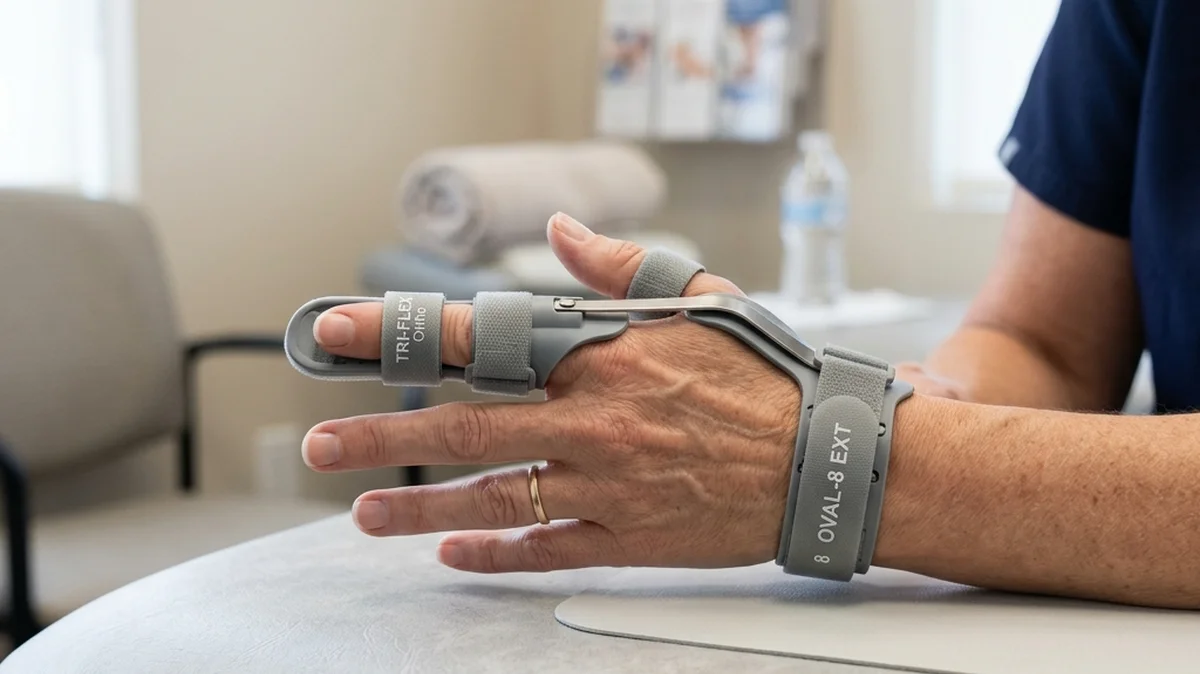
This biomechanical breakdown is what hand therapists address through customized finger extension splints and manual release. Keeping the finger in a straight, neutral position—especially overnight—prevents the tendon from locking and resting in a compressed, swollen state, which allows the local edema to clear.
- Clinical trials show that wearing a night extension splint for 6 weeks reduces the severity of trigger finger in 70% of patients.
- Hand therapy protocols combining targeted tendon gliding exercises with manual release decrease the need for surgical intervention by 68%.
- Electromyography (EMG) studies confirm that progressive tendon gliding maximizes tendon excursion while minimizing friction on the A1 pulley by 35%.
Why Squeezing Stress Balls Worsens Tendon Rubbing
The most common self-treatment error for a stiff finger is using high-resistance stress balls or grip squeezers. When your flexor tendon is already swollen and struggling to slide, squeezing forces the tendon to rub hard against the A1 pulley under load. This friction acts as a mechanical irritant, worsening the swelling and making the locking episodes more frequent.
Instead of strengthening the grip, the focus must be on stretching the tight pulley structures and sliding the tendon without load. This is achieved through specific hand therapy exercises that move the joints through isolated ranges of motion, separating the tissues and breaking down micro-adhesions.
By using an extension splint, you protect the joint from resting in a curled position overnight, which prevents morning locking. Once the tissue swelling decreases, you can transition to progressive hand rehabilitation drills that restore full finger dexterity and grip balance.
"In my clinic, I see so many patients who have tried to 'work through' their trigger finger by squeezing stress balls. They come in with severe palm pain and fingers that are locked solid. Squeezing is the worst thing you can do for an inflamed tendon. We must unload the joint using a custom night splint and then guide the tendon through gentle, unresisted glides. Waking up the wrist extensors and stretching the palm fascia is the key to restoring hand function."
The Three Pillars of Hand Rehabilitation
A successful clinical recovery program for trigger finger is built on three key phases: localized unloading, neural and tendon gliding, and progressive grip reconditioning. First, we use a splint to keep the joint extended and remove the mechanical friction. Second, we restore the tendon's sliding ability. Third, we rebuild hand balance.
This progression ensures that you do not overload the healing tendon while the sheath is still swollen. By performing low-load exercises with high focus, you can rebuild strength in the forearm muscles without triggering compensation patterns in the wrist and thumb.
Additionally, if your hand pain is accompanied by tingling in the thumb and index finger, explore our guide on carpal tunnel syndrome wrist ergonomics. If you are experiencing pain at the base of the thumb, check out our clinical breakdown of de quervains tenosynovitis relief. And for an overall guide on protecting your joints, read our analysis on managing hand osteoarthritis.
The Patient: Sarah, a 48-year-old dental hygienist, presented with severe locking and pain in her right middle finger, which severely disrupted her ability to hold dental instruments.
The Mistake: Sarah spent weeks squeezing a high-resistance foam ball to strengthen her hand, which caused her palm to swell and made her finger lock permanently in a bent position.
The Solution: We suspended all grip exercises, fitted her with a custom night extension splint, initiated daily tendon gliding exercises, and utilized deep transverse friction massage on the A1 pulley.
The Outcome: Sarah achieved complete resolution of finger catching within 6 weeks. Her hand grip strength fully recovered, and she returned to work pain-free with modified instrument grips.
Your Daily Tendon Gliding & Splinting Protocol
Perform this focused clinical sequence twice daily. Spend 5 to 10 minutes on the exercises, focusing entirely on smooth, controlled movements without force:
-
1Phase 1: Night Extension Splinting (Overnight) Before going to bed, apply a small, rigid finger splint that keeps the middle joint (PIP joint) of the affected finger in a completely straight, extended position. Secure it with the strap. This prevents the finger from curling into a fist overnight, protecting the tendon from swelling and preventing painful morning locking.
-
2Phase 2: Tendon Gliding Sequence (10 reps, 2 times daily) Hold your hand straight up. Move through five distinct hand positions in order: (1) Straight hand, (2) Hook fist (bend only the finger tips), (3) Tabletop (bend only the knuckle joints, keeping fingers straight), (4) Straight fist (bend fingers to touch the palm, keeping tips straight), and (5) Full fist. Hold each position for 2 seconds. This slides the flexor tendons through the pulley system with minimal friction.
-
3Phase 3: Deep Transverse Friction Massage (2-3 minutes daily) Locate the tender nodule at the base of your affected finger in the palm (A1 pulley). Apply firm, deep pressure using your opposite thumb. Rub back and forth across the tendon (perpendicular to the direction of the finger) for 2 to 3 minutes. This stimulates blood flow, helps break down scar tissue, and softens the nodule.
Unlocking Full Upper Limb Mechanics
Restoring smooth movement to your fingers is only the first step in reclaiming hand function. To ensure that your hand pain does not lead to compensatory stiffness in your wrist and forearm, you must also look at how your upper body posture and nerve pathways affect your hand health.
To learn how to relieve pinched nerves in your wrist, check out our guide on carpal tunnel syndrome wrist exercises. If your hand stiffness is part of a broader joint issue, explore our clinical breakdown of hand osteoarthritis protection. Additionally, to learn how to keep your neck nerves free of compression that can refer pain to your hand, read our tips on cervical radiculopathy exercises.
Your hands are designed to perform intricate, delicate movements, but they require healthy, friction-free pathways to do so. Stop letting a tight pulley lock your fingers. Unload the tendon, glide your joints, and let your hands work the way they were designed to.
Are you wearing your night splint consistently, or are you allowing your finger to lock overnight and aggravate the tendon sheath?
Featured image: A premium clinical vector illustration of a patient's hand with a neat, modern finger extension splint on the ring finger. A professional physical therapist is demonstrating a gentle tendon gliding exercise in a bright clinical room. Created for AyurPhysio educational resources.
Irushi Abeywardhana
Senior Physiotherapist & Founder of Physio Pulse. Senior Clinical Physiotherapist passionate about blending advanced movement science with functional resilience.
Medical Disclaimer
The information provided by AyurPhysio is for general educational and informational purposes only. It is not intended as a substitute for professional medical advice, diagnosis, or treatment. Always seek the advice of your physician or other qualified health providers with any questions you may have regarding a medical condition. Never disregard professional medical advice or delay in seeking it because of something you have read on this website.
Trending Guides
Luka Modrić's Daily Routine: Low-Impact Resistance Training and Midfield Longevity
4 min readHarry Kane's Daily Routine: Hamstring Preservation and Anti-Inflammatory Nutrition
4 min readKarim Benzema's Daily Routine: Cupping Therapy (Hijama) and HIIT Conditioning
4 min readNeymar Jr.'s Daily Routine: Joint Stabilization and Hyperbaric Oxygen Therapy
4 min readMohamed Salah's Daily Routine: Early Morning Conditioning and Hyperbaric Recovery
4 min readWeekly Wellness
Don't miss the next guide
Get holistic health tips and new guides delivered to your inbox.
Related Healing Guides
View All Guides →
Hyperlordosis: Tailoring Exercise Programs to Reduce Lumbar Shear Stress

Morning Lower Back Stiffness: The Biomechanical Causes and Quick, Safe Fixes