Managing Osteoarthritis of the Hands: Joint Protection and Dexterity Drills
"If opening a simple jar of strawberry jam feels like forcing a rusty, jammed key into an old padlock, your fingers are screaming for a mechanical change. Stopping all hand movement to protect your joints is like parking a classic car in a damp garage and expecting it not to rust solid."
Our hands are the primary interface through which we interact with the world. When osteoarthritis strikes the small joints of your fingers and thumbs, everyday tasks like buttoning a shirt, holding a coffee mug, or typing on a keyboard can turn into an agonizing chore. It can feel like trying to write a delicate letter while wearing heavy, stiff boxing gloves.
Osteoarthritis involves the slow, progressive breakdown of the protective cartilage that caps the ends of your bones. Without this natural cushioning, bone rubs against bone, leading to inflammation, bony nodules, and chronic stiffness. Many patients react by avoiding hand use completely, which is the worst thing they can do for their long-term function.
To protect your hands, you must learn to modify your mechanical habits and keep your joints moving safely. By adopting targeted joint protection techniques and performing daily hand dexterity exercises, you can preserve joint structure and maintain independence. This active approach is the core of modern hand osteoarthritis physical therapy.
The Mechanical Grind: Why Cartilage Demands Motion
Hand osteoarthritis is not a disease of decay, but rather a failure of joint repair. Cartilage is a unique tissue that has no blood vessels or nerve supply. It relies entirely on a process called joint pumping—the cyclic compression and release of movement—to absorb nutrients and flush waste.
When you stop moving your hands, your cartilage is deprived of this essential exchange, accelerating its decay. This lack of movement also causes the surrounding ligaments to shorten, leading to the classic joint contractures that bend the fingers.
To break this cycle, we must apply low-force, rhythmic movements that stimulate synovial fluid production without overloading the joints. This gentle movement acts like a lubricating grease, reducing friction and preserving the remaining cartilage structure.
My strong clinical opinion is that avoiding heavy objects is not enough; you must change how your hands apply force. Most patients continue to pinch small, heavy items like coffee cups or keys with their thumb tips, placing immense stress on the base of the thumb (the CMC joint).
This pinching action multiplies the joint load by up to twelve times compared to a flat grip. We must stop using tight pinch patterns and start using larger muscle groups, like the palms or forearms, to lift objects. By distributing the load, you prevent the bone-on-bone grinding that drives joint degeneration.
The Principles of Joint Protection: Work Smarter, Not Harder
Successful management of hand arthritis starts with modifying your daily environment. By making small adjustments, you can perform your favorite activities without irritating your joints.
The first rule of joint protection is to respect pain. If an activity causes your finger joints to ache for more than two hours afterward, you must modify how you perform it.
The second rule is to use larger handles. Wrap foam padding or tape around utensils, pens, and gardening tools to widen their grip. This simple adjustment reduces the pinch force required to hold them, protecting the delicate joints in your fingers.
Be extremely careful with standard high-resistance stress balls or hand grippers. Squeezing a stiff ball demands intense pinch grip force, which can compress arthritic thumb joints and worsen inflammation.
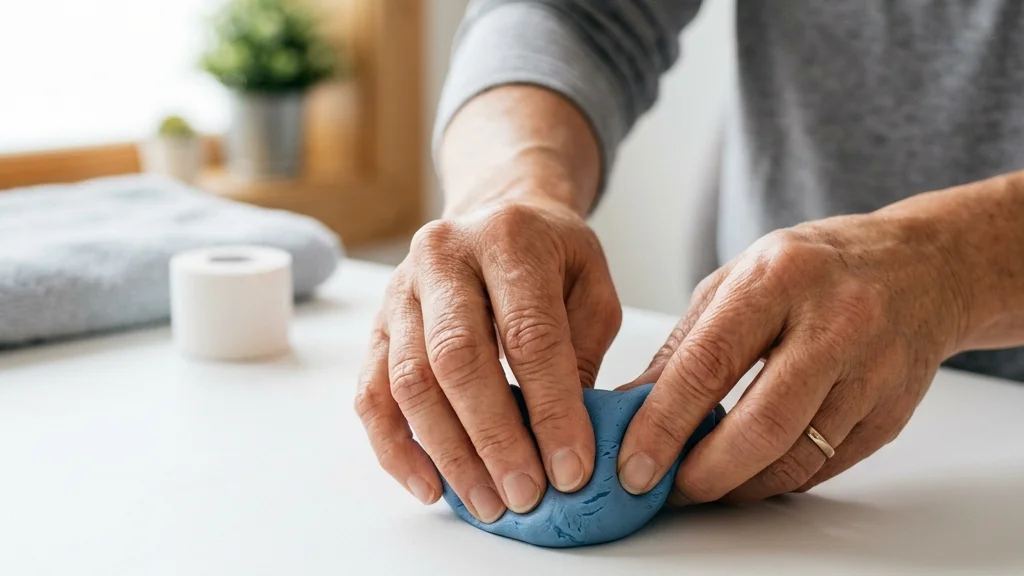
Instead, use soft, compliant therapy putty or perform resistance-free range-of-motion drills. Your exercises should focus on building flexibility and coordination, not crushing power.
Three Essential Dexterity Drills for Daily Hand Care
Perform these three simple hand dexterity exercises twice daily, preferably after warming your hands in a bowl of warm water or after applying herbal remedies for joint stiffness.
Place your hands flat on a table with your fingers spread wide. Slowly lift your thumb, tap it down, then lift your index finger, tap it down, and progress through all five fingers. Reverse the direction, performing 5 complete walks on each hand to maintain motor control and joint alignment.
Take a palm-sized piece of soft, yellow therapy putty. Using the pads of your fingers and thumb (not the tips), pinch the putty and pull it outward. Roll it back into a ball and repeat 10 times to build stable, low-load strength around the thumb joint.
Hold your hand upright with fingers straight. Slowly bend your fingers to touch your upper palms (hook fist), then roll them into a full fist, and finally open them back to straight. Perform 3 sets of 10 slow, smooth repetitions on each hand to lubricate the tendons.
If you want to support your hand joint health naturally, check out our clinical audit of the best Ayurvedic joint pain oils. Applying warm, herbal oils before your exercises can significantly reduce morning stiffness.
The Patient: Evelyn, a 67-year-old retired schoolteacher, was unable to tend her rose garden due to severe, throbbing pain in both thumb joints.
The Mistake: Evelyn stopped gardening and wore tight splints 24 hours a day, which caused her hands to become weak, stiff, and highly sensitive to touch.
The Solution: We removed the daytime splints and introduced gentle finger-tapping and putty exercises. We also taught her to wrap foam around her garden tools and use a two-handed grip to lift flower pots.
The Outcome: Within 8 weeks, Evelyn's thumb pain reduced by 50% and her pinch strength increased by 25%. She returned to her rose garden, proving that movement is the best medicine for arthritic joints.
Maintaining Hand Independence
Managing hand osteoarthritis is a daily journey of small, conscious adaptations. By protecting your joints from excessive force and keeping them lubricated through gentle exercise, you can preserve their structure.
To understand how hand health fits into a broader approach to active aging, read our guide on protecting joint mobility in your 60s. Maintaining movement in all your joints is key to a long, active life.
Protect your thumbs, keep your fingers moving gently, and let daily lubrication guide your hands back to pain-free function.
Irushi Abeywardhana
Senior Physiotherapist & Founder of Physio Pulse. Senior Clinical Physiotherapist passionate about blending advanced movement science with functional resilience.
Medical Disclaimer
The information provided by AyurPhysio is for general educational and informational purposes only. It is not intended as a substitute for professional medical advice, diagnosis, or treatment. Always seek the advice of your physician or other qualified health providers with any questions you may have regarding a medical condition. Never disregard professional medical advice or delay in seeking it because of something you have read on this website.
Trending Guides
Luka Modrić's Daily Routine: Low-Impact Resistance Training and Midfield Longevity
4 min readHarry Kane's Daily Routine: Hamstring Preservation and Anti-Inflammatory Nutrition
4 min readKarim Benzema's Daily Routine: Cupping Therapy (Hijama) and HIIT Conditioning
4 min readNeymar Jr.'s Daily Routine: Joint Stabilization and Hyperbaric Oxygen Therapy
4 min readMohamed Salah's Daily Routine: Early Morning Conditioning and Hyperbaric Recovery
4 min readWeekly Wellness
Don't miss the next guide
Get holistic health tips and new guides delivered to your inbox.
Related Healing Guides
View All Guides →
Hyperlordosis: Tailoring Exercise Programs to Reduce Lumbar Shear Stress

Morning Lower Back Stiffness: The Biomechanical Causes and Quick, Safe Fixes