Total Knee Replacement (TKR): Post-Op Protocols for Restoring Extension
"Attempting to restore knee flexion when you still lack extension is like putting high-performance racing tires on a car with a bent axle — it might look impressive on the rack, but you are heading for a mechanical disaster."
Your surgery was a success. The joint arthrosis is gone, and the new metal implant is in place. But now, the real battle begins in the rehab clinic. Many patients obsess over bending their knee, pushing themselves through painful heel slides to hit 90 degrees of flexion.
While bending is vital, a lack of extension is what will permanently ruin your gait. A knee joint that cannot lock out is the mechanical equivalent of a door hinge jammed with paint — it forces the muscle groups above and below to absorb twice the load, leading to rapid wear.
Establishing full, 0-degree extension early is the single most critical factor in your total knee replacement rehab. Let us break down the clinical biomechanics of post-op extension loss and the exact timeline to restore it.
The Threat of Posterior Joint Capsule Contracture
In the first few weeks after a knee replacement, your body is in a hyper-inflammatory state. The tissues surrounding the knee are highly reactive and swelling filled. If you rest with your knee bent — which is the most comfortable position — the collagen fibers in the posterior joint capsule begin to shorten.
As this scar tissue heals and contracts, it locks the joint into a flexed position. This condition, called a flexion contracture, is incredibly difficult to correct once established. If you do not achieve 0 degrees of passive extension within the first month, you are at a massive risk of permanent scarring (arthrofibrosis).
To avoid this, you must prioritize early knee extension protocols. Every degree of extension lost increases the work your quadriceps must do to support your body weight during standing, leading to severe muscular fatigue and chronic kneecap inflammation.
- Patients who fail to achieve 0 degrees of passive knee extension within the first 21 days post-surgery have a 5x higher rate of permanent arthrofibrosis.
- Clinical trials show that adding a low-load, long-duration (LLLD) extension stretch of 10 minutes, three times daily, increases extension range by an average of 6 degrees in stubborn cases.
- Electromyography (EMG) studies demonstrate that targeted terminal knee extensions achieve a 44% MVIC activation in the vmo strengthening exercises window.
Why the "Pillow Under the Knee" Habit Must End
The most common and damaging mistake post-op patients make is sleeping with a pillow under their knee. It feels comforting because it relieves tension on the surgical incision. However, this holds the joint in a flexed position for hours at a time, allowing scar tissue to glue the posterior capsule in a shortened state.
If you want to walk normally without a limp, your leg must be able to lock out straight. This mechanical lockout allows your bones to bear your weight during the stance phase of walking, letting your muscles rest. Without full extension, your quadriceps are constantly contracting, leading to chronic back and hip pain.
To achieve this lockout, you must actively train your vastus medialis oblique (VMO) muscle. This inner quad muscle is responsible for the last 15 degrees of joint extension. Without active VMO firing, your knee will always yield slightly under weight-bearing loads.
"I tell all my post-op patients: flexion will come with time, but extension is a race against the clock. If you do not get your knee flat in the first three weeks, the posterior capsule will tighten like a drum. Ban the pillows from under your knees immediately. A straight knee is a functional knee. Spend your first week focused on getting the leg flat against the bed, then build your quad control."
The Protocol for Passive and Active Lockout
Restoring extension requires a two-pronged approach: passive tissue lengthening and active muscular control. Passive stretching using low-load, long-duration methods helps creep the posterior capsule tissues back to their normal length without triggering muscle guarding.
Once the passive range is available, you must immediately build active control. This is done through isometric quad sets and progressive terminal extensions, which teach the nervous system to lock the joint under active control.
Additionally, you must maintain patellar mobility. The kneecap must glide smoothly downward during extension. If the patellar tendon is glued with scar tissue, it acts as a physical block, stopping the knee from straightening regardless of how strong your quads are.
The Patient: Robert, a 64-year-old retired contractor, presented 5 weeks post-left TKR with a persistent 8-degree flexion contracture and a pronounced walk limp.
The Mistake: Robert slept with two pillows under his knee to relieve incision throbbing and spent his home exercises doing heel slides to achieve bending, ignoring extension.
The Solution: We banned pillows under his knee, introduced 10-minute weighted extension drapes three times daily, and initiated VMO terminal extensions and manual patellar mobilizations.
The Outcome: Within 3 weeks, Robert achieved 0 degrees of full extension. His walk limp disappeared, and he was able to return to light gardening and walking pain-free.
Your Post-Op Extension Exercises
Perform this clinical sequence three times daily. Work through the steps in order, focusing on deep breathing and relaxation during the passive stretch phases:
-
1Phase 1: Heel Prop Extension Drape (10 minutes) Sit on a chair or lie on a bed with your heel propped on a rolled towel or stool, leaving your knee suspended in mid-air. Allow gravity to pull your knee flat. To increase the stretch, place a light hot pack or 1 kg weight bag on your thigh just above the kneecap. This performs a low-load, long-duration stretch on the posterior joint capsule.
-
2Phase 2: Quad Sets with Towel Roll (20 reps) Lie flat on your back with a small towel roll placed under your ankle. Tighten your thigh muscle (quadriceps), trying to press the back of your knee flat down into the bed while lifting your heel slightly off the surface. Hold the contraction for 5 seconds, then relax. This builds active quad firing in the final range of motion.
-
3Phase 3: Terminal Knee Extensions (TKE) (15 reps) Loop a resistance band around a sturdy post and place it behind your knee, facing the post. Step back until the band is taut. Start with your knee slightly bent, then press your heel down and contract your quad to pull the knee straight against the band's resistance. This is your primary vmo strengthening exercises drill.
Navigating the Complete Knee Rehab Journey
Achieving a straight knee is the cornerstone of joint recovery, but it is only one part of the journey. Once your extension is secure, you must transition to restoring your knee bending mobility and building overall leg strength to protect your new joint.
To compare this recovery with other major knee reconstructions, check out our guide on ACL tear rehabilitation timelines and milestones. If you are experiencing pain around your kneecap as you begin to walk more, explore our clinical advice on patellofemoral pain syndrome hip abductor fixes. And to understand how loaded squatting mechanics change after joint recovery, read our analysis on decline squat protocols for patellar tendinopathy.
Your surgical team replaced the worn-out joint, but it is your job to restore its function. Commit to your extension exercises early, straight out of the gate. A flat knee is a lifetime of pain-free walking waiting to happen.
Are you actively stretching your knee flat every day, or are you letting scar tissue shorten the back of your joint capsule?
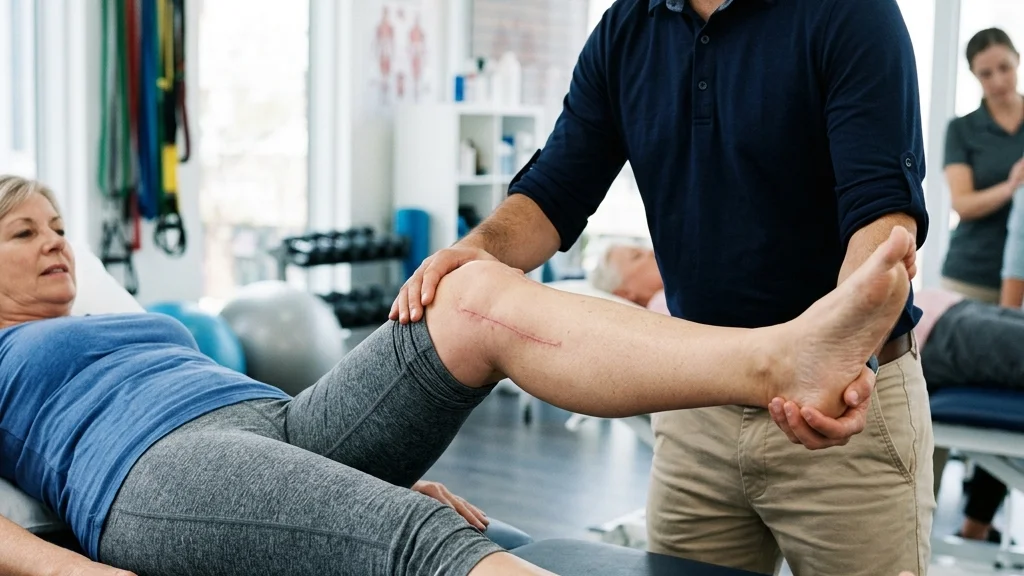
Featured image: A close-up of a patient's leg on a treatment table in a physiotherapy clinic, with a physical therapist guiding knee extension exercises. A clean, subtle surgical scar is visible on the knee, representing a healing knee replacement. Bright, professional clinical setting. Created for AyurPhysio patient education.
Irushi Abeywardhana
Senior Physiotherapist & Founder of Physio Pulse. Senior Clinical Physiotherapist passionate about blending advanced movement science with functional resilience.
Medical Disclaimer
The information provided by AyurPhysio is for general educational and informational purposes only. It is not intended as a substitute for professional medical advice, diagnosis, or treatment. Always seek the advice of your physician or other qualified health providers with any questions you may have regarding a medical condition. Never disregard professional medical advice or delay in seeking it because of something you have read on this website.
Trending Guides
Luka Modrić's Daily Routine: Low-Impact Resistance Training and Midfield Longevity
4 min readHarry Kane's Daily Routine: Hamstring Preservation and Anti-Inflammatory Nutrition
4 min readKarim Benzema's Daily Routine: Cupping Therapy (Hijama) and HIIT Conditioning
4 min readNeymar Jr.'s Daily Routine: Joint Stabilization and Hyperbaric Oxygen Therapy
4 min readMohamed Salah's Daily Routine: Early Morning Conditioning and Hyperbaric Recovery
4 min readWeekly Wellness
Don't miss the next guide
Get holistic health tips and new guides delivered to your inbox.
Related Healing Guides
View All Guides →
Hyperlordosis: Tailoring Exercise Programs to Reduce Lumbar Shear Stress

Morning Lower Back Stiffness: The Biomechanical Causes and Quick, Safe Fixes