The Iliopsoas Muscle: The Link Between Tight Hips and Back Stiffness
"If your iliopsoas muscle is chronically tight, it acts like a taut bungee cord connecting your thighs directly to your spine, pulling your lower back forward with every step you take."
If you stand up from a long sitting session and find yourself hunched forward, unable to stand tall without a dull ache deep in your lower back, you are dealing with a classic muscle imbalance. The culprit is almost always a hidden muscle that links your upper body directly to your legs: the iliopsoas muscle.
As the body's primary hip flexor, the iliopsoas is responsible for lifting your thigh toward your chest. However, because it originates directly on the sides of your lumbar vertebrae, its tension level has a direct, crushing influence on your spinal joints.
Understanding the exact mechanical connection of this deep muscle is the first step to resolving the link between tight hips and back stiffness, allowing you to implement effective hip flexor release exercises for permanent recovery.
The Anatomical Bridge: Connecting Thigh to Spine
The iliopsoas is actually a composite of two distinct muscles: the psoas major and the iliacus. Together, they form an anatomical bridge that crosses the hip joint and stabilizes the lower trunk.
Sitting with your hips bent at a 90-degree angle for over 8 hours a day places the iliopsoas in a state of adaptive shortening, forcing its fibers to contract.
A shortened psoas major pulls the lumbar vertebrae forward, triggering structural compensation:
- Spinal Shear: A tight psoas increases direct compressive load across the L3-L4 and L4-L5 discs by up to 100 lbs.
- Reduced Extension: Low back pain sufferers exhibit a 10 to 12-degree reduction in hip extension compared to pain-free individuals.
- Lordotic Collapse: The forward pull rotates the pelvis, creating a pronounced arch in the lower back and pinching the facet joints.
This mechanical forward pull is a primary catalyst for anterior pelvic tilt. Seeking passive massage on the lower back without resolving this anterior hip tightness simply treats the symptom while leaving the mechanical driver untouched.
Why Static Lunge Stretching is Making Your Hips Tighter
When patients experience hip tightness, their immediate reaction is to perform long, passive lunge stretches. They hold deep lunges for minutes, pushing their hips forward in hopes of forcing the tight fibers to relax.
My decisive clinical opinion is that performing passive static stretches on a tight psoas is a short-lived illusion—and can actually worsen your instability if your glutes are dormant. When you stretch a muscle passively, your nervous system responds by triggering a protective stretch reflex, making the muscle contract even tighter afterward. To release the psoas permanently, you must utilize reciprocal inhibition—actively contracting your glutes to signal the brain to relax the front hips.
By replacing passive lunges with active, glute-loaded extensions, you restore balance. This should be combined with active core stabilization to prevent the pelvis from dumping forward during movement.
The Patient: David, a 38-year-old cyclist and graphic designer, presented with severe lower back stiffness that was at its worst immediately after sitting or cycling.
The Mistake: David was using aggressive foam rollers on his lower back and doing passive hamstring stretches, which worsened his anterior pelvic tilt.
The Solution: We stopped all passive back stretching and initiated active glute-contracted psoas releases, paired with deep core bracing.
The Outcome: Within 3 weeks, David experienced a 90% reduction in morning back stiffness and returned to pain-free cycling.
Three Clinical Exercises to Release the Iliopsoas Muscle
To relax your hip flexors, reduce lumbar compression, and eliminate back stiffness, perform these three clinical exercises daily:
-
1The Active Glute-Contracted Lunge (Reciprocal Inhibition) Kneel on one knee, placing your opposite foot flat in front of you. Keep your torso perfectly upright. Before moving forward, actively squeeze the glute muscle of your kneeling leg as hard as possible. Maintain this contraction while gently shifting your hips forward 2 inches until you feel a stretch in the front hip. Squeezing the glute forces your nervous system to inhibit and relax the psoas. Hold for 10 seconds, and repeat 8 times on each side.
-
2The Single-Leg Glute Bridge with Psoas Hold Lie on your back with knees bent and feet flat. Pull your right knee toward your chest and hold it firmly with both hands. Squeezing your left glute, push through your left heel to lift your hips up to a bridge position. Holding the right knee in flexion keeps the right psoas active, while forcing the left psoas to extend under load. Perform 3 sets of 10 lifts on each leg. This builds the exact stability needed to support your hip alignment.
-
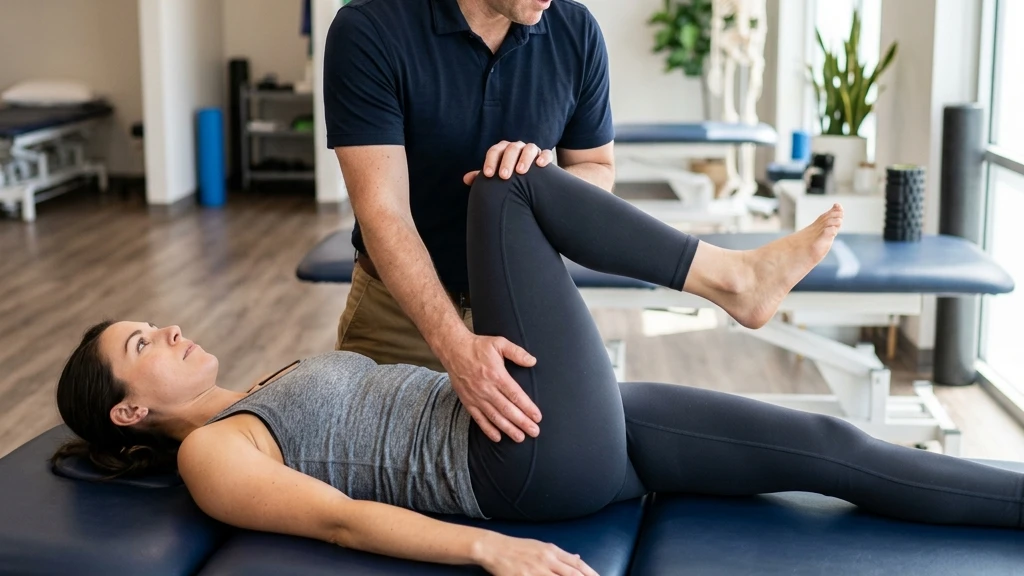
3The Thomas Stretch (Gravity-Assisted Release) Lie on your back at the very edge of a firm bed. Pull both knees toward your chest. Holding your non-stretch leg toward your chest, slowly lower your opposite leg off the edge of the bed, letting gravity pull it down toward the floor. Keep your lower back flat against the bed. You will feel a deep stretch in the front hip. Hold for 30 seconds, repeating 3 times per side. This is the ultimate test and exercise for psoas length. If tightness also causes radiating back pain, consult our guide on sciatica-like symptoms.
Restoring Hip-Spine Harmony
Your hips and lower back do not operate in isolation. When you sit all day, your tight hip flexors act like a mechanical anchor, pulling your pelvis out of alignment and compressing your lumbar joints with every step you take.
By utilizing active glute contraction, practicing gravity-assisted stretches, and building deep core stability, you can release the iliopsoas, unload your spine, and walk with complete, pain-free mobility.
Irushi Abeywardhana
Senior Physiotherapist & Founder of Physio Pulse. Senior Clinical Physiotherapist passionate about blending advanced movement science with functional resilience.
Medical Disclaimer
The information provided by AyurPhysio is for general educational and informational purposes only. It is not intended as a substitute for professional medical advice, diagnosis, or treatment. Always seek the advice of your physician or other qualified health providers with any questions you may have regarding a medical condition. Never disregard professional medical advice or delay in seeking it because of something you have read on this website.
Trending Guides
Luka Modrić's Daily Routine: Low-Impact Resistance Training and Midfield Longevity
4 min readHarry Kane's Daily Routine: Hamstring Preservation and Anti-Inflammatory Nutrition
4 min readKarim Benzema's Daily Routine: Cupping Therapy (Hijama) and HIIT Conditioning
4 min readNeymar Jr.'s Daily Routine: Joint Stabilization and Hyperbaric Oxygen Therapy
4 min readMohamed Salah's Daily Routine: Early Morning Conditioning and Hyperbaric Recovery
4 min readWeekly Wellness
Don't miss the next guide
Get holistic health tips and new guides delivered to your inbox.
Related Healing Guides
View All Guides →
Hyperlordosis: Tailoring Exercise Programs to Reduce Lumbar Shear Stress
Morning Lower Back Stiffness: The Biomechanical Causes and Quick, Safe Fixes