Hamstring Strain Rehabilitation: Preventing Re-injury in Sprinters and Field Athletes
"A hamstring strain is the most predictably re-injured soft tissue lesion in sport. The reason is almost always the same: athletes return to sprinting when they are pain-free, not when the tissue is mechanically ready. Pain-free is not the same as healed."
You felt it in the first fifty meters. A sudden, sharp detonation at the back of your thigh — like a rubber band snapping inside your leg. You hobbled off the track and spent three weeks icing, resting, and waiting. Then you returned to training, felt fine for the first session, and on day two it happened again. In the exact same spot.
Hamstring re-injury rates in sport hover between 12% and 34% — and in sprinters who return to competition within two weeks, the rate climbs to over 50%. This is not bad luck. It is a predictable, clinically preventable outcome of an incomplete rehabilitation protocol.
Understanding What Actually Tears
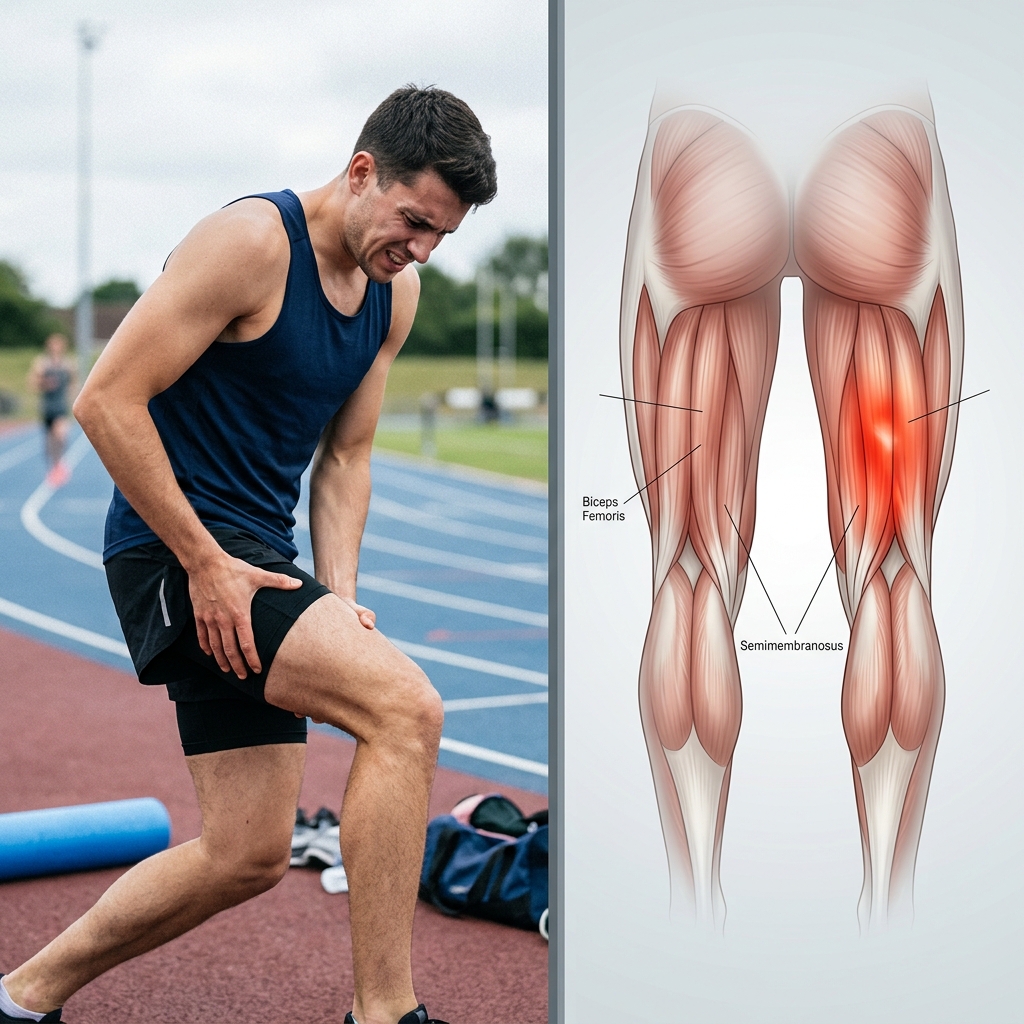
The hamstring group comprises three muscles: the biceps femoris (long and short heads), the semitendinosus, and the semimembranosus. In sprinting, over 80% of acute tears occur in the long head of the biceps femoris, at the musculotendinous junction approximately two-thirds down the posterior thigh — the exact zone visible in a clinical MRI as a focal hyperintense signal.
The injury mechanism is almost always the same: during the terminal swing phase of sprinting, when the foot is about to contact the ground, the hamstrings must simultaneously lengthen under enormous load to decelerate the swinging leg while preparing for explosive ground contact. This eccentric demand — lengthening while contracting — is the most mechanically violent moment in the entire gait cycle. It is here that the tissue tears when it lacks sufficient eccentric strength.
"Standard isokinetic strength testing clears athletes to return to sprint training based on a Limb Symmetry Index (LSI) of 90% — meaning the injured limb measures 90% of the uninjured limb's strength. But this test is almost always performed concentrically, measuring how hard you can curl against resistance. It does not test eccentric capacity at long muscle lengths — the exact capacity required during sprinting. An athlete who passes the standard test at 90% LSI may still have only 65% of the eccentric capacity needed to safely sprint at maximum velocity."
The Four-Phase Rehabilitation Protocol
-
1Phase 1: Acute Protection (Days 1–3) Relative rest, ice (15 minutes every 2 hours), compression bandage. Begin isometric hamstring contractions at pain-free resistance within 48 hours. Avoid aggressive stretching — the inflammatory phase is actively building collagen scaffolding and premature stretch disrupts this process.
-
2Phase 2: Early Active Loading (Days 4–14) Introduce isotonic exercises: prone leg curls, standing hip hinges, and submaximal Nordic curl holds. Load should be pain-free or produce no more than a 3/10 discomfort. Targets include scar tissue orientation along the muscle fiber line rather than random cross-fiber adhesions.
-
3Phase 3: Eccentric Strength Loading (Weeks 2–5) The Nordic hamstring curl is the evidence-based gold standard. Research from the British Journal of Sports Medicine demonstrates that athletes who complete a structured Nordic curl program reduce hamstring re-injury rates by 51%. Progress from partial range to full range over 3 weeks.
-
4Phase 4: Running Progressions and Return to Sprint (Weeks 5–8) Introduce progressive running intensity: jog → tempo run → submaximal sprint → maximal sprint. Clearance criterion must include pain-free sprinting at 100% velocity AND a >90% LSI on both concentric AND eccentric isokinetic testing before return to competition.
The Nordic hamstring curl remains the single most evidence-supported injury prevention exercise in sports science:
- A 2015 meta-analysis in the British Journal of Sports Medicine showed a 51% reduction in new hamstring injuries in athletes performing Nordic curls consistently.
- Athletes who perform the Nordic program 2x per week maintain a hamstring eccentric strength advantage of 18–22% over untrained peers throughout an entire competitive season.
- MRI studies show that Nordic curl training specifically hypertrophies the biceps femoris long head — the precise zone most susceptible to tears.
The Patient: Kavya, a 26-year-old 200m sprinter, sustained her third hamstring re-injury in 18 months, each occurring within 3 weeks of returning to competition.
The Mistake: Each time, she returned when pain resolved — typically at 10–12 days post-injury — without any eccentric strengthening or formal clearance criteria.
The Solution: A complete 8-week AyurPhysio protocol including Nordic curls, single-leg deadlifts, and a graduated sprint program with isokinetic testing prior to return.
The Outcome: Zero re-injury in 14 months of competitive sprinting following the protocol. Her biceps femoris eccentric strength LSI reached 96% before she was cleared to compete.
The Hidden Re-Injury Risk Factor: Contralateral Hip Strength
One of the most underappreciated drivers of hamstring re-injury is weakness in the contralateral (opposite side) gluteus medius. During high-speed running, a weak opposite hip causes the pelvis to drop on the swing side (Trendelenburg pattern), placing the hamstring of the striding leg in an even more extreme lengthened position at heel strike — dramatically amplifying the eccentric demand on an already compromised tissue.
Any complete hamstring rehabilitation program must assess and correct single-leg hip stability. For the full picture on how hip weakness cascades into lower limb injury, our guide on patellofemoral syndrome and hip abductor weakness reveals the same principle applied to the knee. For tendon healing science, our breakdown of heavy slow resistance for Achilles tendinopathy provides the physiological model that applies equally to hamstring tendon healing.
Hamstring strains are predictable. Hamstring re-injuries are preventable. The only bridge between those two realities is a clinically complete rehabilitation that tests the exact mechanical capacity that failed — not just the absence of pain. When will you move from pain-free to actually ready?
Featured image: Composite of sprinter with hamstring injury and anatomical muscle group illustration. Created for AyurPhysio editorial use.
Irushi Abeywardhana
Senior Physiotherapist & Founder of Physio Pulse. Senior Clinical Physiotherapist passionate about blending advanced movement science with functional resilience.
Medical Disclaimer
The information provided by AyurPhysio is for general educational and informational purposes only. It is not intended as a substitute for professional medical advice, diagnosis, or treatment. Always seek the advice of your physician or other qualified health providers with any questions you may have regarding a medical condition. Never disregard professional medical advice or delay in seeking it because of something you have read on this website.
Trending Guides
Luka Modrić's Daily Routine: Low-Impact Resistance Training and Midfield Longevity
4 min readHarry Kane's Daily Routine: Hamstring Preservation and Anti-Inflammatory Nutrition
4 min readKarim Benzema's Daily Routine: Cupping Therapy (Hijama) and HIIT Conditioning
4 min readNeymar Jr.'s Daily Routine: Joint Stabilization and Hyperbaric Oxygen Therapy
4 min readMohamed Salah's Daily Routine: Early Morning Conditioning and Hyperbaric Recovery
4 min readWeekly Wellness
Don't miss the next guide
Get holistic health tips and new guides delivered to your inbox.
Related Healing Guides
View All Guides →
Hyperlordosis: Tailoring Exercise Programs to Reduce Lumbar Shear Stress

Morning Lower Back Stiffness: The Biomechanical Causes and Quick, Safe Fixes