Achilles Tendinopathy: A Safer Guide to Progressive Loading
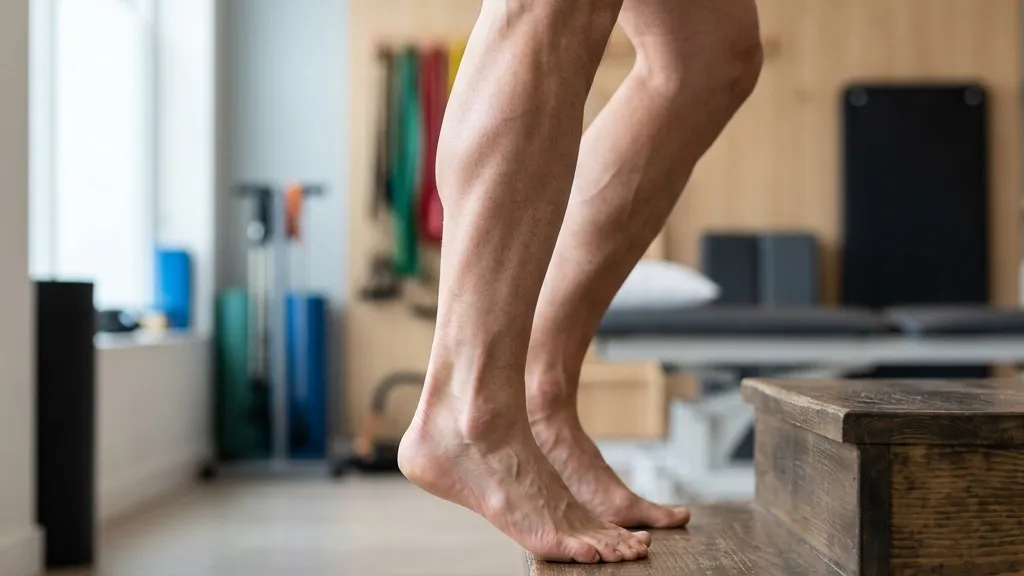
Achilles tendon pain is often called “tendinitis,” but persistent symptoms are commonly discussed as tendinopathy. The wording matters less than a careful assessment: pain at the middle of the tendon, pain near its heel-bone attachment, and a sudden rupture are not interchangeable problems.
Editorial correction, 16 September 2026: We removed a prescriptive heavy-slow-resistance schedule and an unsupported success-rate claim. This revision explains the role of loading without assigning an exercise dose to someone we have not assessed.
Start by identifying the problem
Midportion Achilles tendinopathy usually involves activity-related pain and impaired loading capacity in the tendon several centimetres above the heel. Insertional symptoms occur closer to the heel bone and may respond differently to positions that compress the tendon. A clinician may also consider other causes of heel or calf pain.
Seek prompt medical assessment after a sudden snap or pop, a new inability to push off or rise onto the toes, marked swelling, or a traumatic injury. Those features can occur with a rupture and should not be managed from an online strengthening plan.
What progressive tendon loading means
The 2024 clinical practice guideline from APTA Orthopedics identifies tendon-loading exercise as a central part of care for midportion Achilles tendinopathy. “Loading” is a broad category, not one universal protocol. It may include isometric, isotonic, eccentric, concentric or heavier resistance work, selected and progressed according to the person’s symptoms, capacity and goals.
Heavy slow resistance is one way to apply progressive load. It is not automatically the best starting point, and “heavy” is relative to the individual. A programme may change the exercise range, resistance, repetitions, recovery time and weekly exposure. The appropriate choices differ for a new runner, a competitive jumper and someone returning from a long period of inactivity.
Monitor response, not just repetitions
A rehabilitation plan should track function as well as discomfort. Useful measures can include walking tolerance, calf-raise capacity and the response to the person’s sport or work demands. Symptoms during and after exercise help guide progression, but a single pain number cannot diagnose the condition or guarantee that a load is safe.
Recovery is rarely perfectly linear. A temporary symptom increase may follow a sudden rise in running, jumping, hills or training volume. That does not prove the tendon is damaged again, but it is a reason to review the recent load and adjust the plan rather than force the same session.
Common mistakes
- Using complete rest as the whole plan: rest can calm symptoms, but it does not by itself rebuild tolerance for work or sport.
- Copying an advanced programme: a published scheme cannot account for diagnosis, baseline strength or other health conditions.
- Changing several variables at once: large simultaneous jumps in resistance, distance and speed make the response difficult to interpret.
- Ignoring the pain location: exercises tolerable for midportion symptoms may aggravate insertional symptoms through compression near the heel.
Practical takeaway
Progressive loading is better understood as a guided process than as a downloadable “cure.” Confirm the likely diagnosis, establish a tolerable starting point, progress one variable at a time and reassess function. A physiotherapist or other qualified clinician can adapt the programme when symptoms, medical history or sport demands make self-management uncertain.
Sources and scope
APTA Orthopedics: Achilles Pain, Stiffness, and Muscle Power Deficits—Midportion Achilles Tendinopathy Revision 2024 and the linked clinical practice guideline. These sources address midportion Achilles tendinopathy; they do not establish an individual diagnosis or exercise prescription.
Medical Disclaimer
The information provided by AyurPhysio is for general educational and informational purposes only. It is not intended as a substitute for professional medical advice, diagnosis, or treatment. Always seek the advice of your physician or other qualified health providers with any questions you may have regarding a medical condition. Never disregard professional medical advice or delay in seeking it because of something you have read on this website.
Trending Guides
How to Read a Health-Product Review Without Being Misled
4 min readOne in Six Older Adults Faced Delayed Home Rehabilitation After Joint Replacement
3 min readCan Group Knee-Osteoarthritis Care Work by Video? A Small Trial Offers a Cautious Yes
3 min readBlended Digital Physiotherapy Was Not Better for Neck and Shoulder Pain in a 2026 Trial
3 min readPressure-Wave Therapy After Rotator-Cuff Repair: What a Small 2026 Trial Adds
3 min readWeekly Wellness
Don't miss the next guide
Get holistic health tips and new guides delivered to your inbox.
Related Healing Guides
View All Guides →
Retrolisthesis: What the Imaging Finding Means for Rehabilitation