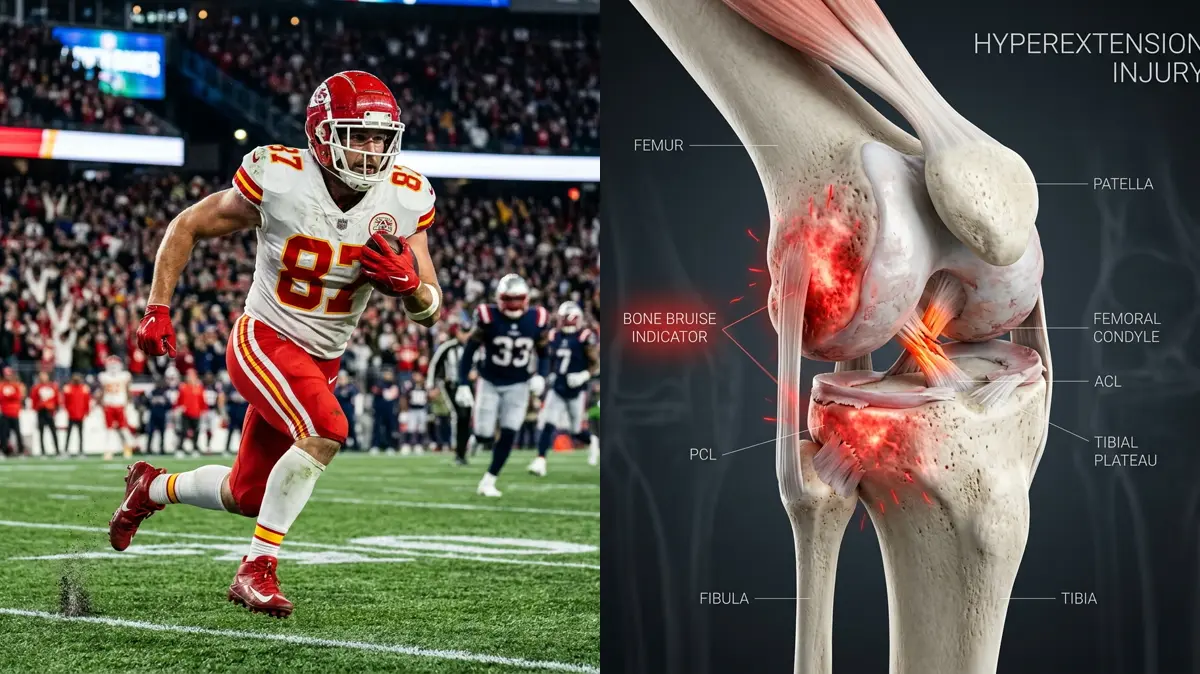
"When a 250-pound tight end hyperextends his knee, the mechanical toll on the joint cartilage and subchondral bone is immense. Rebuilding dynamic stability requires respecting bone healing timelines while aggressively retraining the hamstrings as active knee brakes."
If your knee has ever clicked backward during a sudden stop, you know the instant, sickening pain of joint hyperextension. For NFL fans, that panic was realized when star tight end Travis Kelce suffered a highly publicized travis kelce knee injury during a pre-season practice. The diagnosis of a hyperextended knee and a deep bone bruise immediately sidelined him, triggering intense debate over recovery timelines and joint longevity.
While mainstream sports media often treats a bone bruise as a minor setback, the biomechanics of catch-and-collision impacts tell a different story. In this clinical analysis, we will explore the tissue-level damage of knee hyperextension, dissect the microvascular trauma of bone bruising, and outline the rehab protocols required for elite sports return.
Our goal is to demystify this common athletic injury and provide clear, actionable steps for restoring joint health. By analyzing how elite athletes recover, we can apply these same biomechanical principles to everyday patients seeking pain-free movement.
The Biomechanical Mechanics of Joint Hyperextension
The knee is designed to operate primarily in the sagittal plane, allowing for flexion and a small degree of extension up to 0 degrees (neutral alignment). A hyperextension injury occurs when the knee joint is forced beyond its anatomical limit of extension, typically exceeding 5 to 10 degrees of backward curvature.
During high-velocity cutting or landing, the joint experiences intense mechanical force. If the quadriceps contract explosively while the heel strikes the ground, the tibia is forced backward relative to the femur. This action places severe tensile stress on the posterior capsule, the posterior cruciate ligament (PCL), and the anterior cruciate ligament (ACL).
In collision sports, this mechanical failure is magnified when an external force strikes the front of the knee while the foot is fixed. This violent impact compresses the anterior structures of the joint while over-stretching the posterior stabilizers. The result is a dual-injury profile of ligament sprains and articular compression.
- Bone bruises are identified in approximately 80% of acute knee hyperextension cases evaluated by MRI.
- The average bone bruise recovery time ranges from 6 to 12 weeks, depending on the volume of trabecular damage.
- Repetitive joint impact in elite football players increases subchondral bone loads to 5 to 7 times body weight during landing.
- Returning to impact sports with an active bone bruise increases the risk of secondary cartilage degradation by over 30%.
Understanding the subchondral Impact of Bone Bruises
A bone bruise, or microtrabecular fracture, is not a simple contusion of the skin. It represents a structural injury to the subchondral bone plate located just beneath the joint cartilage. When the knee hyperextends, the femur and tibia collide violently at the front of the joint.
This impact forces the bone marrow to compress, rupturing microscopic blood vessels within the bone's trabecular network. This vascular damage leads to localized bleeding and fluid accumulation (edema) inside the rigid bone structure. Because the outer layer of the bone is solid, this fluid build-up increases internal pressure, causing deep, throbbing pain.
Unlike soft tissues, bone heals slowly due to its limited blood supply. If an athlete returns to play too early, the weakened subchondral bone can collapse under loading. This micro-collapse damages the overlying cartilage, paving the way for early-onset osteoarthritis.
"My strong clinical opinion is that treating a bone bruise as a minor soft tissue injury is a dangerous mistake that ruins joint health. Many players are encouraged to take painkillers and play through the pain, but masking the discomfort doesn't protect the bone. When subchondral bone is bruised, its load-bearing capacity is severely compromised. Loading it prematurely is like driving a car on a cracked wheel rim—eventually, the structure will fail, leading to permanent cartilage loss."
Multi-Phase Knee Hyperextension Rehabilitation Protocol
Successful knee hyperextension rehabilitation requires a progressive, tissue-healing protocol that respects bone biology while rebuilding muscle strength.
- 1Phase 1: Joint Protection and Unloading (Weeks 1–3)Focus on reducing intra-osseous pressure and protecting the joint. Limit weight-bearing using crutches or a locked brace if the bone bruise is severe. Use gentle passive range of motion exercises to promote synovial fluid flow without loading. Avoid terminal knee extension beyond 10 degrees of flexion to prevent articular compression.
- 2Phase 2: Closed-Chain Strength and Hamstring Activation (Weeks 4–6)Introduce progressive weight-bearing exercises as pain subsides. Focus on hamstring strengthening, as these muscles act as the primary active brakes against hyperextension. Perform eccentric hamstring curls and Romanian deadlifts. Initiate closed-chain quad exercises like wall sits and shallow squats, keeping the joint within a comfortable range.
- 3Phase 3: Proprioceptive and Landing Retraining (Weeks 7–9)Retrain the nervous system to protect the knee during dynamic movements. Practice balance drills on unstable surfaces to rebuild joint position sense. Introduce progressive landing mechanics, teaching the athlete to land with soft, flexed knees. Focus on controlling lateral forces and preventing knee valgus collapse during squatting.
- 4Phase 4: Sport-Specific Agility and Impact Loading (Weeks 10+)Progress to high-velocity movements, including acceleration, deceleration, and cutting. The athlete must demonstrate equal single-leg hop distances and pain-free landing before return to play. Incorporate drills that mimic joint impact sports biomechanics to ensure the knee can handle game-like forces. Use protective bracing or taping during the initial return.
Synergy in Lower Extremity Healing
Knee injuries rarely occur in isolation and are often influenced by the stability of the joints above and below. For a detailed guide on restoring ligament strength after major knee trauma, read our complete guide on ACL rehabilitation milestones. To understand how weak hips contribute to poor patellar alignment and knee pain, study our protocols for patellofemoral pain recovery. Additionally, if you are managing post-traumatic joint swelling, check our guide on integrating physical therapy with joint preservation.
Travis Kelce's recovery from his knee injury highlights the importance of combining professional biomechanics with biological healing timelines. By giving bone bruises the time they need to heal and focusing on active hamstring stabilization, athletes can protect their joints and extend their careers. The key is to listen to the deep signals of the body rather than rushing back to the field.
Featured image attribution: "Travis Kelce running" by All-Pro Reels, licensed under CC BY-SA 2.0. Modified by cropping and compositing.
Dr. Dhanushika Dilshani
Expert Ayurvedic Wellness Doctor. Specialized in modern holistic wellness, optimizing dermal resilience, cosmetic radiance, and systematic diagnosis driven by traditional and evidence-based medical logic.
Medical Disclaimer
The information provided by AyurPhysio is for general educational and informational purposes only. It is not intended as a substitute for professional medical advice, diagnosis, or treatment. Always seek the advice of your physician or other qualified health providers with any questions you may have regarding a medical condition. Never disregard professional medical advice or delay in seeking it because of something you have read on this website.
Trending Guides
Luka Modrić's Daily Routine: Low-Impact Resistance Training and Midfield Longevity
4 min readHarry Kane's Daily Routine: Hamstring Preservation and Anti-Inflammatory Nutrition
4 min readKarim Benzema's Daily Routine: Cupping Therapy (Hijama) and HIIT Conditioning
4 min readNeymar Jr.'s Daily Routine: Joint Stabilization and Hyperbaric Oxygen Therapy
4 min readMohamed Salah's Daily Routine: Early Morning Conditioning and Hyperbaric Recovery
4 min readWeekly Wellness
Don't miss the next guide
Get holistic health tips and new guides delivered to your inbox.
Related Healing Guides
View All Guides →
Luka Modrić's Daily Routine: Low-Impact Resistance Training and Midfield Longevity
Harry Kane's Daily Routine: Hamstring Preservation and Anti-Inflammatory Nutrition