"Rebuilding a leg after a high-energy crush injury is not just about gluing the porcelain vase back together; it is about re-teaching the nervous system's circuitry to fire through the cracks, while adapting adjacent joints to handle double the load of a permanently locked foundation."
In February 2021, the sporting world came to a standstill when golf legend Tiger Woods survived a horrific high-speed rollover car crash in California. The sheer mechanical forces sustained when his luxury SUV struck a tree and rolled multiple times resulted in catastrophic lower-extremity trauma that nearly cost him his right leg.
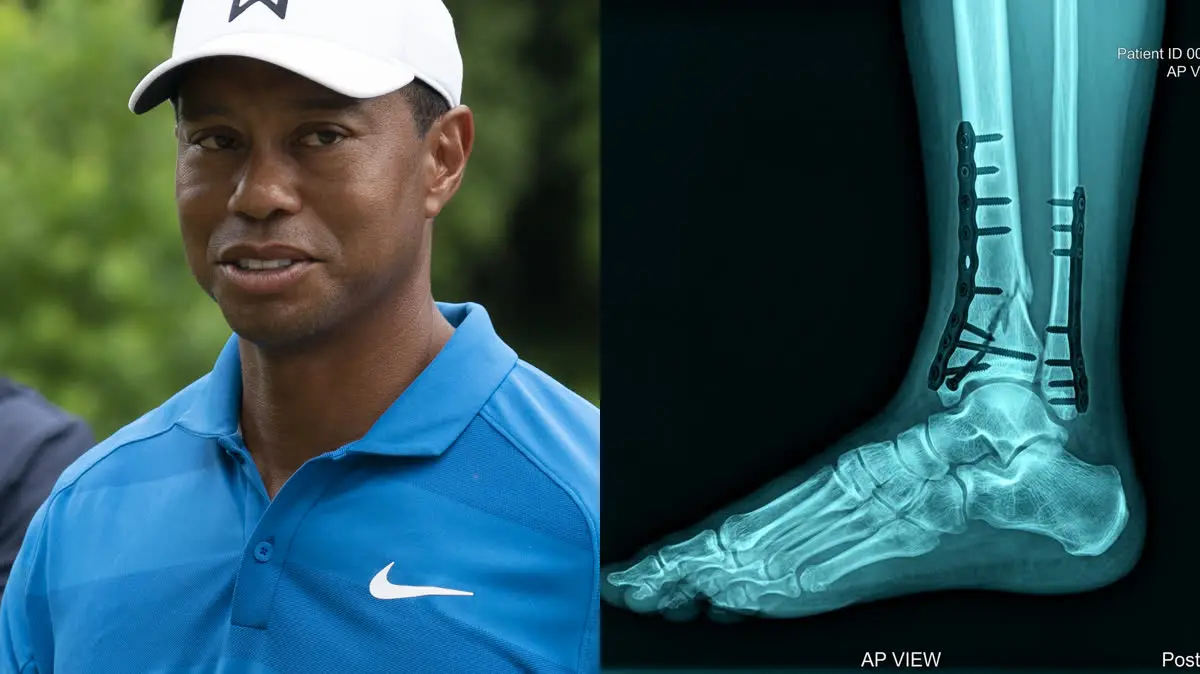
Surgeons at Harbor-UCLA Medical Center worked tirelessly to stabilize what were classified as "open, comminuted fractures" of both the upper and lower portions of his tibia and fibula. Stabilizing the leg demanded the insertion of an intramedullary rod running down the entire length of his shinbone, combined with surgical plates, screws, and pins to reconstruct a severely shattered foot and ankle.
For over two years, Woods’ grueling comeback to professional golf captivated audiences. However, in April 2023, he was forced to undergo another major procedure: a Subtalar Joint Fusion to address progressive post-traumatic arthritis. For a golfer whose swing relies entirely on explosive weight transfer and pivoting, fusing the ankle is an absolute biomechanical game-changer.
As a clinical sports therapist, deconstructing the Tiger Woods car crash injury profile is one of the most profound case studies in modern rehabilitation. It demonstrates the limits of surgical hardware, the kinetic realities of joint fusion, and the immense neurological challenge of overcoming foot drop.
The Pathophysiology: Comminution and the Locked Heel
A "comminuted" fracture means the bone has not merely snapped, but has exploded into three or more distinct fragments. In high-energy impact traumas, the soft tissues—muscles, nerves, and arteries—suffer massive crush damage alongside the bone.
One of the primary concerns in Woods’ early recovery was the threat of compartment syndrome, where mounting pressure inside the muscle compartments cuts off blood flow, necessitating emergency surgical releases (fasciotomies) to save the limb.
Once the tibia was structurally secured with a titanium rod, the focal point of his long-term disability shifted to the Subtalar joint. This is the joint residing directly beneath your main ankle joint, where your heel bone (calcaneus) articulates with the talus bone.
The main ankle joint allows you to point your toes up and down (dorsiflexion and plantarflexion). However, it is the subtalar joint that is responsible for side-to-side motion—known as inversion and eversion.
Fusing this joint eliminates all side-to-side articulation to eliminate arthritic bone-on-bone friction. While it successfully stops the intense pain of walking on uneven ground, it permanently removes the foot’s ability to adapt to the terrain.
Clinical biomechanics dictates that every degree of motion lost in the heel must be absorbed somewhere else up the kinetic chain. For an athlete like Woods, the shear stresses of pivoting are now transferred directly up to his right knee and into his already multi-level fused lower back, dramatically increasing the rate of wear and tear in those regions.
The Neurological Battle: Re-wiring the Deep Peroneal Nerve
Beyond structural bone repair, high-energy tibia fractures frequently implicate the Deep Peroneal Nerve, which wraps tightly around the neck of the fibula.
When this nerve is stretched or crushed, the communication to the Tibialis Anterior muscle (the primary muscle that lifts your foot toward your shin) is severed. The result is Foot Drop—an inability to lift the foot while walking, causing the toes to drag along the ground and creating a severe tripping hazard.
Rehabilitating from foot drop requires aggressive neuromuscular re-education, often utilizing high-frequency electrical stimulation (NMES) to force the muscle to fire while the slow process of nerve regeneration (averaging 1mm per day) occurs.
Just as managing loading parameters is vital for posterior chain release in plantar fasciitis, reconstructing a functional gait after a crush injury requires micro-managing every step of the patient's heel-strike-to-toe-off sequence.
Three Essential Clinical Checks for Post-Traumatic Gait
If you are recovering from a severe lower leg injury or ankle fracture, use these three physical therapy checks to monitor your mechanical recovery:
-
1The Knee-to-Wall Dorsiflexion Test Stand facing a wall with your big toe 10cm away. Keeping your heel firmly on the floor, bend your knee and attempt to touch the wall. If your heel lifts or you feel a sharp pinch in the front of the ankle, your joint mobility is restricted, which forces your knee to collapse inward during walking.
-
2Single-Leg Balance (Proprioceptive Check) Attempt to stand on your injured leg for 30 seconds with your eyes closed. Severe trauma damages the joint’s mechanoreceptors (position sensors). If you wobble instantly, your nervous system is effectively "blind" to where your foot is in space, requiring targeted balance board training to prevent re-injury.
-
3Heel-Walking Foot Drop Screen Lift both sets of toes off the ground and attempt to walk 10 steps forward on only your heels. If the toes of your injured side drift down toward the floor or slap loudly, it indicates ongoing weakness in the Tibialis Anterior and potential peroneal nerve fatigue that requires clinical intervention.
Every serious orthopedic trauma demands structured milestones. Just like the systematic progressions we map out in ACL tear post-op rehabilitation, rebuilding an exploded leg is a marathon of tissue adaptation, requiring patience and uncompromising biomechanical strategy.
Adapt, Stabilize, and Conquer
Tiger Woods' ability to return to Augusta National walking on a fused ankle and a rod-reinforced shinbone is nothing short of a medical miracle. It proves that with the right surgical and biomechanical intervention, the human body possesses an incredible capacity to adapt to structural limitations. If you are recovering from a major injury, stop focusing on what is broken and start focusing on how to adapt and optimize your remaining architecture today.
Featured image attribution: "Tiger Woods at the 2018 US Open" by Peetlesnumber1, licensed under CC BY-SA 4.0. Modified by cropping and compositing with clinical 3D tibia fixation visualization.
Dr. Dhanushika Dilshani
Expert Ayurvedic Wellness Doctor. Specialized in modern holistic wellness, optimizing dermal resilience, cosmetic radiance, and systematic diagnosis driven by traditional and evidence-based medical logic.
Medical Disclaimer
The information provided by AyurPhysio is for general educational and informational purposes only. It is not intended as a substitute for professional medical advice, diagnosis, or treatment. Always seek the advice of your physician or other qualified health providers with any questions you may have regarding a medical condition. Never disregard professional medical advice or delay in seeking it because of something you have read on this website.
Trending Guides
Luka Modrić's Daily Routine: Low-Impact Resistance Training and Midfield Longevity
4 min readHarry Kane's Daily Routine: Hamstring Preservation and Anti-Inflammatory Nutrition
4 min readKarim Benzema's Daily Routine: Cupping Therapy (Hijama) and HIIT Conditioning
4 min readNeymar Jr.'s Daily Routine: Joint Stabilization and Hyperbaric Oxygen Therapy
4 min readMohamed Salah's Daily Routine: Early Morning Conditioning and Hyperbaric Recovery
4 min readWeekly Wellness
Don't miss the next guide
Get holistic health tips and new guides delivered to your inbox.
Related Healing Guides
View All Guides →
Luka Modrić's Daily Routine: Low-Impact Resistance Training and Midfield Longevity
Harry Kane's Daily Routine: Hamstring Preservation and Anti-Inflammatory Nutrition