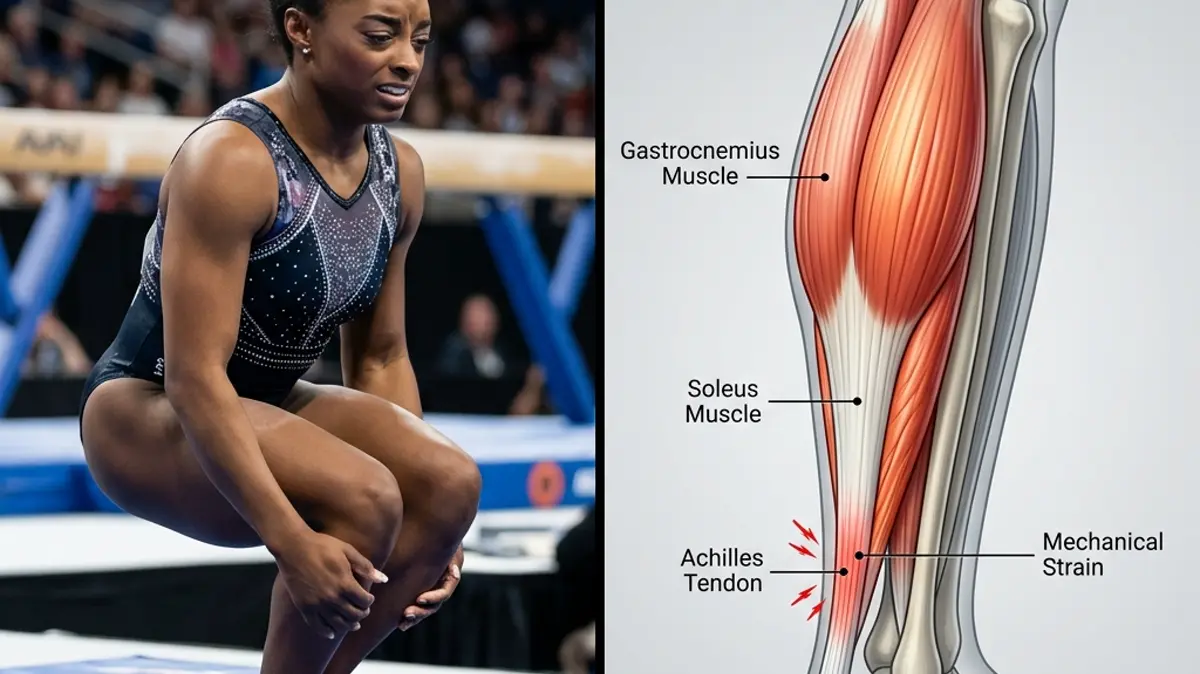
"Dropping from a twelve-foot flight requires the lower leg to absorb a force several times body weight in a fraction of a second. If the calf fails to yield, the Achilles tendon is forced to bear the brunt of the kinetic collision."
Simone Biles' gravity-defying vaults and double-layout flips showcase the absolute pinnacle of athletic power. However, launching and landing these high-velocity maneuvers puts immense strain on her lower leg. When she competes with minor calf soreness and Achilles pain, it highlights the heavy mechanical toll high-impact landing places on the ankle stabilizers.
Many gymnasts view calf tightness as a minor annoyance, stretching it out and continuing to train. In reality, persistent calf soreness is often a warning sign of Achilles tendinopathy and structural tendon wear. Rebuilding a durable ankle requires a structured conditioning program that focuses on dynamic landing mechanics.
Restoring elite gymnastic landings demands a deep look at ground reaction forces. By studying tendon adaptation rates and using targeted simone biles injury rehabilitation, we can rebuild dynamic ankle stiffness. This article examines calf biomechanics, progressive reconditioning stages, and tendon injury prevention.
The Biomechanics of Gymnastic Landings and Calf-Achilles Overload
Gymnastics landings require the athlete to dissipate massive kinetic energy within a fraction of a second. Upon contact with the mat, the ankle undergoes rapid dorsiflexion, stretching the gastroc-soleus complex and the Achilles tendon. This eccentric action acts as a primary brake, slowing down the body's descent.
During a hard landing, the ground reaction force can spike to over nine times the athlete's body weight. If the calf muscles are fatigued or tight, they fail to act as efficient shock absorbers. This failure transfers the mechanical stress directly to the Achilles tendon, causing micro-tearing of the collagen fibers near the heel insertion.
Without proper recovery, these micro-tears lead to chronic tendinopathy, characterized by localized tendon thickening, stiffness, and pain during explosive push-offs. In gymnastics, where rapid plantarflexion is needed for vault and floor take-offs, a weakened tendon severely limits power and increases the risk of a complete rupture.
Key clinical parameters for assessing gymnastic landings and calf recovery:
- 1Ground Reaction ForceGymnastic landings generate impact forces equivalent to 8.5 to 11 times body weight.
- 2Eccentric SpeedAnkle dorsiflexion velocity during a landing exceeds 800 degrees per second.
- 3Tendon Adaptation TimeA minimum of 12 weeks of heavy slow resistance is needed to increase tendon cross-sectional stiffness.
- 4Symmetry TargetGymnasts require a 100% single-leg calf raise symmetry before returning to dynamic tumbling.
The Clinical Opinion: Dynamic Ankle Stiffness vs. Aggressive Static Stretching
"Rehabilitating a gymnast with calf and Achilles pain requires building dynamic ankle stiffness rather than performing aggressive calf stretching. In my clinical opinion, static stretching weakens the tendon's spring capacity and can irritate the insertion site. By using heavy, slow resistance loading and isometric holds, we increase the tendon's load capacity while preserving the elastic spring needed for high-level tumbling."
Standard athletic advice often focuses on stretching tight calf muscles on a slant board. While stretching temporarily improves motion, it reduces the calf-Achilles complex's ability to store and release elastic energy. Modern physical therapy instead utilizes progressive mechanical loading to build tissue stiffness.
Early exercises focus on heavy, slow calf raises, performing both the concentric and eccentric phases over 3 seconds. This controlled loading stimulates collagen synthesis and strengthens the tendon. As pain decreases, we progress to dynamic hopping drills to train the ankle to act as an active spring.
Multi-Stage Calf and Achilles Rehabilitation Protocol
Reconditioning a gymnast's lower leg requires a systematic progression that builds tissue tolerance while restoring high-velocity shock absorption.
Phase 1: Protection and Isometric Loading (Weeks 1-2)
The primary focus is on protecting the tendon, reducing acute pain, and maintaining calf muscle activation. The athlete avoids explosive jumping, running, and deep stretching. Daily soft-tissue massage and cold therapy are used to manage muscle guarding.
We introduce sub-maximal isometric heel raises. The athlete stands on both feet and raises the heels slightly, holding the position for 30 seconds. This exercise is performed in 4 sets twice daily. Isometrics stimulate local pain-relief mechanisms and maintain strength.
Ankle mobility is maintained with gentle, pain-free active movement. The athlete performs ankle circles and letters in the air to promote circulation and prevent stiffness.
Phase 2: Heavy Slow Resistance and Balance (Weeks 3-6)
Once pain-free isometric holds are achieved, we progress to heavy, slow calf raises. The athlete performs standing calf raises on a flat surface, gradually adding weight using a barbell or machine. The exercises are performed over a slow, controlled tempo (3s up, 3s down).
Single-leg balance exercises are introduced to rebuild proprioception. The athlete stands on the injured leg on a foam pad, maintaining a level pelvis and stable ankle. This helps coordinate the foot and ankle muscles to stabilize the leg.
We begin light eccentric heel drops on a step. The athlete raises up on both feet, transfers weight to the injured leg, and slowly lowers the heel below the step level over 5 seconds. This loads the tendon under stretch to align healing fibers.
Phase 3: Plyometric Power and Landing Reconditioning (Weeks 7-12)
The final phase focuses on high-velocity shock absorption and elastic power. The athlete performs double-leg jumps, focusing on landing softly with correct knee and ankle alignment. This is progressed to single-leg hopping and bounding drills.
Sport-specific conditioning, including light tumbling and vault landings on thick mats, is introduced. The athlete performs landing-deceleration drills, focusing on absorbing impact forces through the hips, knees, and ankles.
Full gymnastics training is cleared once the athlete passes a battery of functional landing tests. Ankle strength and range of motion must be symmetrical, with zero pain during high-impact landings.
Securing the Lower Extremity Kinetic Chain
A calf or Achilles injury is rarely a local problem; it is deeply connected to hip and knee stability. Weakness in the gluteal muscles forces the lower leg to work harder to control landing forces. This compensation quickly overloads the calf-Achilles complex, leading to tissue damage.
To ensure long-term leg health, a complete rehabilitation program must target hip strength. Rebuilding gluteal activation ensures that landing forces are distributed across the entire lower body. A balanced kinetic chain is the ultimate safeguard for an elite gymnast.
For more lower leg recovery guidelines, read our detailed guides on Achilles tendinitis HSR protocols, plantar fasciitis calf release, and shin splints recovery. You can also review our dynamic athletic analyses of Usain Bolt's Achilles rupture, Kevin Durant's Achilles loading, and Simone Biles' vestibular twisties recovery.
Featured image attribution: Left panel displays a visual representation of gymnast Simone Biles executing a landing on a gymnastics mat showing calf discomfort. Right panel shows a detailed 3D medical anatomical illustration highlighting the calf muscle group (gastrocnemius, soleus) and the mechanical strain lines along the Achilles tendon. Modified by cropping and compositing.
Dr. Dhanushika Dilshani
Expert Ayurvedic Wellness Doctor. Specialized in modern holistic wellness, optimizing dermal resilience, cosmetic radiance, and systematic diagnosis driven by traditional and evidence-based medical logic.
Medical Disclaimer
The information provided by AyurPhysio is for general educational and informational purposes only. It is not intended as a substitute for professional medical advice, diagnosis, or treatment. Always seek the advice of your physician or other qualified health providers with any questions you may have regarding a medical condition. Never disregard professional medical advice or delay in seeking it because of something you have read on this website.
Trending Guides
Luka Modrić's Daily Routine: Low-Impact Resistance Training and Midfield Longevity
4 min readHarry Kane's Daily Routine: Hamstring Preservation and Anti-Inflammatory Nutrition
4 min readKarim Benzema's Daily Routine: Cupping Therapy (Hijama) and HIIT Conditioning
4 min readNeymar Jr.'s Daily Routine: Joint Stabilization and Hyperbaric Oxygen Therapy
4 min readMohamed Salah's Daily Routine: Early Morning Conditioning and Hyperbaric Recovery
4 min readWeekly Wellness
Don't miss the next guide
Get holistic health tips and new guides delivered to your inbox.
Related Healing Guides
View All Guides →
Luka Modrić's Daily Routine: Low-Impact Resistance Training and Midfield Longevity
Harry Kane's Daily Routine: Hamstring Preservation and Anti-Inflammatory Nutrition