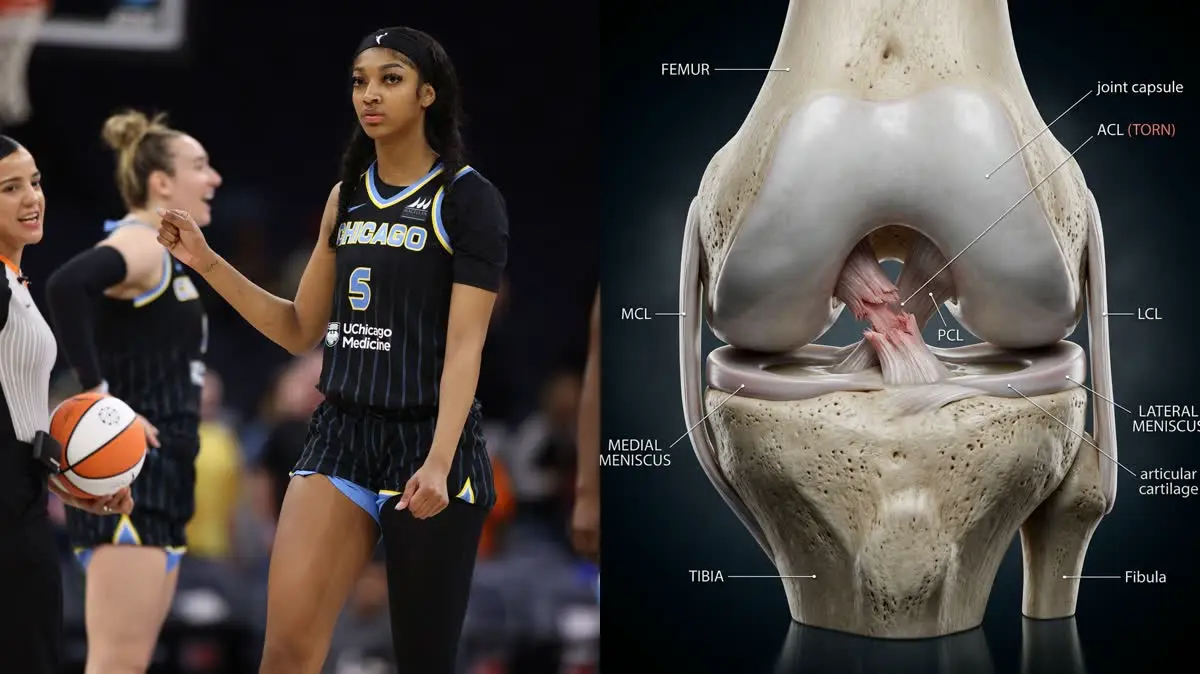
"A non-contact ACL tear is rarely an isolated failure of the knee. It is the end result of a multi-planar biomechanical collapse—combining knee valgus, internal tibial rotation, and quad-dominant loading during rapid deceleration."
On May 17, 2026, Chicago Sky forward Rickea Jackson suffered a devastating knee injury during a high-stakes WNBA matchup. Subsequent medical evaluations confirmed a complete tear of the anterior cruciate ligament (ACL) in her left knee, ruling her out for the remainder of the WNBA season. This injury represents a severe physical and professional hurdle for the rising star, highlighting a persistent vulnerability in women's basketball: the high incidence of non-contact ligament tears.
Returning to elite performance after an ACL reconstruction is a complex, biological process that demands a phased, criteria-based recovery strategy. In this clinical reconstruction, we will analyze the multi-planar biomechanical forces that trigger non-contact ACL tears, discuss graft selection options, and detail the structured physical therapy milestones required to return to competitive play.
Knee Kinematics: The Biomechanics of the Collapse
The anterior cruciate ligament (ACL) is the primary intra-articular stabilizer of the knee. Its primary function is to prevent anterior translation of the tibia relative to the femur, and to control rotational stability during pivoting and cutting movements. The vast majority of ACL tears—approximately 70% to 80%—occur through a non-contact mechanism during landing, deceleration, or sharp change of direction.
A non-contact ACL tear is characterized by a specific kinematic sequence known as the "dynamic valgus collapse." This mechanical failure occurs under three simultaneous forces:
- Knee Valgus: The knee collapses inward relative to the foot, placing massive tension on the medial collateral ligament (MCL) and secondary shear stress on the ACL.
- Tibial Internal Rotation: The tibia rotates inward relative to the femur, twisting the ACL around the posterior cruciate ligament (PCL) and increasing tensile strain beyond its physical limit.
- Shallow Knee Flexion: Decelerating or landing with the knee flexed at less than 30 degrees prevents the hamstrings from dynamically stabilizing the tibia, leaving the ACL to absorb the entire impact force alone.
Furthermore, female athletes exhibit unique anatomical and biomechanical risk factors. These include a wider pelvis (Q-angle), narrower intercondylar notch, and a tendency toward quadriceps dominance, where the quadriceps fire aggressively relative to the hamstrings during landing, pulling the tibia forward and straining the ACL.
- Female basketball players are 2 to 8 times more likely to suffer an ACL tear than their male counterparts under similar playing conditions.
- Up to 80% of female ACL tears occur via non-contact mechanisms during cutting, pivoting, or landing from a jump.
- Graft choice significantly impacts outcomes: bone-patellar tendon-bone (BPTB) autografts show a re-rupture rate of under 6% in elite athletes, compared to higher rates for allografts.
- Successful return to competitive play at the pre-injury level occurs in approximately 81% of elite professional athletes, with full clearance taking 9 to 12 months.
Graft Selection: Rebuilding the Anchor
To restore joint stability, the torn ACL must be surgically reconstructed using a tissue graft. For an elite athlete like Rickea Jackson, the choice of graft is a critical decision. The three primary options include:
1. Bone-Patellar Tendon-Bone (BPTB) Autograft: Often considered the gold standard for high-demand athletes. This graft uses the middle third of the patellar tendon with bone plugs harvested from the patella and tibia. It offers excellent initial fixation (bone-to-bone healing) but carries a risk of anterior knee pain and discomfort when kneeling.
2. Hamstring Tendon Autograft: Harvested from the semitendinosus and gracilis tendons. It is a strong, double-looped graft with lower post-operative donor-site pain, but takes longer to heal into the bone tunnels and can leave residual hamstring weakness.
3. Quadriceps Tendon Autograft: An increasingly popular option that provides a thick, robust graft with a bone plug from the superior patella. It balances the structural density of the BPTB graft with a lower incidence of anterior knee pain.
"When assessing an athlete post-ACL reconstruction, we rely heavily on objective clinical signs like the Lachman and Pivot-Shift tests. However, true readiness to return to the court is governed by neuromuscular control. Following surgery, the knee loses its mechanoreceptors—the sensory cells that signal joint position to the brain. Re-training proprioception and restoring the hamstring-to-quadriceps strength ratio to at least 60% is vital to prevent graft re-rupture."
The WNBA Post-Surgical ACL Rehabilitation Milestones
Rehabilitation is divided into structured, objective-based phases that prioritize graft healing, joint mobility, muscle activation, and sport-specific plyometrics.
- 1Phase 1: Inflammatory Control and Extension Restoration (Weeks 1–4)Focus is on resolving joint effusion (swelling) and regaining full passive knee extension. Early quadriceps activation is achieved through electrical stimulation (NMES) and quad sets. The athlete remains non-weight-bearing or partial-weight-bearing in a locked brace, transitioning to full weight-bearing as quadriceps control returns.
- 2Phase 2: Closed-Kinetic-Chain Strengthening and Balance (Weeks 5–12)Once full extension is secured and swelling is minimal, dynamic strengthening begins. Double and single-leg squats, lunges, and leg presses are introduced. Proprioceptive training (disturbed balance drills on unstable surfaces) is emphasized to restore neurological joint position sense.
- 3Phase 3: Plyometrics and Linear Running (Weeks 13–20)Following successful strength testing (quadriceps strength at least 70% of the uninjured limb), straight-line running is initiated. Light plyometrics, focusing on landing mechanics (eccentric deceleration, avoiding knee valgus), are introduced. Rotator cuff and core stabilization continue.
- 4Phase 4: Sport-Specific Agility and Court Return (Weeks 21–36+)Rehab transitions to lateral agility drills, shuffle-cuts, and sport-specific basketball maneuvers. Return-to-play testing requires a Limb Symmetry Index (LSI) of greater than 90% in quadriceps strength, hamstring strength, and functional hop tests, alongside psychological readiness screening.
Lower Extremity Kinematics: The Kinetic Chain
Knee stability is heavily dependent on the joints above and below it. To learn about pelvic influence on lower extremity movement, read our analysis of gluteal and core stabilization in hip labral tears. If you are using knee orthoses to protect your joint during early loading, study our comparative review of the best post-operative knee braces for ACL recovery. Additionally, for a look at how other elite athletes managed knee compensation without an ACL, read our profile of Zlatan Ibrahimović playing without an ACL.
Rickea Jackson faces a challenging road to recovery, but with the support of advanced sports medicine and a dedicated physical therapy team, she has a high probability of returning to elite WNBA competition. For high-performance athletes, the key to longevity lies in allowing the graft to mature structurally while re-training the entire kinetic chain to handle the intense cutting forces of modern basketball. Patience, biomechanical precision, and focused neurological rehabilitation are the ultimate pillars of a successful return to the court.
Featured image: Clinical side-by-side composite showing a WNBA player in action (left) and an anatomical 3D rendering of a knee joint showing a torn anterior cruciate ligament (right). Created for AyurPhysio editorial use. Wikimedia Commons attribution: Angel Reese Chicago Sky image by Christopher Wilkerson licensed under CC BY-SA 2.0. Modified by cropping and compositing.
Dr. Dhanushika Dilshani
Expert Ayurvedic Wellness Doctor. Specialized in modern holistic wellness, optimizing dermal resilience, cosmetic radiance, and systematic diagnosis driven by traditional and evidence-based medical logic.
Medical Disclaimer
The information provided by AyurPhysio is for general educational and informational purposes only. It is not intended as a substitute for professional medical advice, diagnosis, or treatment. Always seek the advice of your physician or other qualified health providers with any questions you may have regarding a medical condition. Never disregard professional medical advice or delay in seeking it because of something you have read on this website.
Trending Guides
Luka Modrić's Daily Routine: Low-Impact Resistance Training and Midfield Longevity
4 min readHarry Kane's Daily Routine: Hamstring Preservation and Anti-Inflammatory Nutrition
4 min readKarim Benzema's Daily Routine: Cupping Therapy (Hijama) and HIIT Conditioning
4 min readNeymar Jr.'s Daily Routine: Joint Stabilization and Hyperbaric Oxygen Therapy
4 min readMohamed Salah's Daily Routine: Early Morning Conditioning and Hyperbaric Recovery
4 min readWeekly Wellness
Don't miss the next guide
Get holistic health tips and new guides delivered to your inbox.
Related Healing Guides
View All Guides →
Luka Modrić's Daily Routine: Low-Impact Resistance Training and Midfield Longevity
Harry Kane's Daily Routine: Hamstring Preservation and Anti-Inflammatory Nutrition