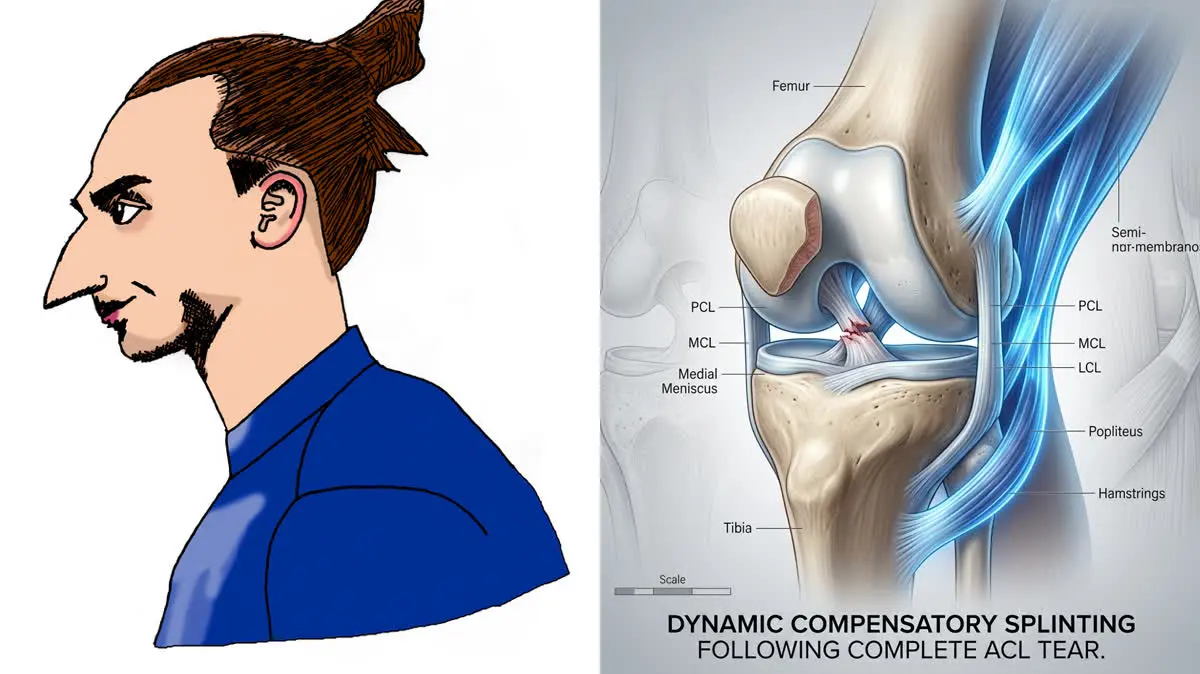
"The Anterior Cruciate Ligament is the ultimate seatbelt of the knee—it mechanically prevents the shinbone from sliding out from under the thigh. To play elite professional football without one is an act of sheer biomechanical defiance, requiring the surrounding muscle groups to actively tense and 'splint' the joint with millisecond precision."
In May 2022, legendary Swedish striker Zlatan Ibrahimović helped lead AC Milan to their first Serie A championship in over a decade. Immediately following the celebrations, Ibrahimović made a staggering clinical revelation: he had played the entire final six months of the grueling season with no Anterior Cruciate Ligament (ACL) in his left knee.
For standard orthopedic patients and modern professional athletes, a ruptured ACL is a season-ending catastrophe requiring immediate surgical reconstruction. The ACL acts as the primary passive restraint to anterior tibial translation (forward sliding of the shinbone) and provides critical rotational stability during pivoting and cutting maneuvers.
To play elite international football—which demands constant, explosive deceleration and sharp changes of direction—with an ACL-deficient knee is considered virtually impossible by traditional sports medicine standards. Analyzing the Zlatan Ibrahimović knee injury profile from a physical therapy perspective exposes the extreme boundary of human muscular compensation, neurological splinting, and the severe long-term trade-offs involved.
The Mechanics of an ACL-Deficient Joint
In a healthy, biomechanically optimized knee, stability is derived from two cooperating systems: the passive stabilizers (ligaments, meniscus, joint capsule) and the active stabilizers (muscles and tendons).
When the ACL is completely absent, the passive "seatbelt" of the knee is destroyed. During activities like landing from a header or decelerating to make a pass, the femur (thighbone) shears backward relative to the tibia (shinbone). Clinical biomechanics classifies this abnormal movement as excessive anterior tibial translation. Without the ACL to arrest this glide, two immediate failures occur:
-
1The Pivot-Shift Phenomenon Under rotational load, the lateral compartment of the tibia subluxates (partially dislocates) forward, causing the joint to buckle or "give way," immediately destroying the patient's balance.
-
2Secondary Restraint Breakdown With the primary restraint gone, extreme mechanical shear is transferred to the secondary stabilizers, primarily the medial meniscus and the articular cartilage, subjecting them to crushing forces.
Ibrahimović openly admitted that during this six-month period, he could only train with the team once a week, had his knee drained of fluid over twenty times, and took daily painkillers just to tolerate the severe mechanical inflammation.
While this displays extraordinary mental grit, the repetitive shearing of an un-stabilized joint is highly destructive. Every instance of micro-instability in an ACL-deficient knee causes irreversible micro-trauma to the articular cartilage. Clinical data proves that delayed reconstruction beyond six months increases the incidence of secondary meniscus tears by over 40%, paving a direct path to early-onset tibiofemoral osteoarthritis.
Dynamic Muscular Splinting: How He Coped
How, then, did Ibrahimović remain upright and strike the ball? He belongs to a rare, highly optimized clinical sub-type known in physical therapy as "Copers." Copers are individuals whose central nervous system automatically adapts to the loss of a ligament by reprogramming the surrounding active stabilizer muscles to contract in precise, protective ways.
To maintain joint congruity, Zlatan’s nervous system relied on three primary compensatory biomechanical engines:
-
1Hamstring Pre-Activation (The ACL Synergist) The hamstrings originate on the pelvis and insert onto the back of the shinbone. When they contract, they pull the tibia backward. In an ACL-deficient knee, the brain must pre-fire the hamstrings milliseconds before the foot even strikes the ground, effectively acting as an active, muscular replacement for the missing ligament.
-
2Popliteus Hyper-Engagement The small, deep popliteus muscle situated at the back of the knee acts as the joint’s "key." It unlocks the knee and controls internal rotation of the tibia. For Copers, the popliteus must work overtime to dynamically lock down the tibia, preventing the dreaded rotational pivot-shift.
-
3Gastrocnemius Stiffening The calf muscles (gastrocnemius) cross the knee joint posteriorly. By maintaining a highly rigid calf-activation profile, the posterior capsule is mechanically tensioned, aiding the hamstrings in resisting anterior tibial shear.
The "Quadriceps Avoidance" Gait
One of the most fascinating adaptations observed in physical therapy gait laboratories is the "Quadriceps Avoidance Pattern." The quadriceps, being on the front of the thigh, pull the tibia forward when they contract—exacerbating the instability of an ACL tear.
To compensate, Copers naturally reduce their quadriceps activation during knee extension, relying instead on "hip-dominant" locomotion driven by the gluteus maximus and hamstrings. For Zlatan, this demanded a complete neurological overhaul of how he decelerated. Instead of sinking deeply into his knee during a stop (which requires quad brakes), he likely shifted his center of gravity backward, transferring the eccentric braking load to his massive gluteal and hamstring complexes.
Clinical Takeaways for the Everyday Athlete
While Zlatan Ibrahimović’s six-month defiance is an inspirational testament to the power of dynamic muscular control, it should not be viewed as the gold standard for the general population. Playing without an ACL represents an extreme risk calculated for elite champions with world-class daily physical therapy, continuous medical fluid drainage, and an impending retirement horizon.
For the everyday athlete, the clinical lesson is twofold:
First, never underestimate the power of hamstring and posterior-chain strengthening. Whether your ACL is intact, torn, or reconstructed, your hamstrings are your primary line of defense against joint shear.
Second, respect the limits of biological structures. If your knee frequently "gives way" or swells after activity, it is a loud physiological warning that your active stabilizers cannot manage the passive structural deficit. Seek a comprehensive orthopedic assessment and focus on neuromuscular retraining to build a robust, stable joint that will carry you pain-free for the next thirty years.
Featured image attribution: "Zlatan Ibrahimović" by Realist786, licensed under CC BY 4.0. Modified by side-by-side horizontal compositing with a clinical 1:1 anatomical illustration mapping ACL-deficient knee compensatory stabilization.
Dr. Dhanushika Dilshani
Expert Ayurvedic Wellness Doctor. Specialized in modern holistic wellness, optimizing dermal resilience, cosmetic radiance, and systematic diagnosis driven by traditional and evidence-based medical logic.
Medical Disclaimer
The information provided by AyurPhysio is for general educational and informational purposes only. It is not intended as a substitute for professional medical advice, diagnosis, or treatment. Always seek the advice of your physician or other qualified health providers with any questions you may have regarding a medical condition. Never disregard professional medical advice or delay in seeking it because of something you have read on this website.
Trending Guides
Luka Modrić's Daily Routine: Low-Impact Resistance Training and Midfield Longevity
4 min readHarry Kane's Daily Routine: Hamstring Preservation and Anti-Inflammatory Nutrition
4 min readKarim Benzema's Daily Routine: Cupping Therapy (Hijama) and HIIT Conditioning
4 min readNeymar Jr.'s Daily Routine: Joint Stabilization and Hyperbaric Oxygen Therapy
4 min readMohamed Salah's Daily Routine: Early Morning Conditioning and Hyperbaric Recovery
4 min readWeekly Wellness
Don't miss the next guide
Get holistic health tips and new guides delivered to your inbox.
Related Healing Guides
View All Guides →
Luka Modrić's Daily Routine: Low-Impact Resistance Training and Midfield Longevity
Harry Kane's Daily Routine: Hamstring Preservation and Anti-Inflammatory Nutrition