Managing Edema in Older Adults: Lymphatic Drainage and Ankle Pumps
"If your legs feel like heavy, waterlogged sponges at the end of the day, gravity is wining the battle against your veins, trapping vital fluids in your lowest tissues."
Lower extremity swelling is one of the most common and limiting complaints in geriatric care. If you struggle with tight skin and heavy ankles, understanding the clinical management of managing edema older adults is essential. Many seniors accept swelling as a normal part of aging, but it is actually a manageable circulatory imbalance.
The return of blood and lymphatic fluid from your feet to your heart requires working against the force of gravity. Chronic lower limb edema affects up to 30% of the elderly population due to reduced physical mobility and weakened vein valves. When fluid is left stagnant in the tissues, it can lead to skin breakdown and infections.
To reduce leg swelling, you must combine passive elevation with active muscle contractions. Learning how to perform simple lymphatic drainage exercises and ankle pumps is the key to maintaining dry, comfortable legs. Let us explore the fluid mechanics at play and detail the daily steps in this guide on how to reduce leg swelling.
The Physiology of Venous and Lymphatic Return
Your circulatory system relies on the heart to pump oxygen-rich blood throughout the body. However, the return of oxygen-poor blood and excess tissue fluid (lymph) back to the chest is a passive process. It relies on the mechanical squeezing of your leg muscles to push the fluid upward.
In older adults, prolonged sitting and walking with a stiff ankle reduce this muscle pumping action. This lack of movement leads to pooling, a condition targeted in venous insufficiency physical therapy. Performing 20 ankle pumps every hour increases venous blood flow speed in the lower legs by 140%, forcing fluid back into circulation.
Additionally, the lymphatic system drains excess fluid that leaks into the spaces between cells. Manual lymphatic drainage combined with elevation reduces lower limb volume by up to 15% in elderly patients. By supporting this drainage pathway, you reduce the mechanical pressure on your delicate skin tissues.
- Chronic lower limb edema affects up to 30% of the elderly population, primarily driven by reduced daily mobility.
- Performing 20 ankle pumps every hour increases venous blood flow velocity in the calves by 140%.
- Manual lymphatic drainage and structured elevation reduce lower limb swelling volume by up to 15%.
- Elevating the legs above heart level for 20 minutes reduces hydrostatic pressure in the ankles by 50%.
Why Static Recliners Do Not Solve Leg Edema
Many seniors are advised to sit in a recliner with their legs raised on a footstool. However, simply propping your legs up on a low footstool keeps your ankles below your hip level, which does not overcome gravity. Relying on gravity-defying compression socks without active leg contraction is like trying to clear a clogged sink without running the garbage disposal—you need a pump to get things moving.
My decisive, clinician-led perspective is that sitting passively in a standard recliner without active movement is a major therapeutic mistake. Passive elevation is only effective if your legs are raised above your heart level to reduce ankle hydrostatic pressure by 50%. To clear fluid permanently, you must combine elevation with active muscle contractions.
By actively moving your ankles while elevated, you utilize the skeletal muscle pump to squeeze the deep veins. This active contraction clears the fluid-logged tissues much faster than passive resting. It also keeps your calf muscles strong and your ankle joints mobile, which are critical for balance and walking.
"When treating older adults with swollen legs, I frequently find they are sitting for six to eight hours a day. Diuretics are often prescribed to flush out fluid, but they do not address the lack of calf muscle activation. I instruct my patients to perform ankle pumps every single hour. We also teach their families how to perform light, upward skin strokes to guide the fluid toward the groin, which provides immediate physical relief."
Implementing Active Lymphatic Drainage Exercises
Reducing leg swelling requires a simple, daily routine of lymphatic drainage exercises. The first phase of this routine involves deep belly breathing to clear the main lymphatic ducts in the chest. This creates a vacuum effect that helps draw fluid upward from the legs.
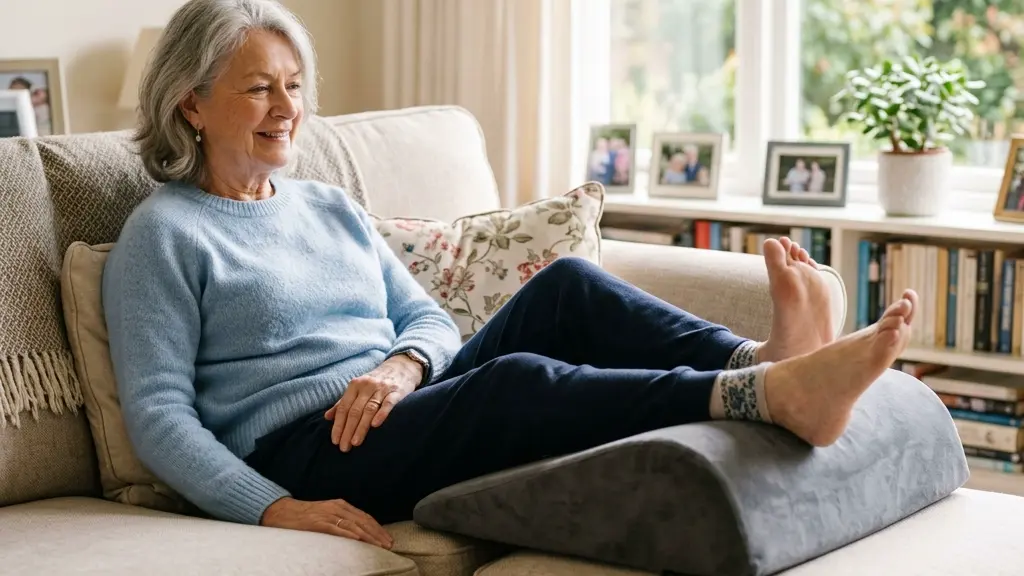
Next, you perform ankle pumps for leg swelling while lying on your back with your legs elevated on a wedge pillow. You point your toes down as far as possible, then pull them up toward your shins, repeating the movement continuously. This contracts the calf muscles, actively pumping the fluid out of the lower leg.
Finally, you perform light manual skin strokes, moving from your ankle toward your knee. This technique helps guide the stagnant fluid into the functional lymphatic channels in the thigh. Implementing this sequence is the most effective way to restore dry, comfortable legs.
The Patient: Margaret, an 80-year-old retired nurse, suffered from severe bilateral leg edema that made wearing shoes painful.
The Mistake: Margaret took high diuretic doses that dehydrated her, while sitting in a low chair all day, letting fluid pool in her feet.
The Solution: We replaced excessive sitting with hourly ankle pump exercises. We had her elevate her legs above heart level on a wedge pillow and perform light retrograde lymphatic massage.
The Outcome: Margaret's leg swelling reduced by 80% within three weeks. She regained full ankle mobility, could wear her normal shoes again, and felt more stable while walking.
Step-by-Step Lower Leg Decongestion Protocol
Execute this active circulation sequence twice daily. Stop immediately if you feel a sharp pain in one calf, sudden shortness of breath, or chest discomfort:
-
1Perform Deep Diaphragmatic Cleansing (Lymphatic Vacuum) Lie comfortably on your back with a pillow under your knees. Place one hand on your belly and take 10 slow, deep breaths, letting your abdomen rise on the inhale and fall on the exhale. This deep breathing clears the main thoracic duct, preparing your body to drain fluid from the limbs. For senior mobility integration details, read our guide on healthy joint mobility in seniors.
-
2Execute High-Velocity Ankle Pumps (3 sets of 20 repetitions)Elevate your legs on a wedge pillow so they are above your hips. Slowly point your toes away from you, then pull them back toward your face as far as possible. Perform this movement 20 times every hour. This is the gold standard exercise to stimulate the calf muscle pump. For matching ankle stability protocols, see our guide on ankle stability for seniors.
-
3Apply Upward Lymphatic Strokes (10 strokes per leg) While keeping your leg elevated, use both hands to wrap around your ankle. Apply very light, gentle pressure and slide your hands upward toward your knee, guiding the fluid. Never slide downward, and avoid heavy pressure which can collapse the lymphatic pathways. To maintain full physical conditioning, read our guide on conditioning after bedrest.
Sustaining a Dry and Mobile Lower Limb
Long-term edema control requires consistent movement throughout the day. Avoid standing still or sitting with crossed legs for prolonged periods. Wear comfortable, supportive footwear that allows your toes to spread and your ankle joint to move through its full range of motion during walking.
Treat your lower legs as a fluid reservoir that requires active daily maintenance. Rebuild your calf muscle pump, elevate your legs correctly, and protect your circulatory health. A dry, active lower leg is your best asset for maintaining balance, independence, and mobility as you age.
Are you actively pumping the fluid out of your lower legs tonight, or are you letting gravity pool stagnant fluid in your feet and ankles?
Irushi Abeywardhana
Senior Physiotherapist & Founder of Physio Pulse. Senior Clinical Physiotherapist passionate about blending advanced movement science with functional resilience.
Medical Disclaimer
The information provided by AyurPhysio is for general educational and informational purposes only. It is not intended as a substitute for professional medical advice, diagnosis, or treatment. Always seek the advice of your physician or other qualified health providers with any questions you may have regarding a medical condition. Never disregard professional medical advice or delay in seeking it because of something you have read on this website.
Trending Guides
Luka Modrić's Daily Routine: Low-Impact Resistance Training and Midfield Longevity
4 min readHarry Kane's Daily Routine: Hamstring Preservation and Anti-Inflammatory Nutrition
4 min readKarim Benzema's Daily Routine: Cupping Therapy (Hijama) and HIIT Conditioning
4 min readNeymar Jr.'s Daily Routine: Joint Stabilization and Hyperbaric Oxygen Therapy
4 min readMohamed Salah's Daily Routine: Early Morning Conditioning and Hyperbaric Recovery
4 min readWeekly Wellness
Don't miss the next guide
Get holistic health tips and new guides delivered to your inbox.
Related Healing Guides
View All Guides →
Hyperlordosis: Tailoring Exercise Programs to Reduce Lumbar Shear Stress
Morning Lower Back Stiffness: The Biomechanical Causes and Quick, Safe Fixes