"A punctured lung is the physiological equivalent of a flat tire on a Formula One car at race speed — the vehicle still has three functioning wheels, but the asymmetry is catastrophic, and nothing about the system can be trusted until every component is individually re-tested and verified safe."
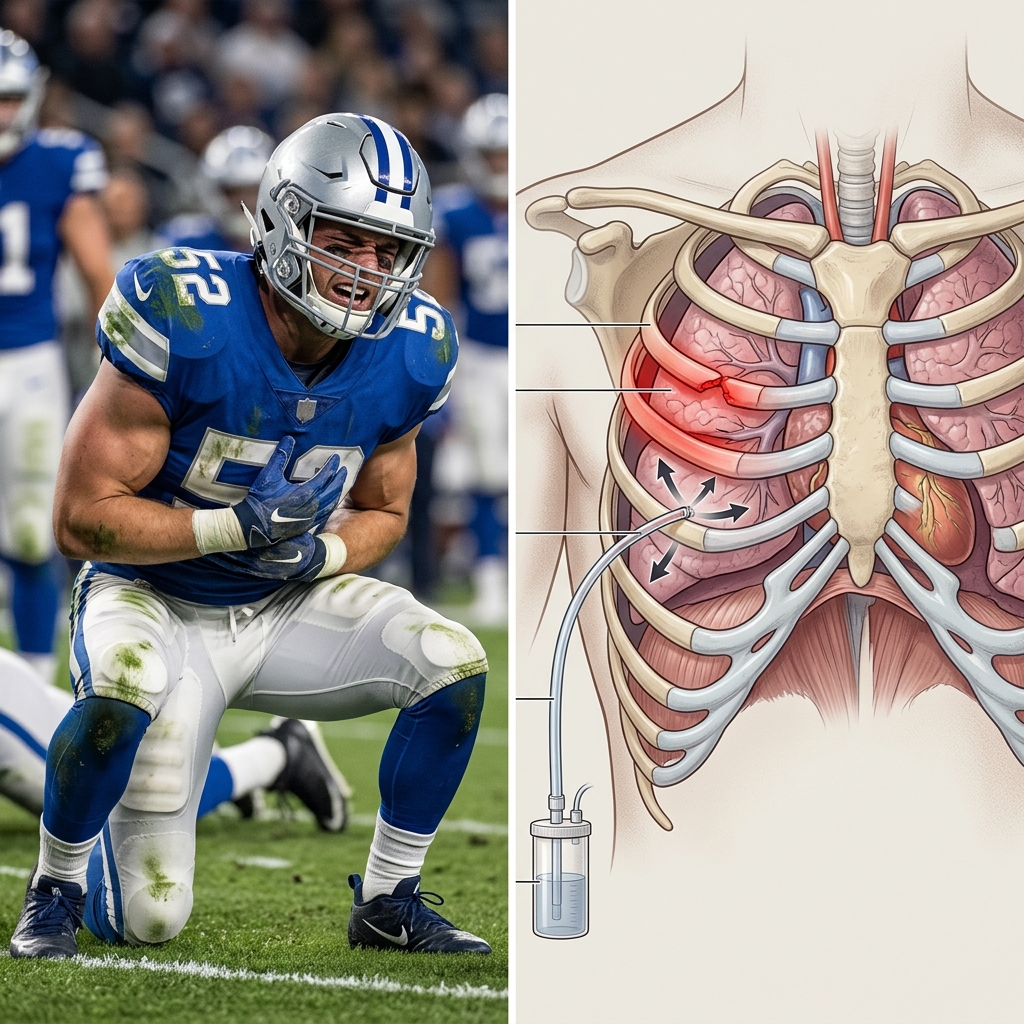
During a Week 9 game against the Dallas Cowboys in November 2025, Arizona Cardinals linebacker Mack Wilson Sr. sustained one of the most serious non-orthopedic injuries in professional football: a rib fracture that simultaneously punctured his lung, causing a traumatic pneumothorax. He was hospitalized for three days with a chest tube, slept upright for three weeks following discharge, and was placed on injured reserve for the remainder of the season.
By May 2026, he was dunking basketballs at a celebrity charity game — a visible demonstration of full athletic recovery that, while impressive, dramatically understates the complexity of the rehabilitation journey that made it possible.
A punctured lung in a professional athlete is not a simple soft tissue injury. It is a life-threatening thoracic trauma that demands the most technically sophisticated respiratory and musculoskeletal rehabilitation in sports medicine.
The Clinical Anatomy of a Traumatic Pneumothorax
The pleural space is the thin, fluid-filled cavity between the lung and the chest wall. Under normal conditions, negative pressure in this space holds the lung expanded against the rib cage — like the suction that keeps a plunger attached to a wall. When a fractured rib punctures the lung parenchyma (the functional tissue), air escapes into the pleural cavity. As air accumulates, the negative pressure gradient collapses, and the lung deflates — sometimes partially, sometimes completely.
Wilson's reported injury — a rib fracture with a lung puncture requiring chest tube drainage — indicates a hemopneumothorax: a combination of air and blood in the pleural space. This is clinically more serious than a simple pneumothorax, as the blood pooling can create fibrin adhesions (scarring between the lung and chest wall) that permanently reduce respiratory capacity if not adequately drained and re-expanded.
- NFL players sustain rib fractures at a rate approximately 4.5 times higher than age-matched recreational athletes, with linebackers and defensive ends at highest risk.
- A tension pneumothorax — where pressure builds rapidly in the pleural cavity compressing the heart — is immediately life-threatening, with hemodynamic collapse occurring within minutes without emergency decompression.
- Post-hemopneumothorax pleural adhesion formation occurs in approximately 20% of cases without adequate early mobilization therapy, permanently reducing peak respiratory capacity.
- Athletes with resolved pneumothorax demonstrate measurable reduced forced vital capacity (FVC) for 6–8 weeks post-resolution, directly limiting cardiovascular training capacity during early rehab.
Why Sleeping Upright for 3 Weeks Was Not Just Comfort — It Was Clinical Necessity
Wilson disclosed that he had to sleep sitting upright for three weeks post-discharge. This is not merely a comfort preference. When the lung is re-expanding after pneumothorax, the gravitational effects of lying flat create significant hydrostatic pressure changes in the pleural space. Upright positioning uses gravity to drain residual pleural fluid inferiorly, reduces the compressive effect of abdominal organs on the diaphragm, and ensures maximal lung recruitment at the apices (lung tops) during tidal breathing.
In physiotherapy, this is formalized as postural drainage — one of the earliest and most critical respiratory rehabilitation interventions in the acute post-thoracic-trauma period.
"The single most common failure in post-pneumothorax rehabilitation is the premature return to upper body and core resistance training. The rib cage forms the attachment origin for numerous core and shoulder muscles — the serratus anterior, the intercostals, the obliques. Placing these muscles under load before the periosteum (bone covering) of the fractured rib has adequately healed — typically at 6–8 weeks minimum — risks displacement of the healing fracture, adhesion formation at the pleural surface, and intercostal neuralgia that can persist for years. Wilson's return to full athletic activity in May 2026, approximately 6 months post-injury, is the correct timeline — not 2–3 months."
The Four-Phase Pulmonary Rehabilitation Protocol
- 1Phase 1: Immediate Post-Chest-Tube — Incentive SpirometryWithin 24 hours of chest tube placement, incentive spirometry is initiated. The patient breathes slowly and deeply against a visual flow-rate target. This recruits the collapsed alveoli at the lung periphery, preventing the post-atelectasis infection cascade (hospital-acquired pneumonia) that is the leading cause of post-thoracic-trauma mortality.
- 2Phase 2: Weeks 1–3 — Controlled Breathing MechanicsDiaphragmatic breathing retraining is critical. Splinting — the involuntary restriction of chest expansion to avoid rib pain — causes the patient to breathe shallowly and rapidly, further reducing lung recruitment. Physiotherapists teach lateral costal expansion and diaphragmatic descent using manual cueing and pain-managed splinted coughing techniques to safely clear secretions.
- 3Phase 3: Weeks 4–8 — Graduated Cardiovascular ReconditioningAs rib fracture healing enters the callus formation phase, low-impact cardiovascular conditioning (stationary cycling, walking) begins. Forced vital capacity (FVC) is monitored weekly. Return to upper body resistance training is cleared only when FVC exceeds 80% of pre-injury baseline and rib palpation reveals no tenderness at the fracture site.
- 4Phase 4: Weeks 8–24 — Return to Contact SportFull contact practice clearance requires confirmed radiographic rib union (bridging callus visible on CT), FVC >90% predicted, and pain-free resisted core and upper extremity testing. Impact absorption drills using training pads progressively reintroduce the shock-loading pattern of linebacker play before return to live scrimmage.
The Hidden Cost: Intercostal Neuralgia
One of the most underreported sequelae of rib fracture with pneumothorax is intercostal neuralgia — chronic pain along the nerve pathway between the ribs that persists well beyond bone healing. The intercostal nerves pass along the inferior margin of each rib in the neurovascular bundle. When the fracture disrupts this bundle, regenerating nerve fibers can form neuromas (painful scar tissue tangles) or become entrapped in the fracture callus. The result is a burning, shooting, or sharp pain that can persist for 12–24 months — or permanently — without targeted nerve gliding and desensitization therapy.
For athletes returning to sport, this pain can be misinterpreted as ongoing structural damage, unnecessarily delaying return-to-play clearance. Identifying and directly treating the neuropathic component is a critical but frequently overlooked element of comprehensive thoracic trauma rehabilitation.
For the broader framework of how thoracic injuries impact movement chains, our thoracic mobility guide provides essential context. For the respiratory physiotherapy principles used in post-pneumothorax care, our neuro-rehabilitation framework shares the same graduated reconditioning principles.
Mack Wilson dunking a basketball in May 2026 is more than a feel-good comeback story. It is a testament to what six months of precisely calibrated, stage-appropriate rehabilitation can achieve — and a quiet reminder that the most dangerous moment in any serious injury recovery is not the initial trauma, but the impatient athlete who feels well enough long before they actually are.
Featured image: Composite of NFL linebacker in chest pain with pneumothorax anatomical illustration and chest tube drainage system. Created for AyurPhysio editorial use.
Dr. Dhanushika Dilshani
Expert Ayurvedic Wellness Doctor. Specialized in modern holistic wellness, optimizing dermal resilience, cosmetic radiance, and systematic diagnosis driven by traditional and evidence-based medical logic.
Medical Disclaimer
The information provided by AyurPhysio is for general educational and informational purposes only. It is not intended as a substitute for professional medical advice, diagnosis, or treatment. Always seek the advice of your physician or other qualified health providers with any questions you may have regarding a medical condition. Never disregard professional medical advice or delay in seeking it because of something you have read on this website.
Trending Guides
Luka Modrić's Daily Routine: Low-Impact Resistance Training and Midfield Longevity
4 min readHarry Kane's Daily Routine: Hamstring Preservation and Anti-Inflammatory Nutrition
4 min readKarim Benzema's Daily Routine: Cupping Therapy (Hijama) and HIIT Conditioning
4 min readNeymar Jr.'s Daily Routine: Joint Stabilization and Hyperbaric Oxygen Therapy
4 min readMohamed Salah's Daily Routine: Early Morning Conditioning and Hyperbaric Recovery
4 min readWeekly Wellness
Don't miss the next guide
Get holistic health tips and new guides delivered to your inbox.
Related Healing Guides
View All Guides →
Luka Modrić's Daily Routine: Low-Impact Resistance Training and Midfield Longevity
Harry Kane's Daily Routine: Hamstring Preservation and Anti-Inflammatory Nutrition