Stroke Rehabilitation: Neuroplasticity Exercises to Rebuild Motor Control
"Trying to regain arm movement after a stroke by just squeezing a stress ball is like trying to learn how to play the piano by only pressing middle C. You must rewire the brain through complex, purposeful movement, not mindless repetition."
Surviving a stroke is a monumental victory, but the battle to reclaim your physical independence often begins the moment you leave the hospital. When a stroke damages a portion of the brain, the neural pathways that once effortlessly commanded your limbs are severed. The resulting hemiplegia—weakness or paralysis on one side of the body—leaves many patients feeling trapped in a body that refuses to listen.
The most powerful tool in stroke recovery is not a medication; it is the miraculous concept of neuroplasticity. Your brain possesses the incredible ability to form entirely new neural connections to bypass the damaged areas. However, this rewiring process demands extremely specific, highly concentrated physical therapy inputs.
To effectively rebuild motor control, we must abandon passive treatments and force the brain to adapt. By implementing highly targeted neuroplasticity exercises, we can wake up dormant pathways and systematically restore functional movement. Let's look at how to drive neurological healing.
The Rules of Neuroplasticity
Neuroplasticity is highly stubborn. It operates under the strict principle of "use it or lose it." If you completely stop using your affected arm because it feels clumsy, the brain will literally prune those motor maps, making future recovery significantly harder—a phenomenon known as learned non-use.
To trigger new connections, movements must be intense, highly repetitive, and above all, functionally meaningful. Squeezing a rubber ball does not teach the brain how to drink from a cup. The brain learns through task-specific challenges that require focused attention and problem-solving.
We achieve this through techniques like Constraint-Induced Movement Therapy (CIMT) and high-repetition task practice, forcing the nervous system to find a way to complete the action.
My strong clinical opinion is that over-assisting stroke patients during therapy is one of the biggest deterrents to neurological recovery. We see well-meaning family members or therapists constantly helping the patient move their affected limb through space to make it "easier."
If the therapist is doing the work, the therapist's brain is getting the workout. We must allow patients to struggle, falter, and attempt the movement independently, even if it looks messy. It is precisely in that moments of intense, frustrating effort that neuroplasticity fires and the new neural pathways are forged. Step back and let the brain struggle.
By the Numbers: The Neurological Comeback
The data surrounding active motor recovery proves that aggressive rehabilitation can yield results long after the initial injury.
- Patients engaged in Constraint-Induced Movement Therapy perform up to 400 functional repetitions per day, leading to a 50% increase in spontaneous arm use within two weeks.
- Research shows that to create a permanent neuroplastic change in the motor cortex, a patient must perform approximately 300 to 400 repetitions of a specific movement pattern.
- Individuals who initiate high-intensity gait (walking) training within the first 30 days post-stroke are 2.5x more likely to achieve independent community ambulation after one year.
Core Exercises to Rewire the Brain
These drills are designed to demand intense cognitive focus and fine motor precision, forcing the brain to build new highways.
-
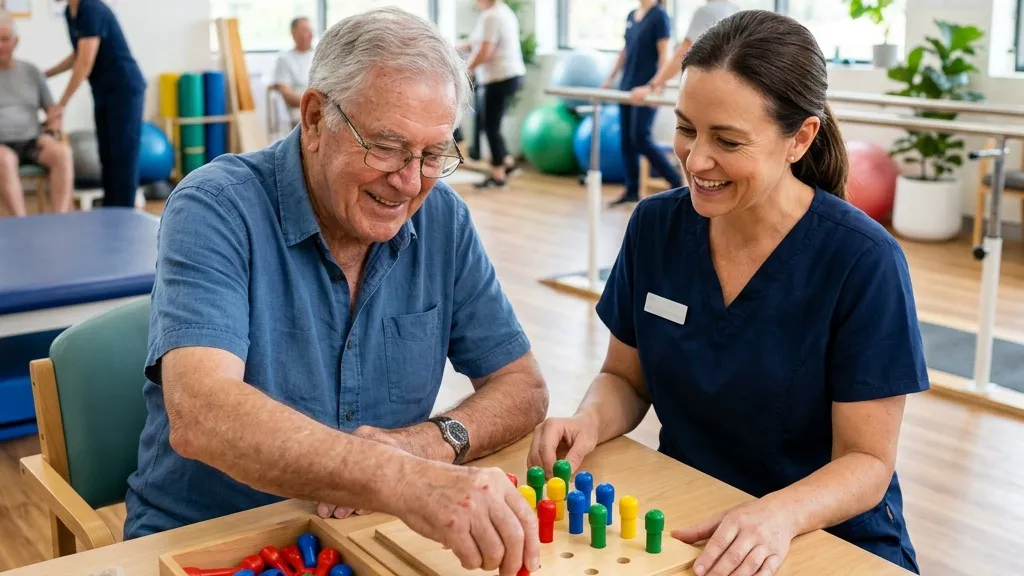
1The Pegboard Precision Drill Sit at a table with a wooden pegboard and a dozen pegs. Using only your affected hand, focus entirely on picking up a single peg, orienting it correctly in space, and placing it into a hole. The intense visual and motor coordination required for this simple task powerfully stimulates the pre-motor cortex. Perform 20 successful placements.
-
2Constraint-Induced Reaching (CIMT) Place a soft oven mitt over your unaffected hand to completely restrict its use. For 30 minutes, you must attempt to perform a meaningful daily task—such as stacking cups, folding a towel, or opening a drawer—using only the affected limb. This forced use shatters the brain's "learned non-use" habit.
-
3Weight-Bearing Joint Approximation Sit securely on a mat or bed. Place your affected hand flat on the surface beside your hip. Gently lean your body weight directly through that straight arm. The heavy proprioceptive feedback sent through the locked joints signals the brain to activate the stabilizing muscles of the rotator cuff and triceps. Hold for 30 seconds.
If you are also dealing with severe balance issues and fear of falling, review our protocols on Healthy Aging and Balance to safely rebuild your core stabilization.
The Patient: Arthur, a 68-year-old retired carpenter, suffered a right-hemisphere stroke that left his left arm completely flaccid. After three months of standard therapy, he had given up hope of ever holding his tools again and refused to use his left arm entirely.
The Mistake: Arthur was attending passive therapy where he was simply hooked up to electrical stimulation machines while resting, completely ignoring the cognitive effort required for true neuroplasticity.
The Solution: We implemented an aggressive CIMT protocol. We placed his good arm in a sling and forced him to practice grasping and releasing large wooden blocks with his left hand for 2 hours a day, demanding intense, exhausting focus.
The Outcome: Within four weeks of intense mental and physical struggle, Arthur regained gross motor grasp. By month three, the neural maps had rebuilt sufficiently for him to hold a piece of wood steady while operating his sander, returning him to the hobby he loved.
Forging the New Path
Stroke recovery is not a passive waiting game; it is an active construction project inside your brain. By embracing the struggle and demanding functional movement through relentless repetition, you can physically alter the architecture of your nervous system.
For a deeper understanding of how the body clears toxic overload after a major medical event, explore the holistic concepts in Understanding Ama and Cellular Toxins.
Are you ready to stop assisting the affected limb and start forcing the brain to adapt? Put the oven mitt on your good hand right now and attempt to lift a cup. What new pathway will you forge today?
Dr. Dhanushika Dilshani
Expert Ayurvedic Wellness Doctor. Specialized in modern holistic wellness, optimizing dermal resilience, cosmetic radiance, and systematic diagnosis driven by traditional and evidence-based medical logic.
Medical Disclaimer
The information provided by AyurPhysio is for general educational and informational purposes only. It is not intended as a substitute for professional medical advice, diagnosis, or treatment. Always seek the advice of your physician or other qualified health providers with any questions you may have regarding a medical condition. Never disregard professional medical advice or delay in seeking it because of something you have read on this website.
Trending Guides
Luka Modrić's Daily Routine: Low-Impact Resistance Training and Midfield Longevity
4 min readHarry Kane's Daily Routine: Hamstring Preservation and Anti-Inflammatory Nutrition
4 min readKarim Benzema's Daily Routine: Cupping Therapy (Hijama) and HIIT Conditioning
4 min readNeymar Jr.'s Daily Routine: Joint Stabilization and Hyperbaric Oxygen Therapy
4 min readMohamed Salah's Daily Routine: Early Morning Conditioning and Hyperbaric Recovery
4 min readWeekly Wellness
Don't miss the next guide
Get holistic health tips and new guides delivered to your inbox.