"Deceleration in lateral cutting is a test of ligamentous integrity and neuromuscular speed. If the peroneal muscles react even a fraction of a second too late, the lateral ankle ligaments are left to absorb the full momentum of the athlete's body weight."
Luka Dončić's style of play relies heavily on sudden changes of pace, lateral deceleration, and his signature step-back jumper. While these movements allow him to create space on the court, they subject his ankles and knees to extreme rotational forces. His history of recurrent ankle sprains and knee contusions highlights the biomechanical stress placed on the lateral chain of the lower limb.
Standard recovery protocols often treat recurring sprains with passive bracing and tape. While these methods provide external stability, they do not address the underlying proprioceptive deficits and muscular imbalances. Rebuilding a resilient ankle joint requires a dynamic program that retrains the nervous system and strengthens the surrounding stabilizing muscles.
Restoring stability for lateral cutting requires analyzing the exact mechanics of deceleration. By studying the forces acting on the foot and using targeted luka doncic injury rehabilitation, we can rebuild a highly responsive ankle.
This article reviews the biomechanics of inversion sprains, the development of joint laxity, and lateral chain conditioning protocols.
The Biomechanics of Deceleration and Inversion Trauma
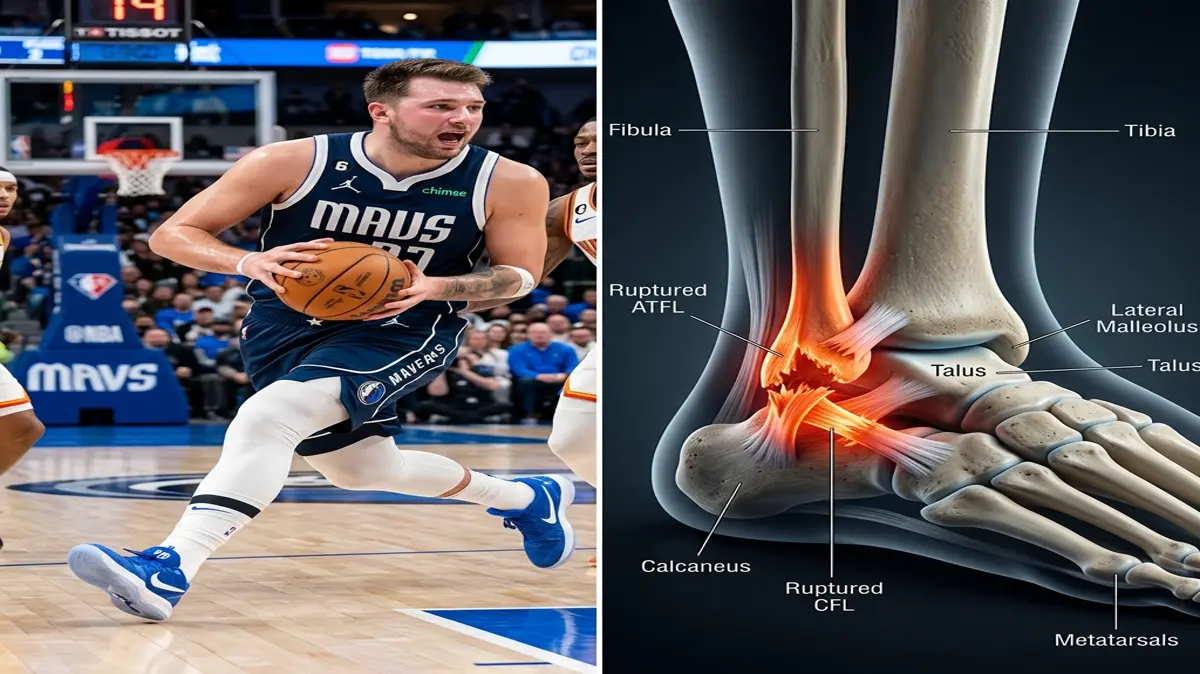
When an athlete performs a step-back or cuts laterally, the foot is placed in a position of inversion (rolling inward) and plantarflexion (pointing downward). In this state, the bones of the ankle joint provide very little structural support. The joint relies almost entirely on the lateral ligaments—primarily the anterior talofibular ligament (ATFL) and calcaneofibular ligament (CFL)—to maintain stability.
If the athlete decelerates rapidly while the foot is inverted, the mechanical load can exceed the tensile limits of these ligaments. This tension creates micro-tearing or complete ruptures of the ligament fibers. In a large athlete who generates high torque, these forces are magnified, making the lateral structures highly vulnerable.
Additionally, each sprain damages the small nerve receptors (proprioceptors) embedded within the joint capsule. These receptors send real-time signals to the brain regarding joint position and motion. When damaged, the brain's ability to detect an roll-over is delayed, allowing future sprains to occur under minor loads.
Ankle sprains account for approximately 25% of all sports-related injuries. Furthermore, up to 70% of athletes who sustain an acute lateral ankle sprain develop chronic joint instability. Recovery requires restoring the neural connection to the peroneal muscles to enable rapid protective contractions.
Key clinical parameters tracking lateral ligament healing and sensorimotor recovery:
- 1Ligament LaxityRepetitive sprains can increase joint laxity by up to 15%, reducing passive mechanical stability.
- 2Reaction Time DelayProprioceptive damage delays peroneal muscle activation by up to 80 milliseconds, failing to prevent rolls.
- 3Balance AssessmentA deficit of over 4 centimeters on the Star Excursion Balance Test indicates severe functional instability.
- 4Reconditioning FocusTargeted balance training reduces recurrent ankle sprain rates by 35% within 6 weeks.
The Clinical Opinion: Dynamic Stabilization vs. Chronic Bracing
"Relying on rigid ankle braces for long-term play is a compensatory strategy that leads to muscle weakness. In my clinical opinion, chronic bracing restricts normal joint motion and weakens the peroneal muscles, transferring stress up the kinetic chain to the knee. We must focus on dynamic stabilization—rebuilding the ankle's natural stabilizers through progressive balance and reaction-time drills."
Chronic ankle bracing restricts the ankle's natural movement, forcing the knee and hip joints to compensate. This compensation can lead to knee contusions and patellar tendon irritation. Dynamic stabilization trains the muscles to act as an active brace, protecting the joint while preserving full range of motion.
Rehab begins with quiet standing on unstable surfaces to activate the stabilizers. As coordination improves, we introduce dynamic balance drills that require the athlete to maintain stability during deceleration. This active reconditioning restores the ankle's natural protective mechanisms, reducing reliance on external supports.
Multi-Stage Ankle and Lateral Chain Rehabilitation Protocol
Reconditioning an athlete's ankle requires a progressive program that restores ligamentous strength, proprioceptive speed, and lateral hip power.
Phase 1: Swelling Management and Early Mobility (Weeks 1-2)
The early phase focuses on controlling swelling, protecting the healing ligaments, and maintaining ankle motion. The athlete uses compression wrapping and elevation to manage inflammation. Active ankle movements are performed in a pain-free range.
Active ankle circles and alphabet writing drills are performed hourly to maintain joint mobility. The athlete sits and moves their foot through a controlled range of motion. These exercises prevent the formation of rigid adhesions in the joint capsule.
Sub-maximal isometric eversion holds are introduced to engage the peroneal muscles. The athlete presses the outer side of their foot against a solid surface, holding the contraction for 5 seconds. This exercise is performed in 3 sets of 10 repetitions twice daily.
Phase 2: Proprioceptive Training and Strength Integration (Weeks 3-5)
Once the acute swelling has resolved, we transition the athlete to active balance training. The athlete begins single-leg standing balance drills on a foam pad, progressing to a wobble board. These exercises retrain the sensory receptors within the joint capsule.
Progressive strengthening focuses on eccentric ankle eversion. The athlete uses a resistance band to pull their foot inward, then controls the movement as the band pulls it outward. This eccentric control builds strength in the lateral muscle group.
Lateral hip strengthening is added, focusing on the gluteus medius. The athlete performs side-lying clam exercises and band walks. A strong lateral hip prevents the leg from collapsing inward, reducing the load on the lateral ankle structures.
Phase 3: Deceleration and Court-Specific Conditioning (Weeks 6-8)
The final phase focuses on rebuilding explosive court-specific stability. The athlete begins plyometric training, performing lateral line hops and box jumps. These exercises train the ankle to absorb and redirect force during rapid directional changes.
Deceleration drills are introduced, focusing on the step-back movement. The athlete performs rapid lateral shuffles, stopping suddenly on the injured leg. These movements are performed at progressive velocities twice weekly.
The athlete is gradually integrated back into team practices and competitive games. We monitor ankle balance and lateral hip control throughout the transition. Continued dynamic balance drills are performed as part of the warm-up routine.
Preventing Secondary Joint Compasations
An ankle injury affects the entire lower extremity kinetic chain. Ankle stiffness restricts dorsiflexion, forcing the knee to hyperextend or collapse inward during landing. This movement fault can lead to knee contusions and patellofemoral pain.
To prevent secondary knee and hip issues, the program includes knee control drills and quadriceps strengthening. Ensuring optimal alignment of the entire leg protects the joints from abnormal impact. A comprehensive approach is the key to maintaining long-term athletic health.
For more lower extremity rehabilitation guidelines, read our detailed guides on restoring ankle stability after sprains, coccydynia pelvic floor rehab, and plantar fascia calf eccentric stretching. To understand sports-specific ankle mechanics, view our analyses of Stephen Curry's ankle recovery, Klay Thompson's joint reconstruction, and Lionel Messi's ankle ligament tear recovery. You can also review Kristaps Porzingis' medial retinaculum tear recovery.
Featured image attribution: Left panel displays basketball player Luka Dončić driving on the court. Right panel shows a clinical 3D medical illustration highlighting the ankle joints, lateral ligaments (ATFL, CFL), and local tissue tear points. Modified by cropping and compositing.
Dr. Dhanushika Dilshani
Expert Ayurvedic Wellness Doctor. Specialized in modern holistic wellness, optimizing dermal resilience, cosmetic radiance, and systematic diagnosis driven by traditional and evidence-based medical logic.
Medical Disclaimer
The information provided by AyurPhysio is for general educational and informational purposes only. It is not intended as a substitute for professional medical advice, diagnosis, or treatment. Always seek the advice of your physician or other qualified health providers with any questions you may have regarding a medical condition. Never disregard professional medical advice or delay in seeking it because of something you have read on this website.
Trending Guides
Luka Modrić's Daily Routine: Low-Impact Resistance Training and Midfield Longevity
4 min readHarry Kane's Daily Routine: Hamstring Preservation and Anti-Inflammatory Nutrition
4 min readKarim Benzema's Daily Routine: Cupping Therapy (Hijama) and HIIT Conditioning
4 min readNeymar Jr.'s Daily Routine: Joint Stabilization and Hyperbaric Oxygen Therapy
4 min readMohamed Salah's Daily Routine: Early Morning Conditioning and Hyperbaric Recovery
4 min readWeekly Wellness
Don't miss the next guide
Get holistic health tips and new guides delivered to your inbox.
Related Healing Guides
View All Guides →
Luka Modrić's Daily Routine: Low-Impact Resistance Training and Midfield Longevity
Harry Kane's Daily Routine: Hamstring Preservation and Anti-Inflammatory Nutrition