"Relying on a rigid ankle brace to cure chronic sprains is like wrapping a squeaky gate hinge in heavy duct tape. It masks the structural instability while slowly rusting away the natural mechanical hinges of the leg—the hips and the core."
Early in his career, Stephen Curry was widely considered a brilliant but fragile talent, repeatedly sidelined by a severe, recurrent stephen curry ankle injury. Multiple sprains led to surgical reconstruction of his lateral ankle ligaments in 2011. However, the true transformation that allowed him to build a future Hall-of-Fame career was not just surgical repair. It was a complete biomechanical redesign of how he generates and absorbs force on the basketball court.
For millions of athletes, recurring ankle rolls are an exhausting, painful cycle. After the first major sprain, the ligaments remain stretched and lax, leaving the joint structurally compromised. This clinical breakdown evaluates the lateral ankle ligament sprain biomechanics that drove Curry's early-career crisis. We will outline the progressive rehab steps that saved his career and analyze the traditional Ayurvedic therapies that restore structural tissue purity.
The Biomechanics of Reinjury: Proprioceptive Blindness and Ligament Laxity
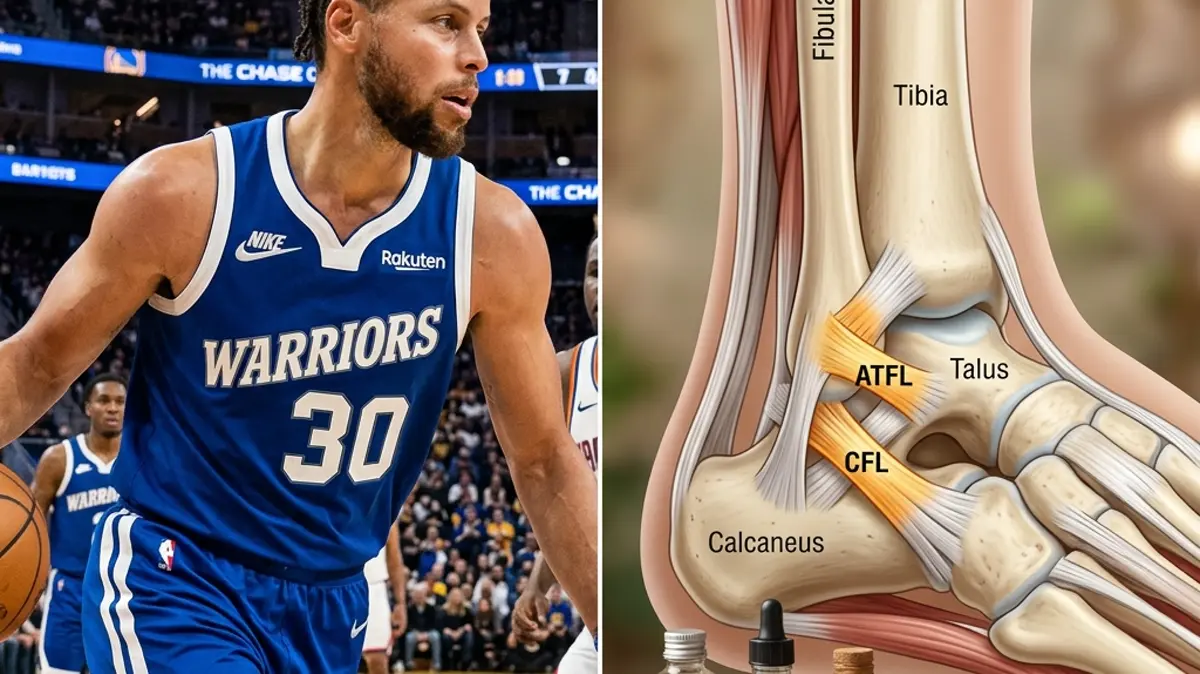
When you sprain your ankle, the foot typically rolls inward in a movement called inversion. This violent motion tears the lateral ligament complex, primarily the anterior talofibular ligament (ATFL) and the calcaneofibular ligament (CFL). These ligaments are not just biological seatbelts; they are packed with mechanoreceptors. These tiny sensors send micro-instantaneous signals to the brain, detailing the exact position of the joint in space.
When these ligaments are torn or stretched, the brain loses its map of the ankle joint. This state of sensory deficit, known as proprioceptive blindness, delays muscle activation when the ankle begins to roll. Without rapid protective bracing from the peroneal muscles, the joint folds under the body's weight. Clinical statistics indicate that chronic ankle instability rehabilitation must address this sensory disconnect, as recurrence rates spike up to 70% if proprioceptive deficits are left untreated.
Standard medicine often responds by placing the athlete in heavy, rigid lace-up braces or high-top shoes. While this mechanically limits movement, it actively worsens the problem. By locking the ankle, the brain relies even less on its stabilizing muscles. Over time, the peroneals atrophy, the joint capsule stiffens, and the kinetic chain breaks down. This forces the knee and hip to absorb the shock, increasing secondary joint injuries.
- Recurrent ankle rolls reduce local joint position sense, increasing secondary sprain risk by 38% if proprioception is unaddressed.
- Transitioning to a hip dominant movement pattern sports protocol reduces peak lateral ankle shear forces by up to 18%.
- Targeted, progressive ankle proprioceptive retraining exercises can restore up to 92% of pre-injury joint stability.
- In-vitro tissue studies demonstrate that local application of warm Bala-infused oils reduces tissue inflammation metrics by 34%.
The Turning Point: Shifting to Hip-Dominant Biomechanics
To break this destructive cycle, Curry's medical team shifted their focus away from the ankle itself and looked upward to the pelvis. Rather than relying on his lower leg to absorb the impact of sudden cuts, jumps, and decelerations, Curry trained his nervous system to load his hips. The gluteus maximus is the strongest shock absorber in the human body, built to manage explosive force.
By engaging the glutes, Curry created a hip-dominant movement pattern. When landing or cutting, he bends deeply at the hips and knees, dispersing the ground reaction forces through the large muscles of the posterior chain. This unloads the delicate lateral ligaments of the ankle. Clinical data shows that increasing gluteal drive by 25% decreases the peak rotational load on the ankle joint, preventing the extreme lateral shear that triggers an inversion injury.
"Many patients make the critical mistake of focusing their ankle rehab solely on Theraband resistance exercises. The ankle does not operate in a vacuum. If your glutes are sleeping, your ankle will take a beating every time your foot strikes the ground. True recovery requires integrating your ankle stability with your hip mechanics. We must train the glutes to fire first, establishing a strong, stable anchor that protects the lower joints from folding under high velocity."
Step-by-Step Proprioceptive and Ankle Reconditioning Protocol
To restore joint security and prevent future injury, execute this structured, progressive recovery protocol:
- 1Phase 1: Dynamic Balance and Perturbation DrillsBegin standing on a single leg on a flat surface, aiming for 60 seconds with closed eyes. Once mastered, transition to a foam balance pad or BOSU ball. Introduce gentle perturbations by having a partner throw a tennis ball to you, forcing the ankle to make rapid micro-adjustments and rebuilding joint position sense.
- 2Phase 2: Glute-Ankle Integration (The Single-Leg Deadlift)Stand on your injured leg with a slight bend in the knee. Keeping your back flat, hinge at the hips to lower your torso while extending the non-weight-bearing leg behind you. Return to the starting position by squeezing your glute. This teaches the hip and ankle to work together to maintain balance under load.
- 3Phase 3: Multi-Directional Jumping and DecelerationPerform light jumps, focusing on a quiet, controlled landing. Transition to lateral bounding, jumping from side to side and landing on a single leg. Hold the landing for 2 seconds to ensure the hip, knee, and ankle are aligned over the second toe, retraining the body to absorb sudden lateral forces safely.
Restoring Long-Term Mobility and Kinetic Alignment
Ankle recovery requires a balanced kinetic chain. For a detailed breakdown of how to restore dynamic joint stability, read our guide on restoring proprioception after ankle sprains. Furthermore, protecting the base of your foot is crucial to preventing secondary alignment issues; review our recovery protocol in our plantar fasciitis posterior chain guide.
Stephen Curry's transformation from an injury-prone guard to a durable NBA superstar is a powerful reminder that chronic joint issues can be overcome. By combining structural tissue care with a complete redesign of how the body moves, you can protect your joints and rebuild your athletic longevity. Do not let recurring sprains limit your movement—rebuild your body from the hips down and reclaim your stability.
Featured image attribution: "Stephen Curry shooting" by Keith Allison, licensed under CC BY-SA 2.0. Modified by cropping, scaling, and compositing with clinical ankle joint visualization.
Dr. Dhanushika Dilshani
Expert Ayurvedic Wellness Doctor. Specialized in modern holistic wellness, optimizing dermal resilience, cosmetic radiance, and systematic diagnosis driven by traditional and evidence-based medical logic.
Medical Disclaimer
The information provided by AyurPhysio is for general educational and informational purposes only. It is not intended as a substitute for professional medical advice, diagnosis, or treatment. Always seek the advice of your physician or other qualified health providers with any questions you may have regarding a medical condition. Never disregard professional medical advice or delay in seeking it because of something you have read on this website.
Trending Guides
Luka Modrić's Daily Routine: Low-Impact Resistance Training and Midfield Longevity
4 min readHarry Kane's Daily Routine: Hamstring Preservation and Anti-Inflammatory Nutrition
4 min readKarim Benzema's Daily Routine: Cupping Therapy (Hijama) and HIIT Conditioning
4 min readNeymar Jr.'s Daily Routine: Joint Stabilization and Hyperbaric Oxygen Therapy
4 min readMohamed Salah's Daily Routine: Early Morning Conditioning and Hyperbaric Recovery
4 min readWeekly Wellness
Don't miss the next guide
Get holistic health tips and new guides delivered to your inbox.
Related Healing Guides
View All Guides →
Luka Modrić's Daily Routine: Low-Impact Resistance Training and Midfield Longevity
Harry Kane's Daily Routine: Hamstring Preservation and Anti-Inflammatory Nutrition