"Tuning the suspension on a high-performance sports car is a delicate art. If one side is rebuilt but the other remains stiff, the vehicle will pull and spin out under high speeds."
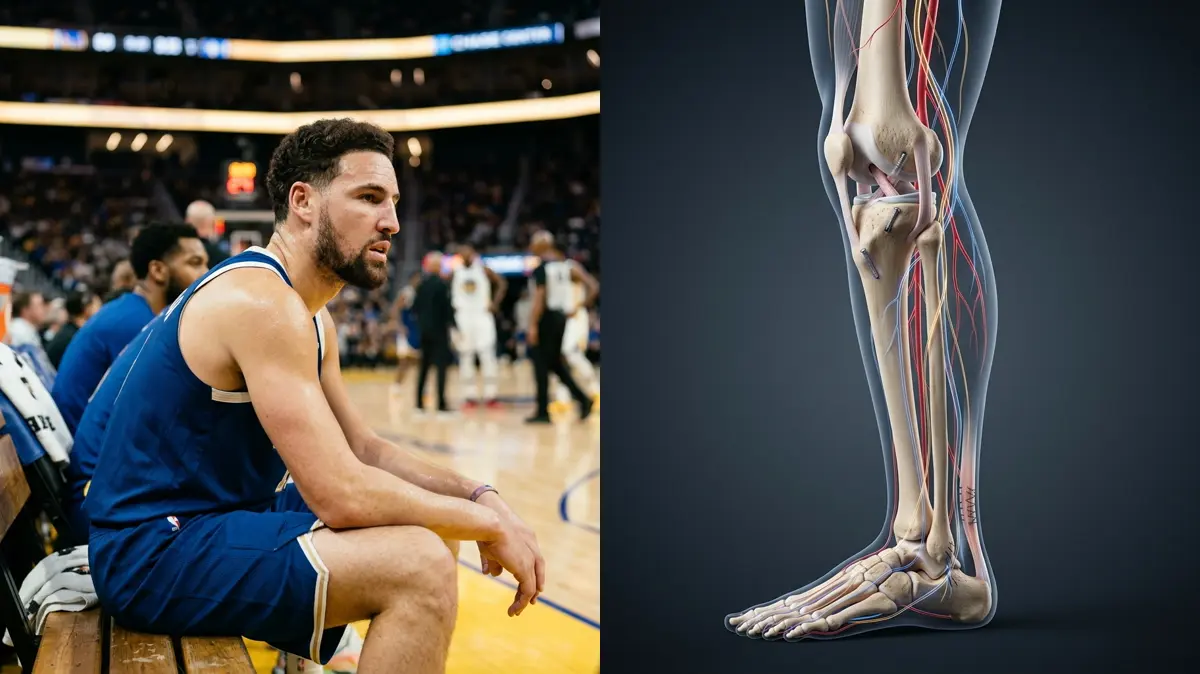
When Golden State Warriors legend Klay Thompson suffered back-to-back catastrophic lower limb injuries, sports fans witnessed a heartbreaking medical saga. First, a torn left anterior cruciate ligament (ACL) during the 2019 NBA Finals, followed just over a year later by a ruptured right Achilles tendon during off-season training. This combination of major joint and tendon failures on opposite legs highlights the complex nature of human movement rehabilitation.
For elite and amateur athletes alike, recovering from a major joint reconstruction is not a localized process because the body is an integrated kinetic chain where an injury to one side instantly alters the forces absorbed by the other. This clinical breakdown evaluates the biomechanical compensation patterns that drive contralateral joint overload. We will outline the progressive sports rehabilitation protocols needed to safely rebuild structural symmetry and balance.
The Kinetic Chain Shift: How ACL Deficits Overload the Contralateral Leg
When Klay Thompson tore his left ACL, his knee joint lost its primary passive stabilizer against anterior tibial translation and rotational shear forces. The subsequent reconstructive surgery successfully restored joint structure, but it triggered a cascade of muscle inhibition. The brain, seeking to protect the healing graft, automatically reduces neural drive to the quadriceps and gluteals on the reconstructed side.
This protective shift leads to a pattern of limb asymmetry, where the athlete unconsciously unloads the injured leg. During jumping, landing, and high-speed cutting, the body diverts a significant portion of the kinetic shock to the opposite limb. This contralateral overload forces the uninjured leg to absorb excessive impact, placing high mechanical demands on the right Achilles tendon.
If this landing asymmetry persists, the opposite tendon undergoes micro-tearing and disorganized collagen accumulation, leading to structural degradation. Clinical statistics indicate that contralateral knee overload must be proactively addressed during rehabilitation. Without restoring symmetry, secondary injuries are highly likely as the athlete attempts to return to sport.
Biomechanical tracking shows that ACL reconstruction increases the risk of a secondary contralateral sprain or rupture by 15% if unilateral limb symmetry remains below 90%.
Furthermore, landing from an explosive vertical jump places a force equal to 6 to 8 times bodyweight directly on the Achilles tendon spring. For a 215-pound athlete, that demands managing up to 1,720 pounds of impact force.
In terms of muscle compensation, 3D motion capture reveals that landing asymmetry shifts up to 12% of the total landing force to the uninjured leg, explaining contralateral tendon failure.
Challenging the Speed Rush: Restoring Neural Control Before Plyometrics
The standard rush to return athletes to running and jumping drills before restoring muscle symmetry is a major mistake. Without adequate eccentric strength in the quadriceps and gluteals, the opposite ankle must bend excessively to absorb landing forces. This deep compression grinds the Achilles tendon, making it highly vulnerable to acute rupture under explosive loads.
To safely navigate this phase, physical therapists must focus on restoring joint proprioception and lateral stability. Understanding how to correct anterior pelvic tilt is a vital precursor to athletic movement, as a forward-tilted pelvis alters the loading angles of the hips and knees. This postural control ensures that forces are distributed evenly across the entire kinetic chain during play.
My clinical opinion is that back-to-back contralateral sprains are rarely bad luck. They are the direct result of unresolved movement deficits, particularly the failure to restore eccentric quadriceps deceleration on the first injured leg. When an athlete cannot decelerate with the left quadriceps, the right calf and Achilles must work twice as hard to stop the body, leading to structural collapse.
To prevent this, we must utilize objective strength tests and progressive eccentric loading to balance the limbs before starting high-velocity drills. Pacing the recovery and tracking the Limb Symmetry Index (LSI) is the only way to safeguard the athlete's career.
If you are also recovering from spinal stiffness or chronic posture limits, incorporating targeted sacroiliac joint stabilizing stretches can help keep the pelvis level, reducing uneven leg loading. You can study the role of progressive tendon loading in our guide on Achilles Heavy Slow Resistance protocols, and review recovery biomechanics in our analysis of Kevin Durant's Achilles tendon rehabilitation.
The 3-Phase Contralateral Rebalancing Protocol
To restore bilateral limb symmetry, modulate tendon pain, and safely transition back to high-impact sports, execute this progressive routine thrice weekly:
-
1Single-Leg Quadriceps Eccentric Squats (Left Side) Stand on your left (ACL reconstructed) leg on a flat surface. Slowly lower your body into a single-leg squat over a strict 4-second tempo, then use both legs to rise back up. Perform 3 sets of 10 repetitions to restore the eccentric quad strength needed for athletic landing.
-
2Bilateral Ankle Proprioceptive Balance Drills Stand barefoot on a foam balance pad or folded towel. Close your eyes and maintain your balance on one leg for 45 seconds, keeping your hips and pelvis perfectly level. Repeat 5 times on each side to retrain the neural pathways and prevent ankle roll recurrences.
-
3Progressive Closed-Chain Heel Raises (Right Side) Stand on the edge of a step with your right heel hovering. Slowly rise onto your toes over 3 seconds, hold the top for 2 seconds, and lower your heel down over 3 seconds. Perform 3 sets of 8 weighted repetitions to stimulate collagen alignment and build Achilles spring capacity.
Protecting Your Athletic Future
Contralateral joint injury is not a sign of permanent structural weakness; it is a movement compensation problem. By replacing aggressive play with progressive, heavy loading and restoring neural balance to the landing leg, you can systematically rebuild your athletic resilience. Do not let dual injuries end your fitness journey—rebuild your movement symmetry step-by-step and reclaim your strength on the court.
Featured image attribution: "Klay Thompson 2018.jpg" by Noah (original photograph by All-Pro Reels), licensed under CC BY-SA 2.0. Modified by cropping and compositing with an AI-generated clinical joint visualization.
Dr. Dhanushika Dilshani
Expert Ayurvedic Wellness Doctor. Specialized in modern holistic wellness, optimizing dermal resilience, cosmetic radiance, and systematic diagnosis driven by traditional and evidence-based medical logic.
Medical Disclaimer
The information provided by AyurPhysio is for general educational and informational purposes only. It is not intended as a substitute for professional medical advice, diagnosis, or treatment. Always seek the advice of your physician or other qualified health providers with any questions you may have regarding a medical condition. Never disregard professional medical advice or delay in seeking it because of something you have read on this website.
Trending Guides
Luka Modrić's Daily Routine: Low-Impact Resistance Training and Midfield Longevity
4 min readHarry Kane's Daily Routine: Hamstring Preservation and Anti-Inflammatory Nutrition
4 min readKarim Benzema's Daily Routine: Cupping Therapy (Hijama) and HIIT Conditioning
4 min readNeymar Jr.'s Daily Routine: Joint Stabilization and Hyperbaric Oxygen Therapy
4 min readMohamed Salah's Daily Routine: Early Morning Conditioning and Hyperbaric Recovery
4 min readWeekly Wellness
Don't miss the next guide
Get holistic health tips and new guides delivered to your inbox.
Related Healing Guides
View All Guides →
Luka Modrić's Daily Routine: Low-Impact Resistance Training and Midfield Longevity
Harry Kane's Daily Routine: Hamstring Preservation and Anti-Inflammatory Nutrition