"A spinal column under constant rotational whip is like a twisted wire. If the surrounding deep core muscles fail to anchor each vertebra, joint friction rises, forming fluid-filled barriers that compress the spinal nerves."
Andy Murray's exceptional career is a testament to grit and biomechanical adaptation. However, generating elite rotational racquet speed and serving at 130 mph places extreme loads on the lumbar spine. When his preparation is interrupted by a spinal cyst requiring urgent surgical decompression, it highlights the heavy physical demands tennis places on the spinal joints.
Many tennis players push through back stiffness, believing it is a muscular strain that stretching can fix. In reality, persistent back pain accompanied by shooting leg pain often points to structural joint issues or nerve compression. Rebuilding the spine after surgery requires a targeted rehabilitation program that focuses on dynamic core stabilization.
Restoring elite tennis performance demands a deep analysis of lumbar biomechanics. By studying spinal loading patterns and utilizing targeted andy murray injury rehab protocols, we can protect the facet joints. This article examines the pathology of spinal cysts, post-operative recovery stages, and dynamic spine stabilization.
The Biomechanics of Tennis Serves and Spinal Cyst Formation
The tennis serve is one of the most complex movements in sports, requiring a combination of spinal hyperextension, lateral flexion, and rapid rotation. During the trophy phase of a serve, the lumbar spine is placed in extreme extension to store elastic energy. At ball contact, this extension is violently reversed into flexion and rotation to whip the racquet forward.
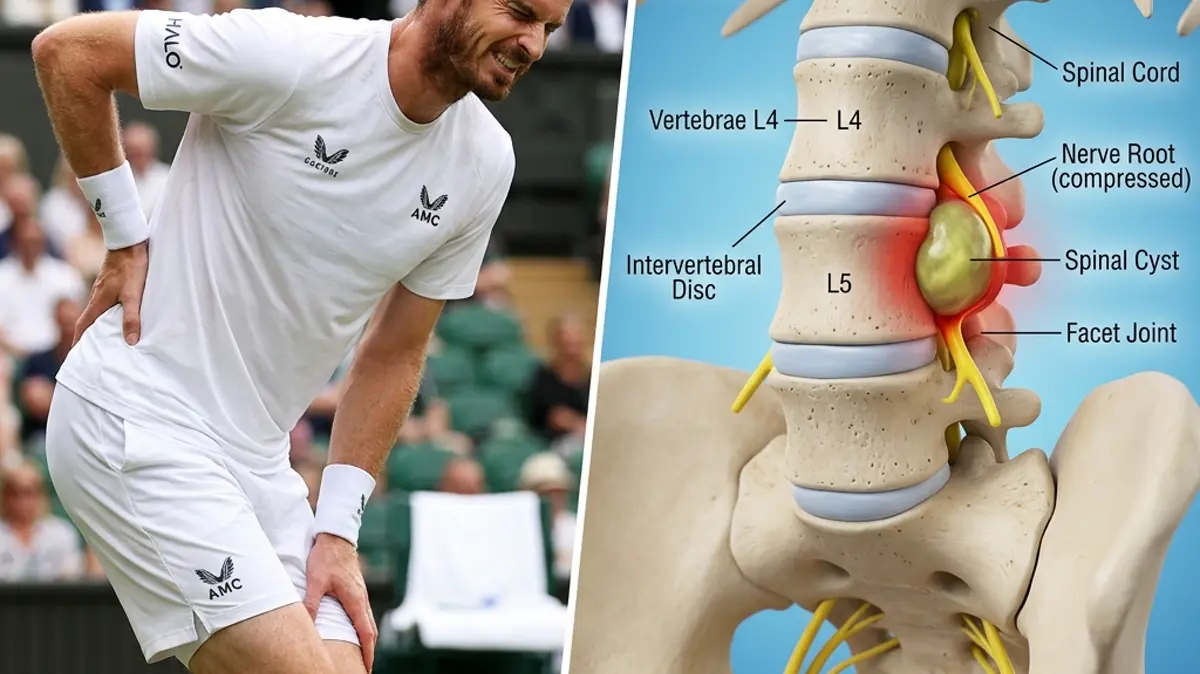
This rapid shift from extension to flexion concentrates mechanical forces on the lumbar facet joints, particularly at the L4-L5 and L5-S1 levels. Repetitive hyperextension causes friction between the joint surfaces. To protect itself, the joint capsule can secrete excess synovial fluid, which can bulge outward and form a synovial cyst.
If the cyst grows into the spinal canal or neural foramen, it directly compresses the adjacent nerve root. This nerve compression leads to radiculopathy, causing severe back pain, muscle weakness, and numbness down the leg. Decompressing the nerve requires surgical excision of the cyst, followed by strict spinal protection guidelines.
Key clinical parameters for assessing lumbar spinal pressure and core rehab:
- 1Disc Pressure SurgeServing with hyperextension spikes lumbar disc pressure to over 250% of baseline upright standing.
- 2Rotational TorsionHigh-velocity trunk rotation puts up to 120 Nm of torsional shear force on the lumbar facet joints.
- 3Deep Core Activation WindowDeep stabilizer activation must begin by week 3 post-surgery to prevent segmental micro-slippage.
- 4Nerve Recovery RateA 90% resolution of radiating leg pain is typically achieved within 8 to 12 weeks of surgical decompression.
The Clinical Opinion: Segmental Control vs. Aggressive Back Stretching
"Rehabilitating a post-surgical spinal cyst patient requires training for segmental control rather than aggressive trunk stretching. In my clinical opinion, forcing the lower back into deep flexion or extension stretches only serves to irritate the healing nerve root. By focusing on maintaining a neutral pelvis and strengthening the deep multifidus muscle, we stabilize the segment and prevent joint friction, protecting the spine from future cyst recurrence."
Traditional recovery protocols often encourage athletes to perform deep hamstring and lower back stretches to relieve tightness. While stretching provides temporary relief, it can overload the healing joints and increase nerve tension. Modern physical therapy instead focuses on building muscular stiffness to protect the joints.
Early exercises focus on isolating the transversus abdominis and multifidus muscles. These deep muscles act as a natural corset, stabilizing each spinal segment and reducing shear forces during movement. As strength improves, we progress to dynamic exercises that challenge the core while maintaining a neutral spine.
Multi-Stage Post-Surgical Spinal Rehabilitation Protocol
Restoring a tennis player's spine to athletic function requires a structured progression that protects the surgical site while building dynamic core integration.
Phase 1: Protection and Deep Core Activation (Weeks 1-4)
The primary focus is on protecting the surgical site, reducing inflammation, and maintaining neural mobility. The athlete avoids any lower back bending, twisting, or heavy lifting. Walking is encouraged daily to promote blood flow and neural healing.
We initiate gentle nerve glides to prevent scar tissue from binding the nerve root. The athlete lies on their back, supports the thigh, and gently extends the knee to a comfortable point, performing 10 repetitions twice daily. Deep abdominal bracing is performed in a lying position.
Isometric core exercises, such as the dead bug and bird-dog progressions, are introduced. The athlete moves the limbs while keeping the lower back completely still, training the core to resist motion.
Phase 2: Segmental Strength and Pelvic Alignment (Weeks 5-8)
Once the surgical incision is fully healed, we progress to light resistance training. The athlete performs standing cable presses (Pallof press) to train the core to resist rotation. This exercise is performed in 3 sets of 10 repetitions twice daily.
Pelvic stabilization exercises are progressed to include single-leg glute bridges and side planks. These movements strengthen the lateral chain and hips, reducing rotational forces on the lumbar spine. Ankle and hip mobility are assessed to ensure optimal movement.
Light closed-chain squatting begins, focusing on maintaining neutral spinal alignment throughout the movement. The athlete avoids dropping the tailbone (butt wink) at the bottom of the squat.
Phase 3: Rotational Power and Tennis-Specific Drilling (Weeks 9-16)
The final phase focuses on high-velocity core strength and court-specific movement patterns. The athlete performs medicine ball throws in a split stance, focusing on generating power from the hips and shoulders while the core remains stable.
On-court training begins with shadow swings, gradually progressing to light baseline hitting at 50% intensity. The athlete avoids serving and hitting high overheads in the initial weeks to protect the spine from hyperextension.
Full-baseline drilling and serve progression are introduced. The athlete returns to competitive tennis only after achieving full core strength symmetry and passing functional stability tests.
Securing the Hip-Spine Biomechanical Chain
A spinal injury is often a symptom of poor mobility in the surrounding joints. If the hips are stiff, the lumbar spine is forced to rotate and extend excessively to compensate. This compensation quickly overloads the facet joints, leading to micro-instability and cyst formation.
To ensure long-term spinal health, a complete rehabilitation program must target hip mobility. Rebuilding hip rotation and extension ensures that power is generated from the larger muscles of the lower body. A balanced kinetic chain is the key to athletic durability.
To learn more about lumbar spine rehabilitation, read our detailed guides on spinal stenosis flexion protocols, core stability lower back injury prevention, and multifidus muscle atrophy and lower back stiffness. You can also review our athletic injury analyses of Andy Murray's hip resurfacing recovery, Elon Musk's cervical spine surgery, and Bruce Lee's sacral nerve injury biomechanics.
Featured image attribution: Left panel displays a visual representation of tennis player Andy Murray holding his lower back in discomfort during court play. Right panel shows a detailed 3D medical anatomical illustration of the human lumbar spine (L3-L5) highlighting a spinal cyst compressing a lumbar nerve root. Modified by cropping and compositing.
Dr. Dhanushika Dilshani
Expert Ayurvedic Wellness Doctor. Specialized in modern holistic wellness, optimizing dermal resilience, cosmetic radiance, and systematic diagnosis driven by traditional and evidence-based medical logic.
Medical Disclaimer
The information provided by AyurPhysio is for general educational and informational purposes only. It is not intended as a substitute for professional medical advice, diagnosis, or treatment. Always seek the advice of your physician or other qualified health providers with any questions you may have regarding a medical condition. Never disregard professional medical advice or delay in seeking it because of something you have read on this website.
Trending Guides
Luka Modrić's Daily Routine: Low-Impact Resistance Training and Midfield Longevity
4 min readHarry Kane's Daily Routine: Hamstring Preservation and Anti-Inflammatory Nutrition
4 min readKarim Benzema's Daily Routine: Cupping Therapy (Hijama) and HIIT Conditioning
4 min readNeymar Jr.'s Daily Routine: Joint Stabilization and Hyperbaric Oxygen Therapy
4 min readMohamed Salah's Daily Routine: Early Morning Conditioning and Hyperbaric Recovery
4 min readWeekly Wellness
Don't miss the next guide
Get holistic health tips and new guides delivered to your inbox.
Related Healing Guides
View All Guides →
Luka Modrić's Daily Routine: Low-Impact Resistance Training and Midfield Longevity
Harry Kane's Daily Routine: Hamstring Preservation and Anti-Inflammatory Nutrition