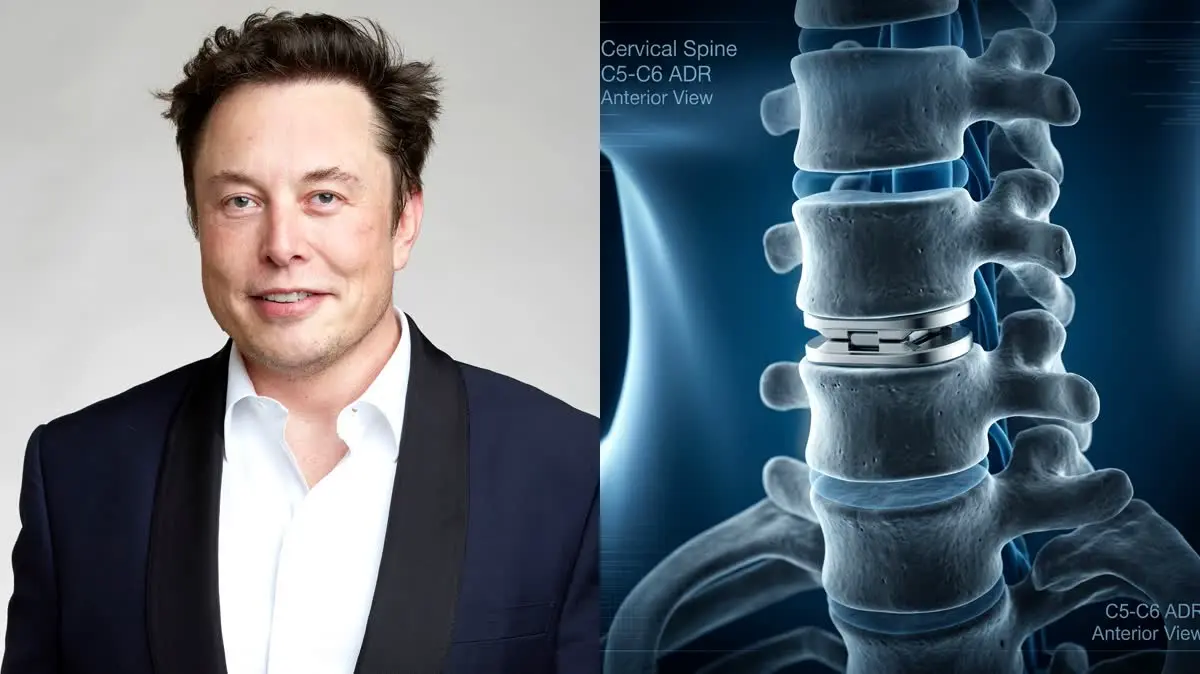
"A spinal fusion is like welding two articulating gears of a clock together to stop them from rattling—it fixes the immediate noise, but forces the gears above and below to spin twice as fast until they fail. Artificial Disc Replacement, conversely, is like inserting a precision-engineered Swiss bearing, preserving the clock's original fluid motion."
Tech visionary and Tesla CEO Elon Musk generated significant medical intrigue when he publically revealed the root of his long-running, "insane" back and neck pain struggles. The catalyst for years of severe nerve compression was surprisingly low-tech: a stunt sumo-wrestling bout at a birthday party years ago, which resulted in a massive spinal impact.
Following over a decade of managing the resulting injury, Musk confirmed he underwent major cervical spine surgery—specifically, a reconstruction at the C5-C6 segmental level. The procedure was vital not just to alleviate his intense chronic headaches and neck pain, but to prevent progressive neurological damage to his arms and hands.
When most patients suffer from a ruptured, herniated, or degenerated disc in the neck, they are presented with the classic gold-standard operation: the Anterior Cervical Discectomy and Fusion (ACDF). However, modern clinical biomechanics has shifted rapidly toward a newer, technologically advanced alternative known as Cervical Artificial Disc Replacement (ADR).
As a clinical physical therapist focusing on advanced orthopedic rehabilitation, analyzing the Elon Musk neck surgery profile provides an essential learning opportunity for anyone living with persistent radiating nerve pain, tingling, or numbness. Understanding the mechanical trade-offs between fusion and disc replacement dictates how well your spine will function ten years from today.
The Pathophysiology: The C5-C6 Biomechanical Hotspot
The cervical spine (your neck) consists of seven small, highly mobile vertebrae. Among them, the C5-C6 segment is the absolute workhorse of the upper spine. Clinical statistics indicate that over 60% of all cervical disc herniations occur at the C5-C6 level, as it serves as the fulcrum for bending the neck forward and backward.
An acute, high-velocity impact—such as being slammed to the floor during a stunt or sumo wrestling—applies extreme axial loading combined with hyperflexion. This force hydraulically forces the soft jelly-like inner core (nucleus pulposus) of the disc to burst through its outer fibrous wall (annulus fibrosus).
When this disc material herniates into the narrow spinal canal, it directly compresses the exiting C6 nerve root. This compression results in the classic clinical symptom pattern known as cervical radiculopathy: radiating pain down the lateral arm, numbness in the thumb and index finger, and weakness in the biceps and wrist extensors.
Historically, the standard of care was to perform an ACDF, where the damaged disc is scraped out, and the two vertebrae are bolted together with a metal plate and bone graft to grow into a single solid block.
While highly effective at eliminating nerve pressure, fusing the spine removes 100% of the motion from that joint. Clinical epidemiology reveals that approximately 25% of fusion patients will develop Adjacent Segment Degeneration (ASD) within 10 years.
Because the fused segment no longer bends, the mechanical torque is transferred directly to the healthy discs immediately above (C4-C5) and below (C6-C7), accelerating their wear and tear and frequently demanding a second surgery.
The Tech Paradigm: Preserving Segmental Kinematics with ADR
For highly active individuals and those seeking to avoid the "domino effect" of multiple fusions, Cervical Artificial Disc Replacement (ADR) has revolutionized spinal medicine. Instead of welding the bones, surgeons insert a cobalt-chrome or titanium device featuring a high-density polyethylene core that perfectly mimics the natural cushioning and articulating glide of a healthy human disc.
By maintaining natural segmental motion, ADR reduces the shear stress on the surrounding levels back to baseline physiological norms. From a physical therapy perspective, post-operative rehab for ADR is significantly faster, as there is no "bone-graft healing" window where neck motion must be strictly immobilized.
Just as we emphasize structural loading management in strengthening deep neck flexors for cervicogenic headaches, protecting your mechanical leverage is the ultimate defense against cumulative spinal breakdown.
Three Clinical Self-Checks for Cervical Disc Issues
If you have been battling nagging neck stiffness, use these three diagnostic tests to screen for potential structural disc involvement:
-
1The Spurling’s Compression Check Sit up straight and gently tilt your head to the painful side, then look slightly upward toward the ceiling. Have a companion apply very light, gentle downward pressure on top of your head. If this maneuver immediately replicates sharp, electrical pain or tingling shooting down your arm, it indicates active nerve root compression at the cervical foramen.
-
2The Shoulder Abduction Relief Sign If your arm is actively aching, raise the hand of the painful arm and place it flat on top of your head. Hold this position for 60 seconds. If your pain significantly decreases, this is a classic positive indicator of a herniated disc. Lifting your arm elevates the brachial plexus, mechanically taking the tension off the compressed nerve root.
-
3Cervical Retraction Assessment (Chin Tucks) Stand against a wall. Draw your head straight back toward the wall as if making a "double chin," keeping your eyes level. If this motion reduces your arm symptoms and centralizes the pain into the middle of your neck, it indicates that your mechanical directional preference favors extension, a major indicator for successful physical therapy.
Addressing nerve compression early is paramount. Much like the rigorous protocols designed for McKenzie method exercises for acute lumbar herniations, the primary goal of cervical rehab is to "centralize" the pain—drawing it out of the limbs and back into the spine where it can be stabilized and healed.
Innovate Your Spinal Health
Elon Musk's journey from acute trauma to progressive technological intervention highlights a vital clinical lesson: your spine is a highly precise mechanical architecture. While surgery is a last resort, understanding the differences between locking a joint via fusion versus restoring its dynamics via artificial disc replacement empowers you to make better choices. If you are tired of living with nagging neck tightness or shooting arm pain, isn't it time to book a clinical assessment and restore your mechanical integrity?
Featured image attribution: "Elon Musk at the Royal Society" by The Royal Society, licensed under CC BY-SA 3.0. Modified by cropping and compositing with 3D cervical disc replacement visualization.
Dr. Dhanushika Dilshani
Expert Ayurvedic Wellness Doctor. Specialized in modern holistic wellness, optimizing dermal resilience, cosmetic radiance, and systematic diagnosis driven by traditional and evidence-based medical logic.
Medical Disclaimer
The information provided by AyurPhysio is for general educational and informational purposes only. It is not intended as a substitute for professional medical advice, diagnosis, or treatment. Always seek the advice of your physician or other qualified health providers with any questions you may have regarding a medical condition. Never disregard professional medical advice or delay in seeking it because of something you have read on this website.
Trending Guides
Luka Modrić's Daily Routine: Low-Impact Resistance Training and Midfield Longevity
4 min readHarry Kane's Daily Routine: Hamstring Preservation and Anti-Inflammatory Nutrition
4 min readKarim Benzema's Daily Routine: Cupping Therapy (Hijama) and HIIT Conditioning
4 min readNeymar Jr.'s Daily Routine: Joint Stabilization and Hyperbaric Oxygen Therapy
4 min readMohamed Salah's Daily Routine: Early Morning Conditioning and Hyperbaric Recovery
4 min readWeekly Wellness
Don't miss the next guide
Get holistic health tips and new guides delivered to your inbox.
Related Healing Guides
View All Guides →
Luka Modrić's Daily Routine: Low-Impact Resistance Training and Midfield Longevity
Harry Kane's Daily Routine: Hamstring Preservation and Anti-Inflammatory Nutrition