“Sprinting with scoliosis is like driving an F1 car with an asymmetrical suspension system. At moderate speeds, the vehicle feels stable; at 27 miles per hour, the slight structural twist forces the entire chassis to absorb massive, uneven loads.”
Usain Bolt is widely considered the greatest sprinter in human history, holding the world record in the 100-meter dash at an astonishing 9.58 seconds. Yet, few fans realize that the fastest man alive achieved his legendary status while battling congenital scoliosis, a condition that curved his spine to the right and made his right leg half an inch shorter than his left.
To run at elite speeds, the body demands near-perfect symmetry to distribute impact forces. Instead of allowing this structural asymmetry to restrict him, Bolt developed a unique, uneven stride that biomechanists have studied for years. However, this compensation came with a major clinical cost: a persistent vulnerability to acute hamstring strains that repeatedly threatened his career.
In this clinical guide, we will analyze the biomechanics of Bolt's sprinting scoliosis, how his pelvic kinetic chain compensated for leg length discrepancy, and the physical therapy protocols required to stabilize an asymmetrical spine and prevent hamstring failure.
The Sprinting Asymmetry: 13% Force Discrepancy
Scoliosis is a lateral curvature of the spine that alters the alignment of the entire skeletal frame. In Bolt's case, the spinal curve forced a lateral tilt in his pelvis, resulting in a functional leg length discrepancy. During high-velocity sprinting, this asymmetry produced two distinct stride dynamics:
- The Left Leg (The Force Generator): Because his left leg is longer, it strikes the ground with up to 13% more peak vertical force than his right. The left leg stays on the ground slightly longer (longer contact time), acting as the primary propulsion engine.
- The Right Leg (The Rapid Stride Recovery): The shorter right leg strikes the ground with less force but must push off rapidly to maintain stride frequency. This creates a rapid, slightly irregular “hitch” in his running gait.
While this asymmetrical pattern allowed Bolt to maximize his unique velocity, it placed an immense eccentric load on his hamstrings. During the terminal swing phase of sprinting (just before the foot hits the ground), the hamstring group must rapidly contract to decelerate the swinging lower leg. With an asymmetrical pelvis, the hamstrings on the longer leg are placed under excessive tension, making them highly vulnerable to micro-tears.
Biomechanical studies of asymmetrical sprinting reveal distinct load variations:
- 1Peak Force AsymmetryThe longer leg delivers up to 13% higher ground reaction forces during maximum velocity sprinting.
- 2Pelvic Drop angleLeg length discrepancy induces a lateral pelvic drop of up to 5 degrees during running mid-stance.
- 3Eccentric OverloadAsymmetrical hip alignment increases hamstring eccentric loading during terminal swing by over 20%.
- 4Injury RecurrenceUncorrected pelvic tilts are associated with a 3x higher rate of recurrent hamstring strains in sprinters.
The 3-Step Asymmetrical Rehabilitation Protocol
To rehabilitate a runner with scoliosis or functional leg length discrepancy, physical therapy must move beyond standard symmetrical hamstring curls. The focus must be on pelvic stabilization and eccentric strength under rotation.
Step 1: Asymmetrical Core & Pelvic Alignment
To stabilize the pelvis, you must target the core muscles that control lateral hip tilt, particularly the Quadratus Lumborum (QL) and Gluteus Medius. Perform asymmetrical side planks: lie on your side, raise your hips, and hold. If your pelvis drops on the right side, perform a longer hold (e.g., 45 seconds) on the left side to build lateral stability. Follow this with single-leg glute bridges, ensuring the pelvis remains perfectly level throughout the movement. Perform 3 sets of 10 repetitions per side, 3 times weekly.
Step 2: High-Load Eccentric Hamstring Remodeling
To protect the hamstring fibers during the terminal swing phase of running, you must build high eccentric strength (strength while the muscle is lengthening). Perform Single-Leg Romanian Deadlifts (RDLs). Stand on one leg with a slight bend in the knee. Hinge forward at the hips, keeping your back flat and your pelvis level. Lower the weight slowly over 3 seconds, engage your glutes, and return to the starting position. Perform 3 sets of 8 repetitions per leg, twice weekly.
Step 3: Rotational Spine & Thoracic Mobility
Scoliosis limits spinal rotation, forcing the lower back and hips to over-rotate to compensate. Releasing the mid-back (thoracic spine) reduces the rotational strain on the lumbar spine and pelvis. Perform thoracic rotation drills: kneel on all fours, place one hand behind your head, and rotate your elbow up toward the ceiling. Hold for 3 seconds, then return. Perform 2 sets of 10 repetitions per side daily to restore spinal rotation symmetry.
Rebuilding the Kinetic Foundation
Rehabilitating an athlete with scoliosis requires understanding that structural asymmetry is a condition to manage, not a disease to cure. By strengthening the stabilizers of the pelvis and building eccentric hamstring capacity, runners can perform at high levels without risking joint or muscle breakdown.
For further recovery resources, review our detailed guide on hamstring strain rehab for sprinters and our clinical analysis of ankle proprioception and balance drills. To learn how pelvic tilt alters lower back dynamics, see our correction guide for anterior pelvic tilt stabilization to secure your spinal alignment.
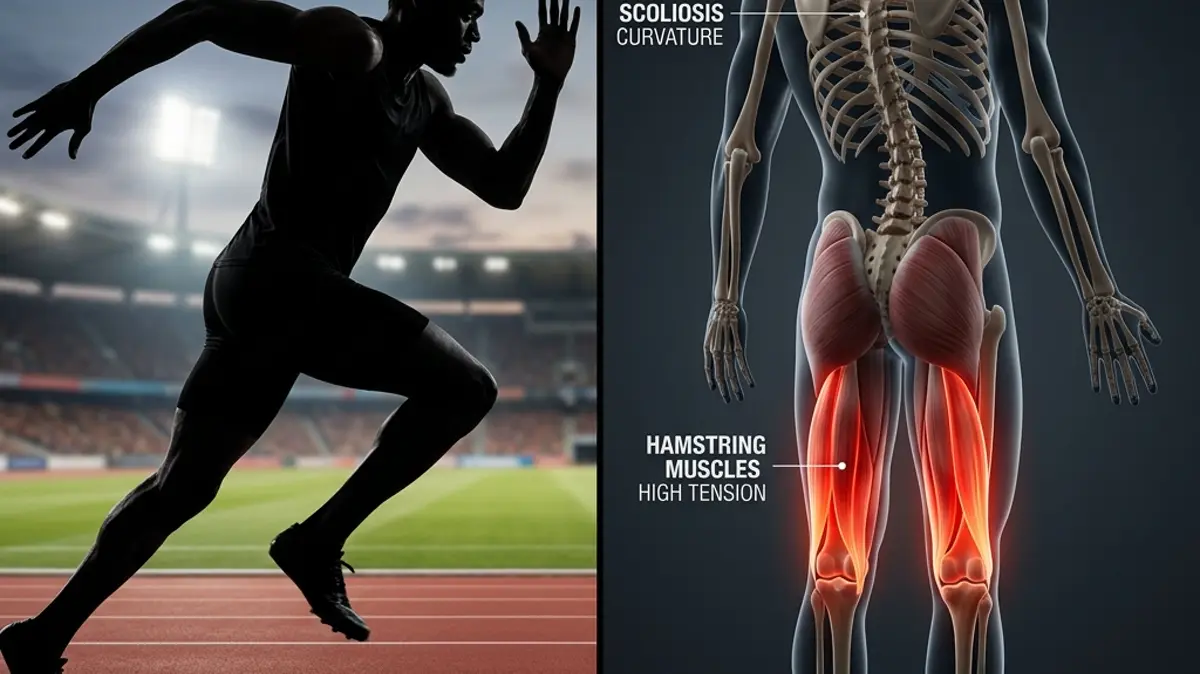
Featured image attribution: Split-screen composite. Left panel: Athletic silhouette representing sprinter Usain Bolt running explosively. Right panel: Clinical 3D anatomical model highlighting scoliosis curvature and the hamstring muscle group under tension. Created for AyurPhysio clinical reference.
Dr. Dhanushika Dilshani
Expert Ayurvedic Wellness Doctor. Specialized in modern holistic wellness, optimizing dermal resilience, cosmetic radiance, and systematic diagnosis driven by traditional and evidence-based medical logic.
Medical Disclaimer
The information provided by AyurPhysio is for general educational and informational purposes only. It is not intended as a substitute for professional medical advice, diagnosis, or treatment. Always seek the advice of your physician or other qualified health providers with any questions you may have regarding a medical condition. Never disregard professional medical advice or delay in seeking it because of something you have read on this website.
Trending Guides
Luka Modrić's Daily Routine: Low-Impact Resistance Training and Midfield Longevity
4 min readHarry Kane's Daily Routine: Hamstring Preservation and Anti-Inflammatory Nutrition
4 min readKarim Benzema's Daily Routine: Cupping Therapy (Hijama) and HIIT Conditioning
4 min readNeymar Jr.'s Daily Routine: Joint Stabilization and Hyperbaric Oxygen Therapy
4 min readMohamed Salah's Daily Routine: Early Morning Conditioning and Hyperbaric Recovery
4 min readWeekly Wellness
Don't miss the next guide
Get holistic health tips and new guides delivered to your inbox.
Related Healing Guides
View All Guides →
Luka Modrić's Daily Routine: Low-Impact Resistance Training and Midfield Longevity
Harry Kane's Daily Routine: Hamstring Preservation and Anti-Inflammatory Nutrition