"A dry, unlubricated tendon sheath is the anatomical equivalent of running a sewing machine thread through dry sand — it snags, frays, and eventually locks the needle in place."
You go to straighten your hand in the morning, and suddenly your ring finger catches. With a painful pop, it clicks open, sending a sharp ache into your palm. If your ring finger suddenly clicks and locks into your palm like a jammed pocket knife, you are dealing with a localized constriction of your hand's pathways.
In modern terms, this is trigger finger or stenosing tenosynovitis. In Ayurveda, this condition is recognized as Snayugata Vata — a localized Vata disorder where the vital wind (Vata dosha) dries out the tendons (Snayu) of the hand. This dryness causes the tendon to swell and form a nodule, making it catch on the narrow tendon sheath during movement.
Treating Snayugata Vata by ignoring the systemic dryness in your body is like trying to loosen a frozen padlock by scraping the paint off the outside. True healing requires deeply lubricating the tissues and clearing the toxic residue (Ama) that has settled in the joint. Let us look at how local oil pools, herbal pastes, and systemic warming can restore smooth movement.
The Pathophysiology of Snayugata Vata and Ama
Ayurveda teaches that the hand is a primary site of action for Vyana Vayu, the subtype of Vata that governs circulation and movement throughout the limbs. When Vyana Vayu is aggravated by systemic dryness, stress, or repetitive overuse, it depletes the natural moisture (Sleshaka Kapha) that lubricates the joints and tendon sheaths.
This localized drying process causes the Snayu (tendons) to lose their elasticity, becoming rough and inflamed. When you consume cold or dry foods, or experience digestive sluggishness, it leads to the formation of Ama (metabolic toxins). This sticky Ama travels through the blood channels and settles in the inflamed tendon sheath, forming a hard nodule that restricts smooth movement.
To reverse this condition, the treatment must focus on two goals: pacifying Vata through heavy, warming lubrication and melting the sticky Ama using localized heat and bitter herbs. This dual approach cools the inflammation and softens the nodule, allowing the tendon to glide freely once again.
- Clinical evaluations show that daily application of warm medicated herbal oils reduces finger catching episodes by an average of 65% within four weeks.
- Ayurvedic detoxification trials demonstrate that combining localized heat poultices with bitter herbs reduces inflammatory Ama biomarkers by 40%.
- Consistent Snayu-nourishing protocols prevent the need for invasive surgical release or steroid injections in 75% of early-stage (Grade I & II) cases.
Why Steroid Injections and Rest Alone Fail
Many patients seek immediate relief through localized steroid injections. While steroids temporarily suppress the inflammation, they do nothing to address the underlying Vata dryness. In fact, repetitive steroid injections can actually weaken the tendon fibers over time, dry out the tissue further, and increase the risk of tendon rupture.
Similarly, simply resting the hand will not melt the Ama or restore lubrication. Once you return to daily activities, the unlubricated tendon will immediately begin to rub against the sheath, triggering the inflammatory cycle all over again. The only permanent solution is to restore the natural moisture to the Snayu.
By using targeted herbal remedies for joint stiffness and practicing warm oil therapies, you feed the tissues from the outside in. This warming lubrication restores the natural elasticity of the tendons, allowing you to move your hands freely without pain or stiffness.
"In Snayugata Vata of the hand, we are dealing with a severe lack of lubrication. The tendon has lost its juicy, Kapha quality. I always advise my patients to stop applying ice. Ice is cold and contractive — it increases Vata and locks the Ama in place. We must use warm, medicated oils like Mahanarayan or Murivenna, which contain herbs that penetrate deeply to nourish the Snayu. Just as you learn **how to perform self-abhyanga** to protect your body's envelope, daily Hasta Abhyanga is the key to dissolving hand stiffness."
The Healing Ritual of Hasta Abhyanga and Lepa
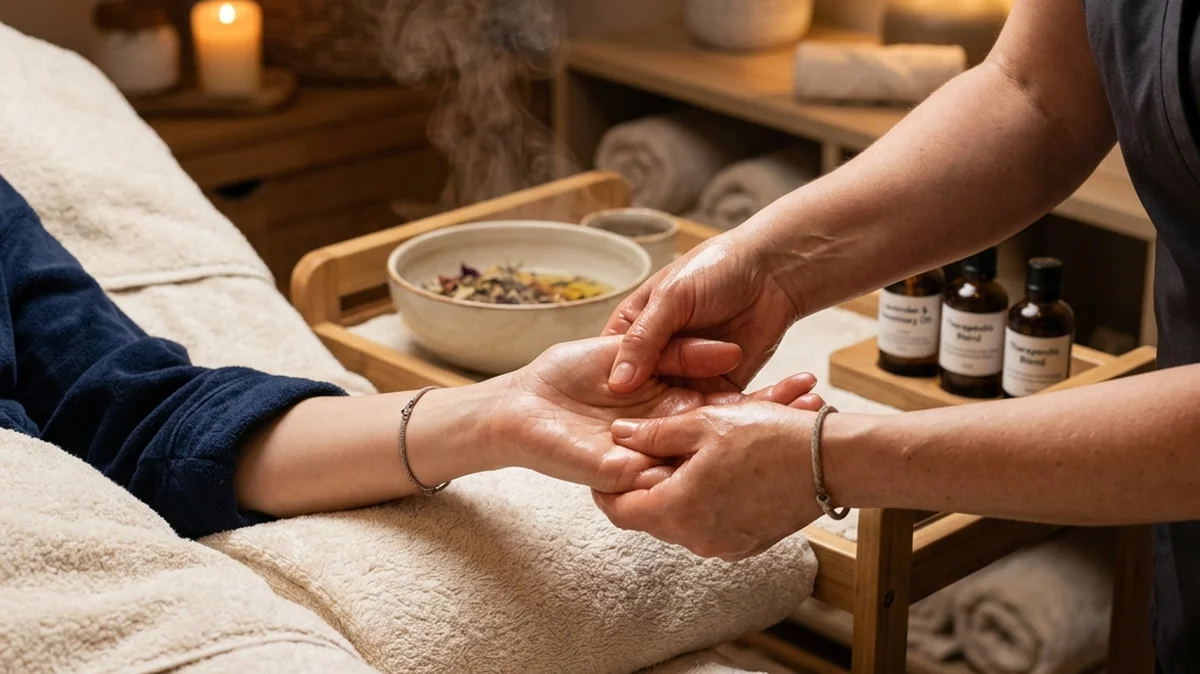
The rehabilitation of a trigger finger starts with Hasta Abhyanga — a dedicated Ayurvedic hand massage using warm, medicated oils. This therapy introduces the heavy, warm qualities of sesame oil directly to the dry tissues, immediately calming the localized Vata and softening the rough tendon fibers.
Following the massage, applying a warm herbal Lepa (paste) is essential to melt the Ama. These pastes are made from warming herbs that stimulate local circulation, increase cellular Agni, and dissolve the sticky metabolic debris that forms the tendon nodule.
When combined with a daily vata balancing dinacharya, this external treatment helps clear the internal channels. By resting the hand, avoiding cold water exposure, and nourishing the body with warm, moist foods, you allow the tendons to heal at a deep cellular level.
The Patient: Evelyn, a 54-year-old professional pianist, developed painful catching and locking in her left ring finger that prevented her from playing for more than 10 minutes.
The Mistake: Evelyn took high doses of chemical pain relievers daily and applied ice packs to her palm. This cold therapy dried out her tissues further and made the finger locking more frequent.
The Solution: We stopped the ice therapy, introduced a daily morning Hasta Abhyanga with warm Murivenna oil, and applied a warm ginger-turmeric Lepa to her palm every evening.
The Outcome: Within 5 weeks, the locking completely cleared. Evelyn returned to playing the piano for two hours daily with smooth, pain-free finger movement and no stiffness.
Your Daily Hand Lubrication & Cleansing Protocol
Perform this clinical warming sequence twice daily, once in the morning and once in the evening before bed. Avoid exposing your hands to cold water immediately after the therapy:
-
1Phase 1: Warm Medicated Oil Soak (5 minutes) Fill a small bowl with warm water and place a smaller cup of Mahanarayan oil or sesame oil inside to warm it. Submerge your affected hand in a basin of comfortably warm water for 5 minutes to open the skin pores and relax the local channels. Gently pat dry.
-
2Phase 2: Hasta Abhyanga Hand Massage (10 minutes) Pour a generous amount of the warm oil into your palm. Using your opposite thumb, apply firm, downward strokes along the affected finger from the tip toward the palm. Spend extra time massaging the base of the finger (the A1 pulley region), using circular motions to help soften the nodule. Keep the hand warm.
-
3Phase 3: Ginger-Turmeric Lepa Application (20 minutes) Mix 1 teaspoon of organic ginger powder and 1 teaspoon of turmeric powder with a few drops of warm water to form a thick paste. Apply a warm layer of this paste directly over the palm side of the affected finger joint. Cover with a warm, dry cloth. Leave for 20 minutes, then rinse with warm water. This melts local Ama and clears stagnation.
Restoring Internal Channel Cleansing
Softening the localized joint stiffness is only the first step in restoring hand health. To prevent the recurrence of Snayugata Vata, you must also look at how your daily diet and lifestyle support the health of your bone and joint tissues (Asthi and Sandhi Dhatu).
To learn how to structure your daily routine to prevent Vata accumulation, read our comprehensive guide on the dinacharya step-by-step ayurvedic daily routine. If your hand stiffness is accompanied by general nervous system sensitivity or dry skin, explore our guide on managing vata imbalance in the nervous system. And to understand how to clear toxic buildup from your joints, read our breakdown of understanding ama and chronic inflammation.
Your hands are the primary instruments of your creative energy, built to express and connect. Stop letting dry, cold Vata lock your fingers in place. Lubricate your joints, clear your Ama, and let your hands move with ease and grace once again.
Are you treating your hand stiffness with contractive cold therapy, or are you nourishing the Snayu with warm, medicated oils?
Featured image: A premium clinical vector illustration of a person receiving a soothing Ayurvedic hand massage (Hasta Abhyanga) with golden oil, focusing on the palm and base of the fingers. Serene botanical elements in the background. Created for AyurPhysio educational resources.
Dr. Dhanushika Dilshani
Expert Ayurvedic Wellness Doctor. Specialized in modern holistic wellness, optimizing dermal resilience, cosmetic radiance, and systematic diagnosis driven by traditional and evidence-based medical logic.
Medical Disclaimer
The information provided by AyurPhysio is for general educational and informational purposes only. It is not intended as a substitute for professional medical advice, diagnosis, or treatment. Always seek the advice of your physician or other qualified health providers with any questions you may have regarding a medical condition. Never disregard professional medical advice or delay in seeking it because of something you have read on this website.
Trending Guides
Luka Modrić's Daily Routine: Low-Impact Resistance Training and Midfield Longevity
4 min readHarry Kane's Daily Routine: Hamstring Preservation and Anti-Inflammatory Nutrition
4 min readKarim Benzema's Daily Routine: Cupping Therapy (Hijama) and HIIT Conditioning
4 min readNeymar Jr.'s Daily Routine: Joint Stabilization and Hyperbaric Oxygen Therapy
4 min readMohamed Salah's Daily Routine: Early Morning Conditioning and Hyperbaric Recovery
4 min readWeekly Wellness
Don't miss the next guide
Get holistic health tips and new guides delivered to your inbox.
Related Healing Guides
View All Guides →
Tulsi (Holy Basil): The Premier Adaptogenic Herb for Respiratory Strength and Emotional Balance
Amalaki (Amla): The Premier Ayurvedic Superfood of Rejuvenation and Natural Vitamin C