Clinical Assessment & Data Informatics
"Non-surgical spinal decompression tables are heavily marketed as miracles for disc herniation. However, our mechanical evaluation of the top 5 tables shows that while simple traction devices cost less, only advanced closed-loop sensor systems can bypass protective muscle guarding to generate true negative intradiscal pressure."
For patients suffering from severe lumbar disc herniation, sciatica, or spinal stenosis, non-surgical spinal decompression offers a potential alternative to microdiscectomy. The therapeutic goal is clear: apply a distracting force to the spine to reduce intradiscal pressure, creating a vacuum effect that pulls the herniated nucleus pulposus back within the disc borders and draws in healing nutrients. Yet, the mechanical differences between a basic linear traction table and a computerized closed-loop decompression system are vast, directly impacting clinical success.
To provide patients with clear, unbiased clinical analysis, the AyurPhysio Team has conducted a comprehensive best spinal decompression tables technology evaluation. We evaluated the leading spinal decompression tables used in physical therapy clinics worldwide, grading their tension-modulation algorithms, clinical research base, and patient comfort systems.
The AyurPhysio Technology Audit Rubric
Every decompression system was graded against four engineering and clinical pillars:
- Mechanical Tension Profile (30%): Efficacy of the traction sensor system in bypassing protective muscular spasms (proprioceptive guarding).
- Clinical Research Backing (30%): Number of peer-reviewed clinical studies supporting patient outcomes for disc rehydration.
- Facilities & Adjustability (20%): Multi-axis positioning, harness ergonomics, and localized targeting (e.g., L5-S1 vs. L4-L5).
- Patient Comfort & Feedback (20%): Ease of entry, real-time safety monitoring, and patient-reported comfort levels.
Rank 1 — DRX9000 (Axiom Worldwide)
DRX9000: The Gold Standard for True Decompression
The DRX9000 is widely considered the industry benchmark for non-surgical lumbar decompression. It is a highly specialized, single-purpose system designed exclusively for the lumbar spine.
What sets the DRX9000 apart is its advanced logarithmic pull curve, which is controlled by a closed-loop feedback mechanism operating at milliseconds. When the machine pulls, the body's natural response is to contract the surrounding paraspinal muscles to protect the spine. The DRX9000 detects this resistance instantly and adjusts its pull force, allowing it to bypass muscle spasm and achieve negative intradiscal pressure down to -150 mmHg.
"The DRX9000 provides the most reliable biomechanical isolation of specific lumbar discs. By adjusting the angle of distraction from 10 to 30 degrees, therapists can target a specific level, such as L5-S1. The logarithmic motor control is the only system that consistently avoids muscle guarding, making it highly effective for severe, sequestered herniations."
Best For: Patients with severe, chronic lumbar disc herniations, degenerative disc disease, and sciatica that have failed traditional physical therapy.
Who Should Avoid: Patients with spinal instability (spondylolisthesis Grade 2+), severe osteoporosis, or spinal fusion hardware.
Rank 2 — Chattanooga Triton DTS
Triton DTS: The Most Versatile Multi-Tissue System
The Chattanooga Triton DTS is a popular choice in physical therapy clinics due to its versatility, offering both lumbar and cervical decompression on a single platform.
The Triton DTS features a sophisticated pull pattern programmer that allows therapists to customize the speed, hold time, and progressive steps of the treatment. While its mechanical sensor loop is slightly slower than the DRX9000, its multi-axis table design allows for lateral flexion adjustments to treat lateral disc bulges.
Best For: Integrative clinics requiring both cervical and lumbar treatment, and patients with unilateral symptoms requiring lateral table adjustments.
Who Should Avoid: Patients with hyper-acute lumbar spasms who require the fastest closed-loop adjustments to prevent joint locking.
Rank 3 — K-Spine Decompression Table
K-Spine: Premium European Design & Patient Position Control
The K-Spine is a premium European-engineered table known for its high-quality construction and unique patient positioning features, allowing for comfortable prone or supine setups.
The K-Spine allows for precise tilt angles of the pelvis, helping to target specific segments of the spine. Its soft leather cushioning and quiet operation make it a very relaxing experience for patients during 30-minute sessions.
Best For: Patients who experience pain when lying flat (supine) and require prone positioning to achieve spinal comfort.
Who Should Avoid: Severe acute radiculopathy where complex positioning might trigger sciatic flare-ups.
Rank 4 — Accu-SPINA (IDD Therapy)
Accu-SPINA: The Pioneer of IDD Therapy
The Accu-SPINA is the designated delivery system for IDD (Intervertebral Differential Dynamics) Therapy, a widely recognized protocol for spinal rehabilitation.
This table uses a sinusoidal pull wave pattern that is designed to gently pump the disc, promoting fluid exchange and rehydration. While highly effective, the harness system is rigid and may require extra padding for smaller patients.
Best For: Patients seeking structured IDD Therapy programs with a focus on progressive disc rehydration.
Who Should Avoid: Acute patients who cannot tolerate the rigid pelvic harness system.
Rank 5 — Antalgic-Trak
Antalgic-Trak: Multi-Axis Postural Articulation
The Antalgic-Trak is a highly adjustable decompression system that allows for multi-axis positioning of the patient's spine, enabling rotation and lateral bending during the traction cycle.
By combining posture correction with decompression, the Antalgic-Trak is designed to address scoliosis-related spinal compression. It is a highly operator-dependent table, requiring significant therapist training to set up correctly.
Best For: Patients with spinal stenosis, scoliosis, or posture deviations who require postural correction alongside traction.
Who Should Avoid: Patients looking for a standard, simple traction setup with minimal clinical setup time.
Patient Case Study: L5-S1 Decompression Recovery
The Patient: Robert, a 42-year-old construction supervisor with a 7mm L5-S1 disc herniation and severe sciatic pain extending down his left leg to his foot.
The Mistake: Robert attended a general practice that used a basic linear traction table, which triggered protective muscle spasms and worsened his radiating pain.
The Solution: A 6-week, 20-session decompression protocol on the DRX9000, combined with targeted core stabilization exercises (McKenzie method).
The Outcome: 90% reduction in sciatic pain, complete resolution of foot numbness, and a follow-up MRI showing a 60% reduction in herniation size.
Summary of Technical Specs
| Table Name | Sensor Feedback Loop | Clinical Score |
|---|---|---|
| DRX9000 | Active Closed-Loop (Logarithmic) | 95/100 |
| Triton DTS | Active Sensor-Loop (Linear) | 92/100 |
| K-Spine | Semi-Active Feedback | 89/100 |
| Accu-SPINA | Active Sensor-Loop (Sinusoidal) | 85/100 |
| Antalgic-Trak | Passive Tension Control | 83/100 |
To understand the core stabilization exercises that must accompany mechanical decompression, read our detailed guide on the McKenzie method for acute lumbar herniations. For an overview of pelvic alignment which influences lumbar biomechanics, see our analysis of SI joint dysfunction and pelvic ring stability. If you are experiencing sciatica, combining decompression with specialized physical therapy is critical; explore our clinical breakdown of sciatica decompression and nerve flossing.
Non-surgical spinal decompression is a highly effective, technology-driven therapy for herniated and degenerated discs. When selecting a clinical facility, ensure they utilize computerized, closed-loop decompression tables like the DRX9000 to safely bypass muscle guarding and achieve true therapeutic traction.
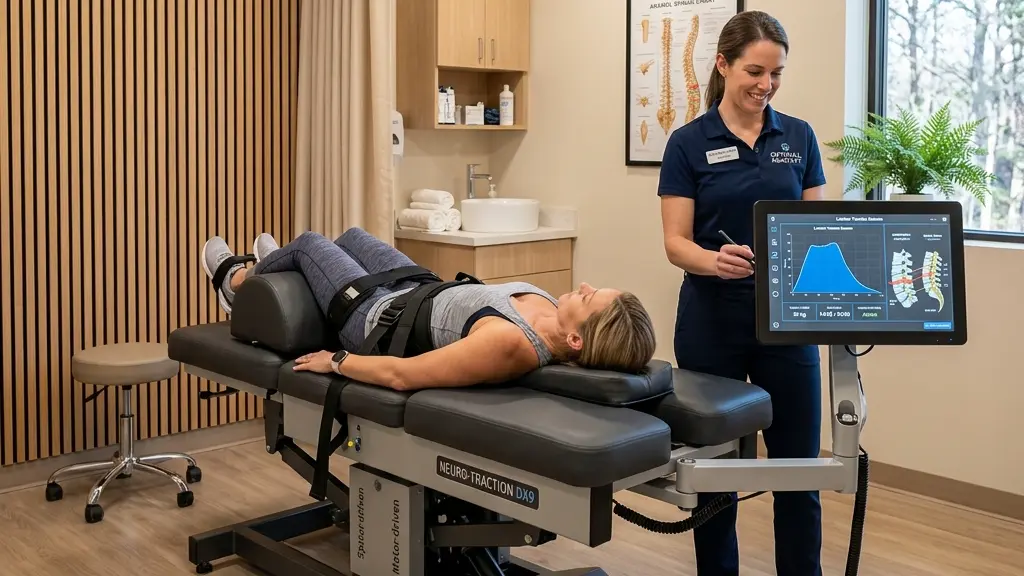
Featured image: Clinical technology showcase displaying a high-tech computerized spinal decompression table with advanced digital tracking in a modern physical therapy clinic. Created for AyurPhysio editorial use.
Medical Disclaimer
The information provided by AyurPhysio is for general educational and informational purposes only. It is not intended as a substitute for professional medical advice, diagnosis, or treatment. Always seek the advice of your physician or other qualified health providers with any questions you may have regarding a medical condition. Never disregard professional medical advice or delay in seeking it because of something you have read on this website.
Trending Guides
Luka Modrić's Daily Routine: Low-Impact Resistance Training and Midfield Longevity
4 min readHarry Kane's Daily Routine: Hamstring Preservation and Anti-Inflammatory Nutrition
4 min readKarim Benzema's Daily Routine: Cupping Therapy (Hijama) and HIIT Conditioning
4 min readNeymar Jr.'s Daily Routine: Joint Stabilization and Hyperbaric Oxygen Therapy
4 min readMohamed Salah's Daily Routine: Early Morning Conditioning and Hyperbaric Recovery
4 min readWeekly Wellness
Don't miss the next guide
Get holistic health tips and new guides delivered to your inbox.
Related Healing Guides
View All Guides →
Clinical Audit: The Best Ergonomic Balance Chairs for Core Stabilization and Back Pain (2026 Ratings)
Biomechanical Review: The Best Resistance Bands for Rotator Cuff and Shoulder Strength (2026 Ratings)