"A fracture of the hamate hook is a silent killer of grip strength in batter sports. Rather than attempting to repair a bone segment with poor perfusion, the clinical standard is simple: excise the hook, protect the ulnar nerve, and progressively rebuild forearm and grip mechanics."
In mid-May 2026, the Minnesota Twins announced a serious blow to their lineup: starting catcher Ryan Jeffers would undergo surgery to address a hamate fracture in his left wrist. The injury, commonly sustained during swings or from high-velocity impact, typically leaves catchers and power hitters sidelined for several weeks. While a tiny carpal bone might seem minor, the hamate hook plays an indispensable role in transmitting grip forces and protecting vital nerves in the wrist.
The standard treatment for a fracture of the hook of the hamate is surgical excision rather than fixation. In this clinical evaluation, we will explore the anatomy of the carpal bones, analyze the biomechanics of how bat handles fracture the hamate, discuss the surgical excision process, and detail the four-phase physical therapy rehabilitation protocol required to restore elite grip strength.
The Anatomy of the Wrist: The Hook of the Hamate
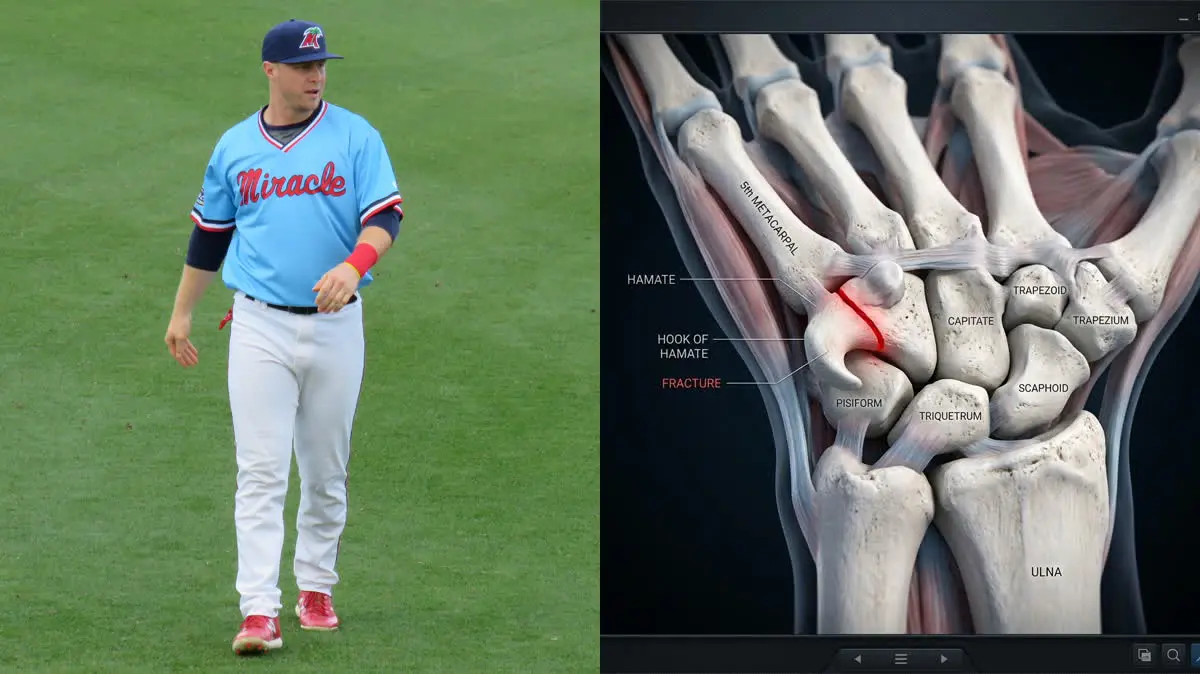
The wrist is a complex structure composed of eight carpal bones arranged in two rows. The hamate is a wedge-shaped bone situated on the medial (ulnar) side of the distal carpal row. It is distinguished by a prominent, hook-like projection—the hook of the hamate (hamulus)—that projects palmarward.
The hook of the hamate serves several critical mechanical functions:
- Ligamentous Anchor: It acts as an insertion point for the transverse carpal ligament (flexor retinaculum), which forms the roof of the carpal tunnel, as well as the pisohamate ligament.
- Muscular Anchor: It provides attachment sites for the flexor digiti minimi and opponens digiti minimi, which govern little finger movement.
- Pulley System: It acts as a mechanical pulley for the deep flexor tendons of the ring and little fingers, optimizing the angle of pull and maximizing grip strength.
Crucially, the hook of the hamate forms the radial border of Guyon's canal, a fibro-osseous tunnel through which the ulnar nerve and ulnar artery pass. A fracture or displacement of the hook can cause direct pressure on the ulnar nerve, leading to pain, numbness, and motor deficits in the ring and little fingers.
- Hamate fractures represent approximately 2% to 4% of all carpal fractures, but are highly prevalent in baseball players, golfers, and tennis players.
- Conservative treatment (casting) has a non-union rate of up to 50% due to the poor vascularity at the base of the hamate hook.
- Surgical excision of the fractured hook yields a successful return-to-play rate of over 95% in professional athletes.
- Average return-to-play time for baseball players following hook excision is 4 to 8 weeks, with grip strength fully recovering in most cases.
Biomechanical Triggers: The Bat Handle Impact
Why are baseball catchers and hitters so susceptible to hamate fractures? The answer lies in the interaction between the player's grip and the knob of the bat. When swinging a bat, the knob rests directly against the hypothenar eminence (the fleshy base of the pinky side of the palm), which lies directly over the hook of the hamate.
If a player makes contact with a pitch off the end of the bat or executes a checked swing, the bat undergoes a rapid deceleration. This deceleration creates a massive torque, transferring a direct, blunt impact force from the bat knob into the hook of the hamate. Over time, repetitive impacts from thousands of swings create micro-fractures, which can culminate in an acute fracture under a single forceful swing. In catchers, receiving high-velocity pitches can also transfer repetitive impact forces through the glove directly onto the hamate.
"When a hamate hook fracture is diagnosed, we almost always recommend surgical excision rather than attempting to let the bone heal. The blood supply to the hook enters from its tip and flows to the base; a fracture at the base cuts off this supply, leading to avascular necrosis and non-union. Excising the fragment relieves ulnar nerve irritation and avoids tendon rupture, allowing the athlete to begin early active range of motion and return to play much faster."
The Catcher's Post-Surgical Hamate Excision Rehabilitation Protocol
Following surgical excision of the hamate hook, physical therapy focuses on scar tissue management, ulnar nerve mobilization, and progressive grip and forearm strengthening.
- 1Phase 1: Wound Healing and Desensitization (Weeks 1–2)The wrist is kept in a soft dressing or removable splint to protect the incision. Gentle active finger flexion and extension are initiated immediately to prevent tendon adhesions. Desensitization techniques (tapping, massaging, and texture exposure over the scar site) are performed daily to reduce hypersensitivity from the ulnar nerve branch.
- 2Phase 2: Range of Motion and Light Loading (Weeks 3–4)The splint is discontinued. Active and active-assisted wrist range of motion exercises (flexion, extension, radial/ulnar deviation) are performed to restore joint mobility. Light putty exercises, gentle grip squeezing, and ulnar nerve flossing are introduced. Direct pressure on the palm is strictly avoided.
- 3Phase 3: Progressive Grip and Forearm Strengthening (Weeks 5–6)Once range of motion is near-normal and the surgical site is non-tender, aggressive grip strengthening begins. Hand gripper exercises, finger resistance bands, wrist curls, and forearm pronation/supination drills are performed. The athlete begins light batting drills with a padded batting glove or modified bat knob.
- 4Phase 4: Sport-Specific Catcher Drills and Return to Play (Weeks 7–8+)Rehab transitions to receiving pitches, blocking drills, and throwing programs. Full-velocity batting practice is introduced. The athlete is cleared for competitive play once grip strength matches the uninjured hand, ulnar nerve symptoms are completely absent, and they can receive pitches without pain.
Wrist Mechanics and the Upper Extremity
Wrist stability and grip strength depend heavily on the alignment and function of the entire arm. To understand how lateral elbow issues affect hand and forearm function, read our guide on eccentric strengthening for tennis elbow and the Tyler Twist. If you are experiencing nerve symptoms radiating down the arm, study our analysis of cervical radiculopathy and traction devices. Additionally, for a comprehensive overview of how athletes recover from structural hand and ankle traumas, check our analysis of Alexander Rossi's Indy 500 crash recovery.
Ryan Jeffers' recovery from a hamate fracture will require a careful balance of resting the surgical site and aggressively restoring wrist mobility and grip strength. By following a structured post-excision protocol, managing scar sensitivity, and progressive loading, he can return to the Twins' starting catcher spot with his throwing and catching abilities fully intact. While a hamate fracture is a painful setback, modern surgical excision and physical therapy ensure a reliable and full recovery for elite baseball catchers.
Featured image: Clinical side-by-side composite showing Ryan Jeffers in action (left) and an anatomical 3D rendering of a human hand showing a fracture at the base of the hamate bone's hook (right). Created for AyurPhysio editorial use. Wikimedia Commons attribution: Ryan Jeffers image by Windbag licensed under CC BY-SA 4.0. Modified by cropping and compositing.
Dr. Dhanushika Dilshani
Expert Ayurvedic Wellness Doctor. Specialized in modern holistic wellness, optimizing dermal resilience, cosmetic radiance, and systematic diagnosis driven by traditional and evidence-based medical logic.
Medical Disclaimer
The information provided by AyurPhysio is for general educational and informational purposes only. It is not intended as a substitute for professional medical advice, diagnosis, or treatment. Always seek the advice of your physician or other qualified health providers with any questions you may have regarding a medical condition. Never disregard professional medical advice or delay in seeking it because of something you have read on this website.
Trending Guides
Luka Modrić's Daily Routine: Low-Impact Resistance Training and Midfield Longevity
4 min readHarry Kane's Daily Routine: Hamstring Preservation and Anti-Inflammatory Nutrition
4 min readKarim Benzema's Daily Routine: Cupping Therapy (Hijama) and HIIT Conditioning
4 min readNeymar Jr.'s Daily Routine: Joint Stabilization and Hyperbaric Oxygen Therapy
4 min readMohamed Salah's Daily Routine: Early Morning Conditioning and Hyperbaric Recovery
4 min readWeekly Wellness
Don't miss the next guide
Get holistic health tips and new guides delivered to your inbox.
Related Healing Guides
View All Guides →
Luka Modrić's Daily Routine: Low-Impact Resistance Training and Midfield Longevity
Harry Kane's Daily Routine: Hamstring Preservation and Anti-Inflammatory Nutrition