"When a race car impacts a wall at 220mph, the forces absorbed by the driver's lower extremities are astronomical. Securing a syndesmotic ankle injury with a surgical tightrope is the only biomechanical pathway that allows a driver to safely press a 100-pound brake pedal just six days later."
On May 18, 2026, during practice for the 110th running of the Indianapolis 500, American INDYCAR driver and former Indy 500 champion Alexander Rossi suffered a violent crash at Turn 4, hitting the SAFER barrier at an estimated 220 miles per hour. The high-energy impact required emergency surgery to stabilize an ankle syndesmosis injury and a fractured finger. Remarkably, Rossi and his team announced their intention to have him in the car for the race in just six days.
To the average sports fan, returning to a 230mph race car six days after orthopedic surgery sounds like science fiction. But in modern motorsport, where elite engineering meets cutting-edge trauma medicine, such timelines are increasingly common. In this clinical reconstruction, we will analyze the biomechanics of Rossi's ankle injury, look at how the surgical tightrope device enables rapid weight-bearing, and evaluate the intense physical therapy protocol required to clear a driver for competition.
The Biomechanics of the Crash: High-Energy Deceleration
When an INDYCAR crashes, the driver's feet are positioned on the pedals within a carbon fiber tub. During a frontal or angled impact, the car decelerates from 220mph to a stop in milliseconds. Although the SAFER (Steel and Foam Energy Reduction) barrier absorbs a massive portion of the energy, the driver's legs are subjected to intense G-forces.
Because the driver's feet are braced against the pedals, the force of the impact travels straight up the leg. If the foot is forced into extreme external rotation and dorsiflexion while pressing the pedal, the talus (ankle bone) rotates outward, forcing the tibia and fibula bones apart. This separates the distal tibiofemoral joint, tearing the high ankle ligaments—a condition known as an ankle syndesmosis injury or high ankle sprain.
- Frontal INDYCAR impacts can subject the driver's lower extremities to loads exceeding 10 to 15 times their body weight.
- Pressing an INDYCAR brake pedal requires a driver to exert up to 130 pounds of force in a single, explosive motion.
- A syndesmosis injury separates the tibia and fibula, reducing the ankle joint's load-bearing capacity by up to 50%.
- Surgical stabilization using a flexible TightRope button system provides immediate mechanical fixation, allowing weight-bearing within 24 to 48 hours compared to 6 weeks for traditional screws.
Surgical Innovation: The Ankle TightRope Fixation
Traditionally, severe syndesmosis injuries were treated with rigid metal screws that locked the tibia and fibula together. While effective, syndesmotic screws are rigid; they prevent the natural micro-motion of the ankle joint. If the patient bears weight too early, the screws can bend or snap. Consequently, patients are kept non-weight-bearing in a cast for six weeks, leading to massive muscle atrophy and joint stiffness.
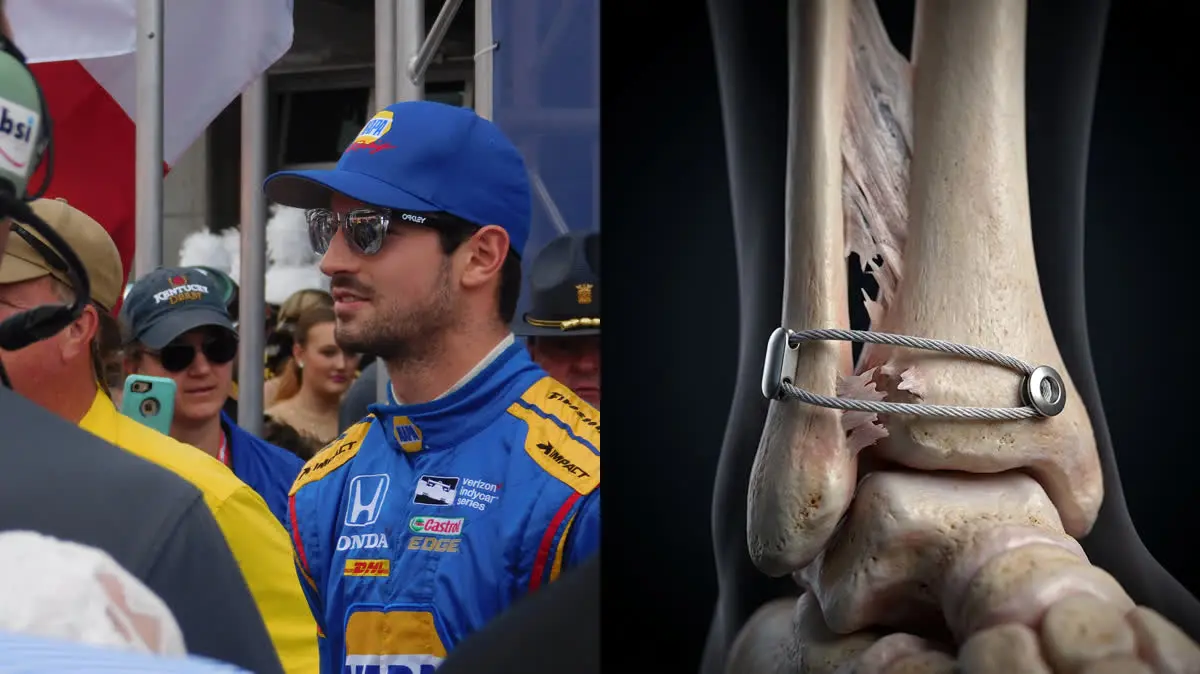
For an athlete like Rossi, surgeons utilize the Arthrex TightRope system. Instead of rigid screws, the TightRope uses a high-strength fiberwire loop secured by two metal buttons on the outer walls of the tibia and fibula. This acts like a heavy-duty bungeecord, holding the bones in perfect alignment while allowing the natural micro-rotation and expansion of the ankle joint during movement. Because the fixation is flexible and strong, it cannot snap under load. This allows the athlete to begin immediate weight-bearing and aggressive physical therapy within 24 hours of surgery.
"For a driver returning to the cockpit six days after surgery, the primary limitation is pain control and cockpit ingress. An INDYCAR driver does not need to run or jump, but they must be able to exert 100+ pounds of force on the brake pedal and quickly exit the car in an emergency. With a TightRope fixation, the structural integrity of the ankle is mechanically secure. Our rehab focuses on aggressive swelling management (using intermittent compression pumps), localized nerve blocks for pain, and building a custom carbon fiber brace that fits inside the racing boot to prevent lateral ankle rotation."
The 6-Day Accelerated Motorsport Recovery Protocol
To prepare Rossi for the physical demands of the Indy 500, a specialized sports medicine team executed an intensive, round-the-clock rehabilitation protocol.
- 1Day 1–2: Swelling Management and Early Active Range of MotionFollowing surgery, the ankle is wrapped in a cryotherapy compression boot. Active-assisted dorsiflexion and plantarflexion are initiated immediately to keep the joint capsule mobile. Laser therapy and lymphatic drainage massage stimulate local circulation, accelerating the removal of inflammatory fluid from the joint.
- 2Day 3–4: Progressive Weight-Bearing and Pedal Press SimulationWeight-bearing is initiated in a walking boot, transitioning quickly to normal footwear. Using a leg press machine, we simulate the force profile of the INDYCAR brake pedal. The driver performs isometric pedal presses, gradually building from 30 pounds of force up to the target 120 pounds, verifying that the ankle can handle the load without pain.
- 3Day 5: Cockpit Ingress and Custom Carbon Boot FittingThe driver sits in the cockpit of the race car. We test their ability to quickly exit the car (ingress/egress test), which is a mandatory safety requirement by the sanctioning body. A custom carbon-kevlar orthotic is molded to the lateral side of the ankle to lock the joint against lateral shear forces while allowing essential flexion for pedal work.
- 4Day 6: Final Medical Clearance and Qualification TestingRossi undergoes final clinical testing. Ankle stability, pedal press force, and egress speed are assessed. Once cleared by the INDYCAR medical director, the driver takes the track for practice, using localized padding inside the boot to protect the surgical incisions from vibration.
Vascular and Ankle Recovery: A Comparative Perspective
Ankle stability requires a balanced kinetic chain and healthy systemic tissue recovery. For a comparative case study on how ankle syndesmosis injuries are managed in other high-performance settings, read our detailed analysis of Tom Cruise's ankle fracture and syndesmosis recovery. To understand how high-energy impacts affect the pelvis and lower body alignment, see our guide on stabilizing the SI joint and pelvic ring. Furthermore, protecting the tendon attachments is key to preventing secondary compensations; study our recovery protocol for achilles tendinitis rehabilitation.
Alexander Rossi's drive to compete in the Indy 500 six days after ankle surgery is a testament to the incredible advances in modern orthopedics and physical therapy. While the risk of racing is always present, the mechanical security of the TightRope fixation combined with an aggressive, targeted physical therapy protocol makes this rapid return a biomechanical reality. As the green flag drops at Indianapolis, Rossi's focus will be on the track, backed by a medical team that has engineered his body to perform under the extreme pressures of the world's most famous race.
Featured image: Clinical side-by-side composite showing Alexander Rossi (left) and an anatomical 3D rendering of the ankle syndesmosis stabilized with a surgical TightRope suture button fixation device (right). Created for AyurPhysio editorial use. Wikimedia Commons attribution: Alexander Rossi image from 2017 licensed under CC BY-SA 2.0.
Dr. Dhanushika Dilshani
Expert Ayurvedic Wellness Doctor. Specialized in modern holistic wellness, optimizing dermal resilience, cosmetic radiance, and systematic diagnosis driven by traditional and evidence-based medical logic.
Medical Disclaimer
The information provided by AyurPhysio is for general educational and informational purposes only. It is not intended as a substitute for professional medical advice, diagnosis, or treatment. Always seek the advice of your physician or other qualified health providers with any questions you may have regarding a medical condition. Never disregard professional medical advice or delay in seeking it because of something you have read on this website.
Trending Guides
Luka Modrić's Daily Routine: Low-Impact Resistance Training and Midfield Longevity
4 min readHarry Kane's Daily Routine: Hamstring Preservation and Anti-Inflammatory Nutrition
4 min readKarim Benzema's Daily Routine: Cupping Therapy (Hijama) and HIIT Conditioning
4 min readNeymar Jr.'s Daily Routine: Joint Stabilization and Hyperbaric Oxygen Therapy
4 min readMohamed Salah's Daily Routine: Early Morning Conditioning and Hyperbaric Recovery
4 min readWeekly Wellness
Don't miss the next guide
Get holistic health tips and new guides delivered to your inbox.
Related Healing Guides
View All Guides →
Luka Modrić's Daily Routine: Low-Impact Resistance Training and Midfield Longevity
Harry Kane's Daily Routine: Hamstring Preservation and Anti-Inflammatory Nutrition