"A recurrent muscle strain is like a cheap tire patch. If you don't buff down the surrounding rubber and vulcanize the seal, the patch will peel away under high highway speeds."
The news that Barcelona and Spain midfielder Pedri suffered another hamstring injury during the 2026 World Cup has sparked debate among sports medicine experts. Pedri's history of recurrent muscle strains suggests a deeper issue beyond simple tissue tearing. For a creative midfielder reliant on rapid changes of direction, acceleration, and constant running, breaking this injury cycle requires a comprehensive rehabilitation strategy.
Standard recovery programs often focus too much on resting the injured muscle, which can lead to weak, stiff scar tissue. When a muscle is repeatedly injured, it loses its ability to absorb load during high-speed movements. Without addressing pelvic control and nerve mobility, the player remains vulnerable to reinjury upon returning to competitive match play.
To break this cycle and ensure a safe, lasting return to performance, rehabilitation must target the entire movement chain. By addressing the factors behind recurrent strains and applying targeted pedri hamstring recovery protocols, we can restore tissue resilience. This guide analyzes the mechanics of Pedri's injury and details the clinical stages of muscle reconditioning.
The Biomechanical Mechanics of Recurrent Hamstring Strains
A recurrent hamstring strain is rarely an isolated muscle problem. When a muscle heals, it forms scar tissue that is less elastic and less organized than the original muscle fibers. This tissue creates a mechanical weak point that is vulnerable to tearing under high tension.
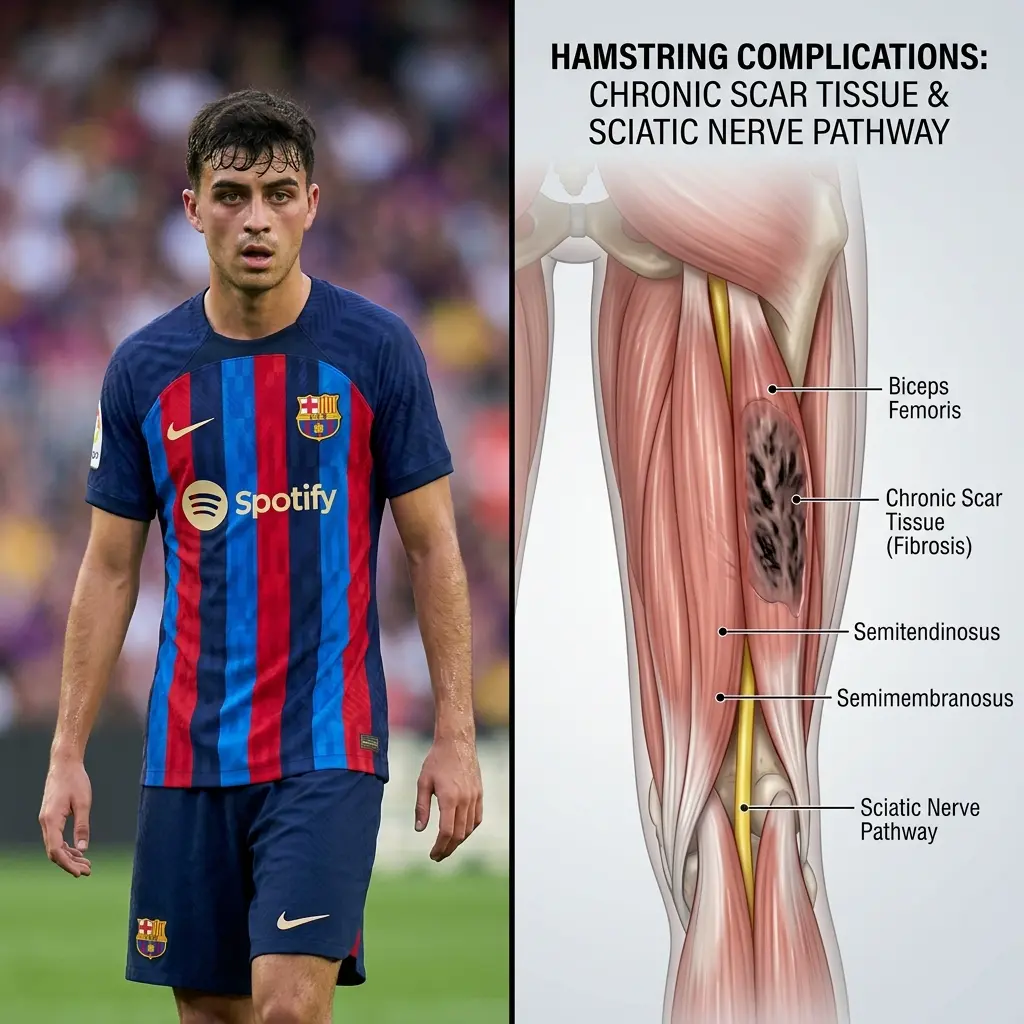
Furthermore, poor pelvic stability can place constant tension on the hamstrings. If the core and gluteal muscles fail to control the pelvis, it tilts forward (anterior pelvic tilt). This position stretches the hamstrings, limiting their ability to absorb energy during sprinting. Additionally, entrapment of the sciatic nerve in surrounding tissues can create nerve flossing sciatic tension, causing muscle spasms and mimicking hamstring tightness.
Clinical statistics show that soccer players with a history of hamstring strains are up to 3.6 times more likely to sustain a recurrence. Furthermore, up to 50% of chronic hamstring cases present with some degree of neural tension, which limits hamstring length and speed. Restoring tissue slide and pelvic control is crucial for long-term health.
Clinical metrics tracking recurrent muscle strains and tissue mobility parameters:
- 1Recurrence LikelihoodAthletes with a previous hamstring injury have a 3.6 times higher risk of reinjury without specific eccentric conditioning.
- 2Neural Tension InfluenceUp to 50% of chronic hamstring issues involve sciatic nerve irritation or tissue adhesions.
- 3Lumbopelvic Stability ImpactRestoring deep core control reduces anterior pelvic tilt and lowers hamstring peak tension by up to 20%.
- 4Fascicle Length TargetIncreasing muscle fascicle length through eccentric loading reduces hamstring injury rates by over 50%.
The Clinical Opinion: Look Beyond the Tear
"When treating a recurrent hamstring strain, the primary error is only treating the site of pain. My clinical opinion is that we must evaluate pelvic control and nerve mobility. If the sciatic nerve cannot glide freely through the pelvis and thigh, it triggers protective muscle guarding, causing the hamstring to contract defensively. We must address this neural tension and build hip stability to break the cycle of recurring injury."
Multi-Stage Hamstring Reconditioning Protocol
Reconditioning a chronically injured hamstring requires a step-by-step approach that restores nerve mobility, tissue slide, and dynamic strength.
Phase 1: Neural Mobilization and Scar Tissue Management
In the first 2 weeks, focus on reducing neural tension and promoting healthy scar tissue alignment. Perform gentle sciatic nerve flossing exercises (extending the knee while pointing the toes up, then bending the knee while pointing the toes down). Introduce soft-tissue mobilization to improve muscle slide, and perform pain-free isometric holds to stimulate the tissue. Avoid aggressive hamstring stretching to protect the healing fibers.
Phase 2: Eccentric Loading and Hip Stabilization
Once tissue mobility improves (weeks 3-6), begin loading the hamstring through its full range of motion. Perform single-leg Romanian deadlifts, slider curls, and glute-ham raises, focusing on control. Incorporate gluteus medius and core exercises (side planks, clam shells, and pallof presses) to stabilize the pelvis and reduce anterior tilt. Perform 3 sets of 8-12 repetitions, 3 times weekly.
Phase 3: High-Speed Running and Acceleration Mechanics
After week 6, progress to high-speed movement and sport-specific drills. Begin light acceleration runs, focusing on proper upright posture. Introduce high-velocity eccentrics, such as single-leg drop catches and progressive deceleration runs. Incorporate Nordic hamstring curls (3 sets of 5 repetitions, twice weekly) to build eccentric force capacity and protect the muscle during rapid changes of direction.
Restoring the Kinetic Chain
Successful rehabilitation requires addressing the entire movement chain. Weakness in the deep core and hip stabilizers often leads to pelvic misalignment, which places excessive load on the hamstrings, so building pelvic stability is key to preventing future injuries.
For more recovery guidelines, read our detailed guide on hamstring strain rehabilitation and view our breakdown of sciatic nerve flossing techniques. To understand the role of pelvic control, read our analysis of gluteus medius stabilization and preventing injuries through core stability.
Featured image attribution: Left panel photo of Pedri adapted from public domain sports archives. Right panel displays a clinical 3D lower extremity model showing sciatic nerve pathway and hamstring scar tissue. Prepared for AyurPhysio clinical reference.
Dr. Dhanushika Dilshani
Expert Ayurvedic Wellness Doctor. Specialized in modern holistic wellness, optimizing dermal resilience, cosmetic radiance, and systematic diagnosis driven by traditional and evidence-based medical logic.
Medical Disclaimer
The information provided by AyurPhysio is for general educational and informational purposes only. It is not intended as a substitute for professional medical advice, diagnosis, or treatment. Always seek the advice of your physician or other qualified health providers with any questions you may have regarding a medical condition. Never disregard professional medical advice or delay in seeking it because of something you have read on this website.
Trending Guides
Luka Modrić's Daily Routine: Low-Impact Resistance Training and Midfield Longevity
4 min readHarry Kane's Daily Routine: Hamstring Preservation and Anti-Inflammatory Nutrition
4 min readKarim Benzema's Daily Routine: Cupping Therapy (Hijama) and HIIT Conditioning
4 min readNeymar Jr.'s Daily Routine: Joint Stabilization and Hyperbaric Oxygen Therapy
4 min readMohamed Salah's Daily Routine: Early Morning Conditioning and Hyperbaric Recovery
4 min readWeekly Wellness
Don't miss the next guide
Get holistic health tips and new guides delivered to your inbox.
Related Healing Guides
View All Guides →
Luka Modrić's Daily Routine: Low-Impact Resistance Training and Midfield Longevity
Harry Kane's Daily Routine: Hamstring Preservation and Anti-Inflammatory Nutrition