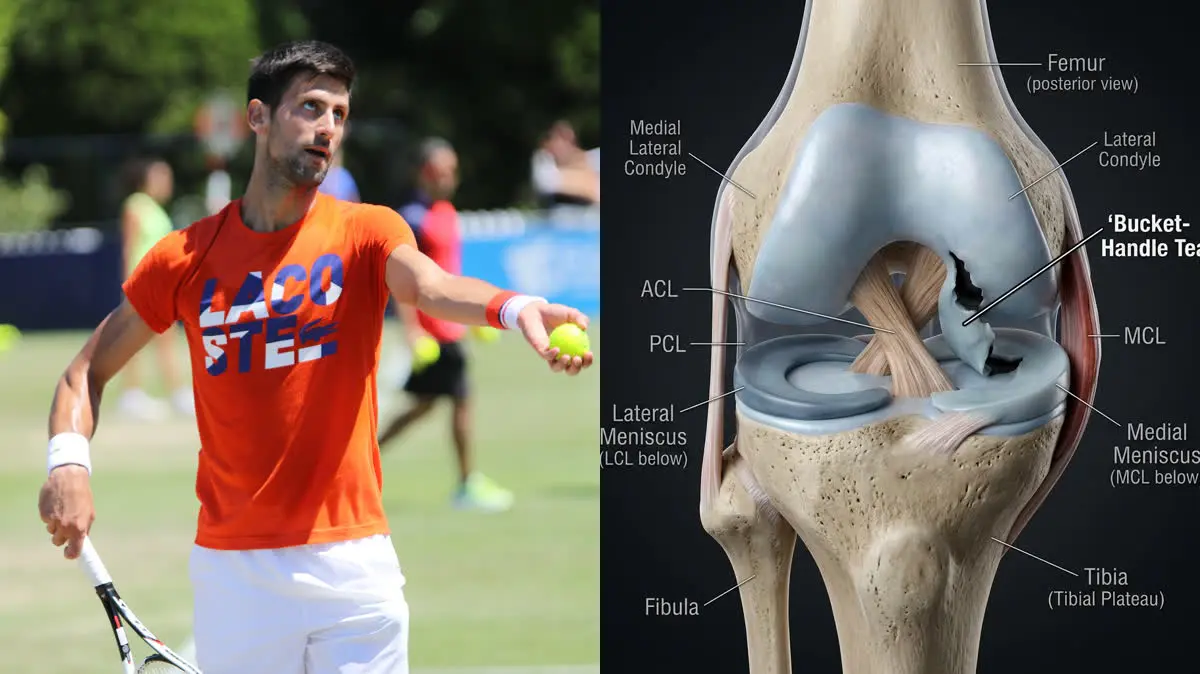
"When an elite tennis player slides and twists on clay, the rotational shear forces absorbed by the knee joint are massive. A medial meniscus tear is a mechanical failure of the knee's primary shock absorber. Rebuilding joint stability post-arthroscopy requires restoring quadriceps force transfer and preventing long-term cartilage degeneration."
During the French Open tennis tournament, legendary champion Novak Djokovic suffered a sharp, debilitating injury to his right knee during a grueling match. Despite completing the match through sheer determination, subsequent scans revealed a tear of the medial meniscus. Djokovic was forced to withdraw from the tournament and immediately underwent arthroscopic surgery, triggering a high-stakes rehabilitation race to recover in time for Wimbledon and the Summer Olympics.
The meniscus is a vital structural component of the knee joint. In professional sports, a meniscus tear is a critical crossroads where athletes must balance immediate return-to-play goals with the long-term preservation of their joint cartilage. In this clinical biomechanical analysis, we will examine the anatomy of the meniscus, dissect the forces that trigger twisting knee injuries, compare surgical debridement versus repair, and detail the post-operative rehabilitation protocol required for elite athletes.
The Anatomy of the Meniscus: The Knee's Primary Shock Absorber
The knee joint (tibiofemoral joint) is a modified hinge joint that bears the weight of the entire body. Located between the condyles of the femur (thigh bone) and the plateau of the tibia (shin bone) are two crescent-shaped wedges of fibrocartilage: the medial meniscus and the lateral meniscus.
The menisci serve several critical mechanical functions:
- Force Distribution: They increase the contact surface area between the round femur and flat tibia by up to 300%, distributing load and protecting the articular cartilage from concentrated wear.
- Shock Absorption: They act as buffers, absorbing energy during high-impact activities like running, jumping, and landing.
- Joint Stability: Their concave shape helps deep the shallow tibial plateau, stabilizing the femur during movement.
- Proprioception: Nerve endings in the outer borders of the meniscus supply vital sensory feedback regarding joint position and motion.
The medial meniscus is larger and shaped like a semi-circle. It is firmly attached to the medial collateral ligament (MCL) and the joint capsule. Because it is less mobile than the circular lateral meniscus, the medial meniscus is much more vulnerable to shearing forces and is injured three times as frequently.
- Meniscus tears occur in approximately 60 out of 100,000 individuals annually, with a significantly higher prevalence in competitive cutting sports.
- A partial meniscectomy reduces the contact area of the knee joint by up to 50%, increasing localized peak pressure on the remaining cartilage by up to 200%.
- Following arthroscopic partial meniscectomy, elite athletes can return to play in 4 to 6 weeks, compared to 4 to 6 months for a complete meniscal repair.
- However, patients who undergo partial meniscectomy exhibit a 14-fold increase in the risk of developing knee osteoarthritis within 10 to 15 years.
Pathophysiology of Twisting Knee Injuries: How Clay Sliding Triggers a Tear
A meniscus tear is typically triggered by a combination of axial weight-bearing (compression) and rotational shear (twisting) forces. In tennis, this mechanical profile occurs during sliding, deceleration, or quick changes of direction on clay courts. If a player slides and their foot catches on the surface, the tibia is suddenly forced into external rotation while the knee is in a flexed, weight-bearing position.
This motion pinches the posterior horn of the medial meniscus between the femur and tibia, tearing the fibrocartilage fibers. The tear can present in various geometric patterns: radial, horizontal, longitudinal, or a complex bucket-handle tear, where a large inner portion of the meniscus splits and flips into the center of the joint, mechanically locking the knee and preventing extension.
"Djokovic chose a partial arthroscopic meniscectomy (debridement of the torn tissue) rather than a complete meniscal repair. The reason is biological: the inner two-thirds of the meniscus (the white-white zone) has no blood supply and cannot heal, while the outer one-third (the red-red zone) has a rich capillary network and can be sutured. Debriding the torn white zone allows for an accelerated return to play because there is no tissue that needs to knit together, but it sacrifices a portion of the shock absorber, putting the articular cartilage at risk of accelerated wear."
The Post-Operative Meniscus Rehabilitation Protocol
Following a partial meniscectomy, physical therapy focuses on rapidly restoring range of motion, resolving quadriceps inhibition, and re-educating the knee to handle tennis-specific impact.
- 1Phase 1: Mobilization and Quadriceps Activation (Days 1–7)The primary goals are to resolve post-surgical swelling and restore knee extension. Apply cryotherapy compression and perform active heel slides. Initiate early quadriceps recruitment using electrical muscle stimulation (EMS) and straight leg raises. The patient is allowed to bear weight as tolerated with crutches, transitioning to normal gait within 5 days.
- 2Phase 2: Closed-Chain Strength and Gait Normalization (Weeks 2–3)Introduce closed kinetic chain strengthening, such as leg presses, mini-squats (0-60 degrees), and step-ups. Integrate gluteal and hamstring strengthening to support the knee joint. Perform balance training on stable single-leg surfaces to restore basic ankle-knee proprioception. Progress stationary cycling to build endurance and joint nutrition.
- 3Phase 3: Dynamic Loading and Impact Progression (Week 4)Begin lateral shuffles, light jogging, and double-leg hopping on foam pads. Perform dynamic eccentric landing drills to train the quadriceps to absorb force, reducing the shock transmitted to the articular cartilage. Start tennis-specific shadow drills on a court, testing lateral sliding mechanics in a controlled environment.
- 4Phase 4: Return to Competition and Cartilage Preservation (Weeks 5+)Gradually reintegrate full tennis play, focusing on explosive pivots, acceleration, and sliding. To protect the articular cartilage from increased stress, the athlete must maintain a lifelong strength program targeting the quadriceps, hamstrings, and gluteal muscles. Periodic clinical reviews are essential to monitor the knee for signs of wear.
Synergy in Joint Preservation
Protecting the knee joint requires a balanced lower extremity kinetic chain, from the hip down to the foot. For a detailed guide comparing surgical options and conservative physical therapy, see our comprehensive review of meniscus tears and rehabilitation pathways. To understand how knee wear is managed through combined natural therapies and strength work, read our clinical guide on knee osteoarthritis, Janu Basti, and quadriceps strength. Additionally, to explore other ligament injuries affecting the knee, study our post-surgical milestones for ACL tear recovery.
Novak Djokovic's rapid recovery from a medial meniscus tear highlights the precision of modern arthroscopy and sports rehabilitation. By systematically restoring range of motion, rebuilding quadriceps force transfer, and following a structured joint preservation protocol, athletes can return to the court safely. Rebuilding from joint injuries requires patience, structural strength, and a long-term commitment to maintaining the muscular support that protects the knee's remaining shock absorbers.
Featured image: Clinical side-by-side composite showing Novak Djokovic (left) and an anatomical 3D rendering of the human knee joint showing a medial meniscus bucket-handle tear (right). Created for AyurPhysio editorial use. Wikimedia Commons attribution: Novak Djokovic image by Carine06 licensed under CC BY-SA 2.0. Modified by cropping and compositing.
Dr. Dhanushika Dilshani
Expert Ayurvedic Wellness Doctor. Specialized in modern holistic wellness, optimizing dermal resilience, cosmetic radiance, and systematic diagnosis driven by traditional and evidence-based medical logic.
Medical Disclaimer
The information provided by AyurPhysio is for general educational and informational purposes only. It is not intended as a substitute for professional medical advice, diagnosis, or treatment. Always seek the advice of your physician or other qualified health providers with any questions you may have regarding a medical condition. Never disregard professional medical advice or delay in seeking it because of something you have read on this website.
Trending Guides
Luka Modrić's Daily Routine: Low-Impact Resistance Training and Midfield Longevity
4 min readHarry Kane's Daily Routine: Hamstring Preservation and Anti-Inflammatory Nutrition
4 min readKarim Benzema's Daily Routine: Cupping Therapy (Hijama) and HIIT Conditioning
4 min readNeymar Jr.'s Daily Routine: Joint Stabilization and Hyperbaric Oxygen Therapy
4 min readMohamed Salah's Daily Routine: Early Morning Conditioning and Hyperbaric Recovery
4 min readWeekly Wellness
Don't miss the next guide
Get holistic health tips and new guides delivered to your inbox.
Related Healing Guides
View All Guides →
Luka Modrić's Daily Routine: Low-Impact Resistance Training and Midfield Longevity
Harry Kane's Daily Routine: Hamstring Preservation and Anti-Inflammatory Nutrition