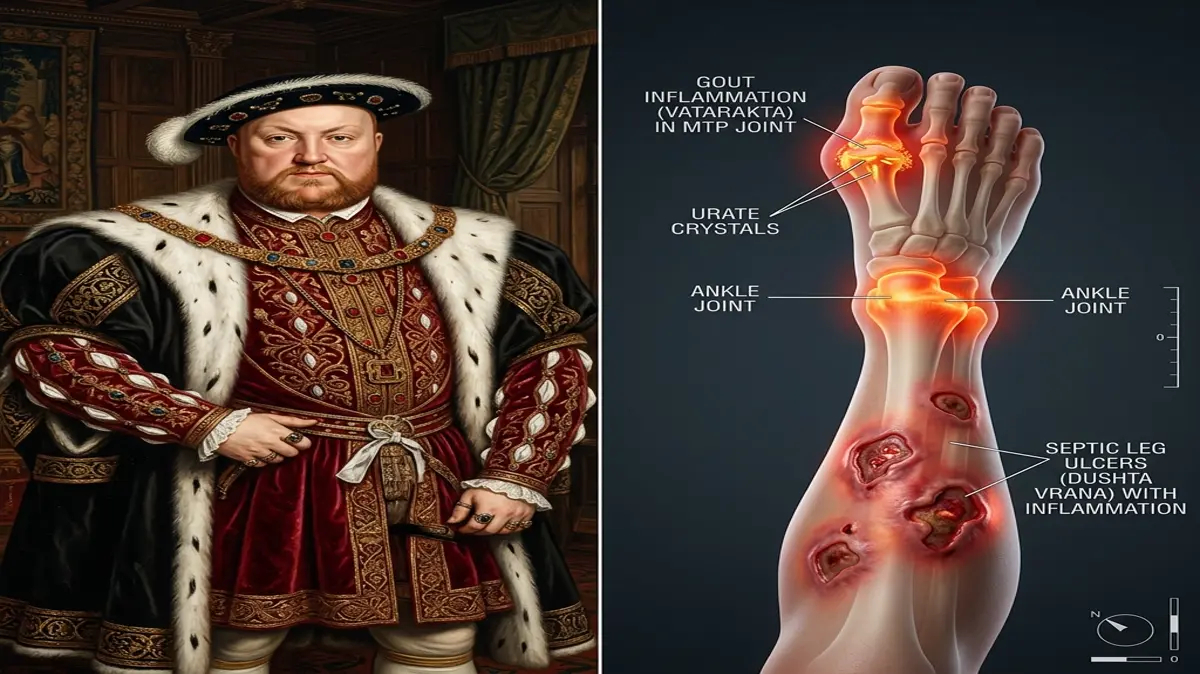
"When the blood is heated by rich meats and heavy wines, and the body becomes stagnant, Vata dosha blocks the joints like dry leaves clogging a stream, turning vital humors into agonizing heat and non-healing wounds."
King Henry VIII, one of England's most famous monarchs, is remembered not only for his historic reign but also for his dramatic physical transformation. In his youth, he was a tall, athletic, and active prince. However, in his later years, he suffered from severe obesity, painful gout, and non-healing leg wounds that eventually led to his metabolic collapse. From a clinical Ayurvedic perspective, this decline represents a classic case of fat tissue congestion and severe blood heating.
Standard historical accounts often attribute his illnesses to separate, unrelated medical conditions. However, traditional Ayurvedic medicine views these symptoms as connected manifestations of the same underlying metabolic imbalances. By analyzing his lifestyle through this holistic lens, we can understand how digestive sluggishness and toxic accumulation led to his systemic decline.
To understand the King's medical struggles, we must analyze the connection between his rich diet and his physical symptoms. By applying traditional principles to his historical profile, we can outline a complete king henry viii health restoration protocol. This forensic study explores tissue congestion and details the Ayurvedic methods to restore metabolic balance.
The Pathology of Vatarakta and Royal Gout
In traditional Ayurveda, gout is classified as Vatarakta, which translates to Vata-vitiated blood. This condition occurs when an individual consumes a diet high in rich, salty, sour, and heavy foods paired with a sedentary lifestyle. These habits vitiate the blood humor (Rakta Dhatu) and increase heat (Pitta) within the circulatory system.
As the King became less active due to leg injuries, the cold, dry qualities of Vata dosha accumulated in his lower limbs. The vitiated Vata blocked the passages of the heated blood, causing the metabolic waste to settle in the small joints of the feet. This blockage resulted in the sudden, agonizing pain, swelling, and redness characteristic of royal gout.
Furthermore, Vatarakta is inherently progressive, moving from the extremities to the larger joints if the blood is not purified. The heavy consumption of red meat, beer, and sweet wines fanned this internal heat, preventing his body from clearing the metabolic waste. The joints became congested with inflammatory toxins, limiting his mobility.
Clinical indications of severe Vatarakta and fat tissue accumulation:
- 1Tissue ProfileRapid expansion of Meda Dhatu (fat tissue) blocks the circulatory channels, reducing overall tissue metabolism.
- 2Toxic Load (Ama)A rich, heavy diet impairs the digestive fire (Agni), leading to systemic toxic waste accumulation.
- 3Joint InflammationVata dosha blocks the heated Rakta Dhatu, fanning joint pain and swelling (Vatarakta).
- 4Ulcer ClassificationChronic, non-healing wounds are diagnosed as Dushta Vrana, indicating high local heat and blood impurity.
The Clinical Opinion: Meda Dhatu Congestion and Leg Ulcers
"King Henry VIII's chronic leg ulcers reflect a severe case of Dushta Vrana, caused by stagnant fat tissue (Meda Dhatu) and heated blood. In my clinical opinion, treating these non-healing wounds requires purifying the blood and cooling the internal heat rather than simple local dressings. We must use bitter, blood-purifying herbs and cooling herbal pastes to clear local toxins and promote tissue repair."
The King's rapid weight gain led to an excess of Meda Dhatu (fat tissue), which congested the body's channels of circulation (Srotas). This congestion restricted the flow of nutrients to the skin and muscle tissues of the lower legs. When he sustained minor leg injuries during jousting, the tissues lacked the vitality to heal, leading to chronic ulcers.
In Ayurveda, these septic wounds are known as Dushta Vrana, driven by high local Pitta and blood impurity. The stagnant fat tissue acted as a reservoir for toxic waste, feeding the local inflammation and preventing healthy skin closure. To heal these wounds, the patient requires blood-purifying therapies to cool the systemic heat and clear the local stagnation.
Ayurvedic Restoration Protocol for Royal Metabolic Collapse
Restoring balance to a patient with severe tissue congestion and gout requires a cooling, purifying protocol that clears fat tissue blockage and calms the heated blood.
Phase 1: Blood Purification and Cooling Herbal Lepas
The early phase focuses on cooling the inflamed blood and clearing local toxins from the wounds. The patient takes bitter, blood-purifying herbs such as Neem, Manjistha, and Guduchi daily to clear systemic heat. These cooling herbs help filter the blood and reduce joint pain.
Cooling herbal pastes, or Lepas, made from sandalwood and turmeric are applied directly to the leg wounds and swollen joints. These natural pastes reduce local heat, soothe the skin, and prevent the spread of infection. The wounds are washed with warm neem decoction to promote antiseptic cleansing.
The patient follows a cooling, light diet, avoiding red meat, alcohol, and fermented foods. Sweet fruits, green vegetables, and bitter melons are introduced to cool the digestive fire. Drinking warm water infused with coriander seeds helps flush metabolic waste through the kidneys.
Phase 2: Clearing Fat Stagnation and Digestive Fire Reset
Once the acute joint pain has settled, we focus on clearing the fat tissue congestion. The patient takes Guggulu formulations to scrape excess fat (Meda Dhatu) from the circulatory channels. Guggulu helps break down stubborn tissue blockages and supports joint mobility.
The irregular digestive fire (Vishama Agni) is stabilized using mild spices such as cumin and fennel. Stabilizing digestion prevents the formation of new toxic waste (Ama). Ghee is used in small amounts to lubricate the digestive tract without increasing fat accumulation.
Gentle daily movement, such as walking in cool evening air, is introduced to stimulate tissue metabolism. The patient avoids strenuous activity to protect the healing leg tissues. Regular sleep patterns are established to support the body's natural tissue repair cycles.
Phase 3: Tissue Rejuvenation and Ojas Restoration
The final phase focuses on rebuilding the depleted skin and muscle tissues using rejuvenating herbs, known as Rasayanas. Amalaki is taken daily to support tissue repair and build physical vitality. Shatavari is introduced to cool the blood and nourish the nervous system.
Licorice root is utilized to soothe the mucosal linings and promote skin healing. These herbs are taken with warm water to ensure their cooling qualities reach the tissues. Rebuilding the vital essence (Ojas) helps prevent future metabolic decline.
Nourishing the Metabolic Pathway
An Ayurvedic approach to metabolic decline looks beyond individual symptoms to restore the body's natural tissue transformation. By purifying the heated blood and clearing fat tissue blockages, we help the body rebuild its natural defenses. This traditional healing path allows the patient to reclaim their physical strength and structural vitality.
For more detailed guidelines, read our guides on managing Vata imbalance, cooling Pitta inflammation, and toxic Ama and inflammation. Check our articles on Vatarakta gout protocols and historical profiles like Beethoven's toxicity reconstruction or Charles Darwin's digestive collapse. You can also read about Abraham Lincoln's Vata skeletal profile.
Featured image attribution: Left panel photo of King Henry VIII adapted from historical public domain portraits. Right panel displays an Ayurvedic anatomical illustration showing Rakta and Meda Dhatu channels in the lower limbs. Modified by cropping and compositing.
Dr. Dhanushika Dilshani
Expert Ayurvedic Wellness Doctor. Specialized in modern holistic wellness, optimizing dermal resilience, cosmetic radiance, and systematic diagnosis driven by traditional and evidence-based medical logic.
Medical Disclaimer
The information provided by AyurPhysio is for general educational and informational purposes only. It is not intended as a substitute for professional medical advice, diagnosis, or treatment. Always seek the advice of your physician or other qualified health providers with any questions you may have regarding a medical condition. Never disregard professional medical advice or delay in seeking it because of something you have read on this website.
Trending Guides
Luka Modrić's Daily Routine: Low-Impact Resistance Training and Midfield Longevity
4 min readHarry Kane's Daily Routine: Hamstring Preservation and Anti-Inflammatory Nutrition
4 min readKarim Benzema's Daily Routine: Cupping Therapy (Hijama) and HIIT Conditioning
4 min readNeymar Jr.'s Daily Routine: Joint Stabilization and Hyperbaric Oxygen Therapy
4 min readMohamed Salah's Daily Routine: Early Morning Conditioning and Hyperbaric Recovery
4 min readWeekly Wellness
Don't miss the next guide
Get holistic health tips and new guides delivered to your inbox.
Related Healing Guides
View All Guides →
Luka Modrić's Daily Routine: Low-Impact Resistance Training and Midfield Longevity
Harry Kane's Daily Routine: Hamstring Preservation and Anti-Inflammatory Nutrition