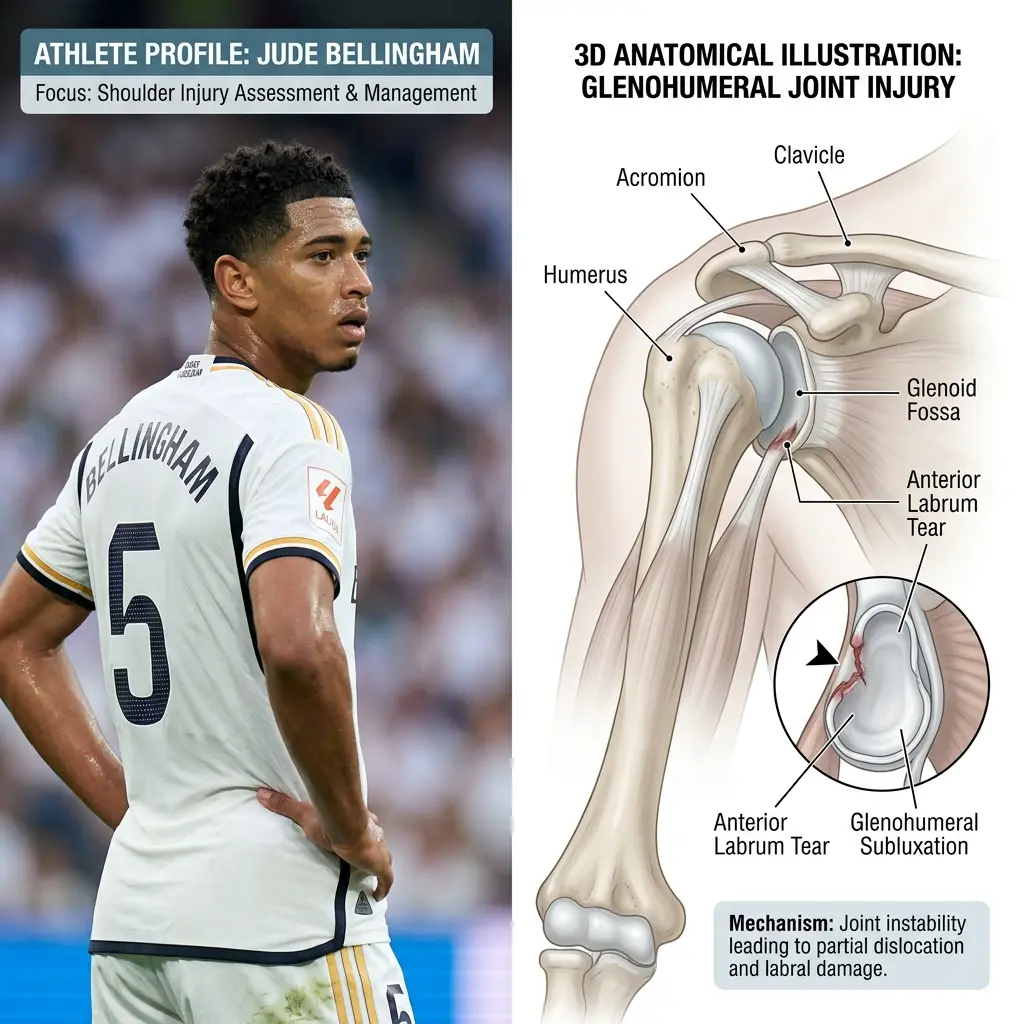
"The shoulder socket is like a golf tee, and the arm bone is the golf ball. If the lip of the tee is chipped, only the surrounding elastic bands can hold the ball centered during a physical clash."
The news that Real Madrid and England midfielder Jude Bellingham suffered a shoulder subluxation during a physical duel at the 2026 World Cup has sparked widespread concern. Bellingham's highly physical style of play—involving shielding the ball, contesting aerial duels, and absorbing heavy impact—makes shoulder stability a critical factor for his performance. Recovering from an instability event without losing competitive edge requires a sophisticated dynamic reconditioning approach.
Standard recovery protocols frequently over-rely on prolonged immobilization in a sling, which leads to rotator cuff atrophy and capsular stiffness. For an elite athlete, dynamic joint stabilization is the primary defense against recurrent subluxations. When the passive stabilizers (the labrum and ligaments) are stretched or torn, the surrounding musculature must be trained to respond with rapid reflexes.
To prevent chronic instability and ensure a safe return to play, rehabilitation must address the dynamic control of the glenohumeral joint. By applying targeted jude bellingham shoulder stabilization protocols, we can restore full joint confidence. This guide analyzes the biomechanics of shoulder subluxation and outlines a comprehensive clinical reconditioning pathway.
The Biomechanical Anatomy of Anterior Shoulder Subluxation
An anterior shoulder subluxation typically occurs when the arm is forced into an abducted and externally rotated position—such as when landing from a fall with the arm outstretched, or when contesting a ball with an opponent. In this vulnerable position, the humeral head is driven forward against the weak anterior aspect of the glenohumeral joint capsule.
The primary passive stabilizer of this region is the glenoid labrum, a ring of fibrocartilage that deepens the shallow shoulder socket. A subluxation forces the humeral head to override the labrum, stretching or tearing the anterior capsule and labral tissues. This structural compromise leaves the joint susceptible to recurrent instability, especially during high-velocity movements.
Clinical studies indicate that young contact athletes (under 22 years of age) have a recurrent shoulder instability rate of over 80% following a first-time subluxation without structured rehabilitation. Furthermore, labral tears are present in up to 90% of acute traumatic shoulder subluxations. Achieving dynamic compensation via the rotator cuff is the absolute key to avoiding reconstructive surgery.
Clinical metrics tracking shoulder joint stability and rehabilitation outcomes:
- 1Recurrence Risk in Young AthletesOver 80% of young contact athletes suffer a recurrent subluxation or dislocation if passive tissue damage is not actively compensated.
- 2Concomitant Labral DamageConcomitant glenoid labrum tears are present in up to 90% of acute anterior subluxations.
- 3Rotator Cuff ContributionTargeted cuff activation provides up to 60% of the compressive force needed to center the humeral head in the socket.
- 4Neuromuscular Reflex WindowRestoring dynamic stabilizer reflex times to under 100 milliseconds is critical to prevent injury during unexpected impacts.
The Clinical Opinion: Avoid Prolonged Sling Rest
"Following an acute glenohumeral instability rehab phase, keeping the shoulder immobilized for more than 5-7 days does more harm than good. My clinical opinion is that we must initiate early pain-free isometric contractions of the rotator cuff and scapular stabilizers. Atrophy of the subscapularis and infraspinatus leaves the humeral head unchecked, allowing it to migrate anteriorly and superiorly, which delays recovery and increases the risk of chronic impingement."
Multi-Stage Shoulder Stabilization Protocol
Reconditioning the shoulder joint requires a systematic progression from muscle activation to dynamic neuromuscular control.
Phase 1: Rotator Cuff Activation and Scapular Control
In the first 2 weeks post-injury, the goals are to reduce pain and initiate rotator cuff activation. Perform submaximal shoulder isometrics in neutral alignment (external rotation, internal rotation, and abduction) against a wall. Introduce scapular setting exercises, such as prone retractions and scapular squeezes, to ensure a stable base for the arm. Perform 4 sets of 10-second holds, twice daily, strictly avoiding positions of abduction and external rotation.
Phase 2: Closed-Kinetic Chain and Perturbation Training
Once basic strength is restored (weeks 3-6), progress to closed-kinetic chain exercises to stimulate joint proprioceptors. Perform wall slides, quadruped shoulder taps, and weight-bearing plank shifts. Introduce manual perturbations, where a therapist applies gentle, unpredictable taps to the hand or arm while the player maintains a stable posture. Perform 3 sets of 30-second holds in multiple positions, 3 times weekly, to rebuild reflex reaction speed.
Phase 3: Open-Kinetic Chain Dynamics and Contact Drills
After week 6, transition to open-kinetic chain exercises and functional movements. Perform dynamic internal and external rotation with resistance bands, progressing to kettlebell halos and overhead carries to build dynamic cuff strength. Introduce plyometric ball tosses and simulated landing drills onto a soft mat to prepare the joint for physical contact. Perform 3 sets of 8-10 repetitions, twice weekly, focusing on perfect scapulohumeral rhythm.
Restoring the Kinetic Chain
A stable shoulder relies on a strong core and hips. Force is transferred from the feet up through the body during athletic movements, so dynamic stability of the pelvis and trunk is essential to reduce the load on the shoulder joint during physical contact.
For more recovery guidelines, read our detailed guide on proprioceptive training for shoulder instability and view our breakdown of scapulohumeral rhythm pathology. For insights into surgical shoulder rehab, see our review of Channing Tatum's shoulder recovery and our analysis of Harrison Ford's scapular dyskinesis.
Featured image attribution: Left panel photo of Jude Bellingham adapted from public domain sports archives. Right panel displays a clinical 3D anatomical shoulder model showing anterior glenoid labral tear and subluxation. Prepared for AyurPhysio clinical reference.
Dr. Dhanushika Dilshani
Expert Ayurvedic Wellness Doctor. Specialized in modern holistic wellness, optimizing dermal resilience, cosmetic radiance, and systematic diagnosis driven by traditional and evidence-based medical logic.
Medical Disclaimer
The information provided by AyurPhysio is for general educational and informational purposes only. It is not intended as a substitute for professional medical advice, diagnosis, or treatment. Always seek the advice of your physician or other qualified health providers with any questions you may have regarding a medical condition. Never disregard professional medical advice or delay in seeking it because of something you have read on this website.
Trending Guides
Luka Modrić's Daily Routine: Low-Impact Resistance Training and Midfield Longevity
4 min readHarry Kane's Daily Routine: Hamstring Preservation and Anti-Inflammatory Nutrition
4 min readKarim Benzema's Daily Routine: Cupping Therapy (Hijama) and HIIT Conditioning
4 min readNeymar Jr.'s Daily Routine: Joint Stabilization and Hyperbaric Oxygen Therapy
4 min readMohamed Salah's Daily Routine: Early Morning Conditioning and Hyperbaric Recovery
4 min readWeekly Wellness
Don't miss the next guide
Get holistic health tips and new guides delivered to your inbox.
Related Healing Guides
View All Guides →
Luka Modrić's Daily Routine: Low-Impact Resistance Training and Midfield Longevity
Harry Kane's Daily Routine: Hamstring Preservation and Anti-Inflammatory Nutrition