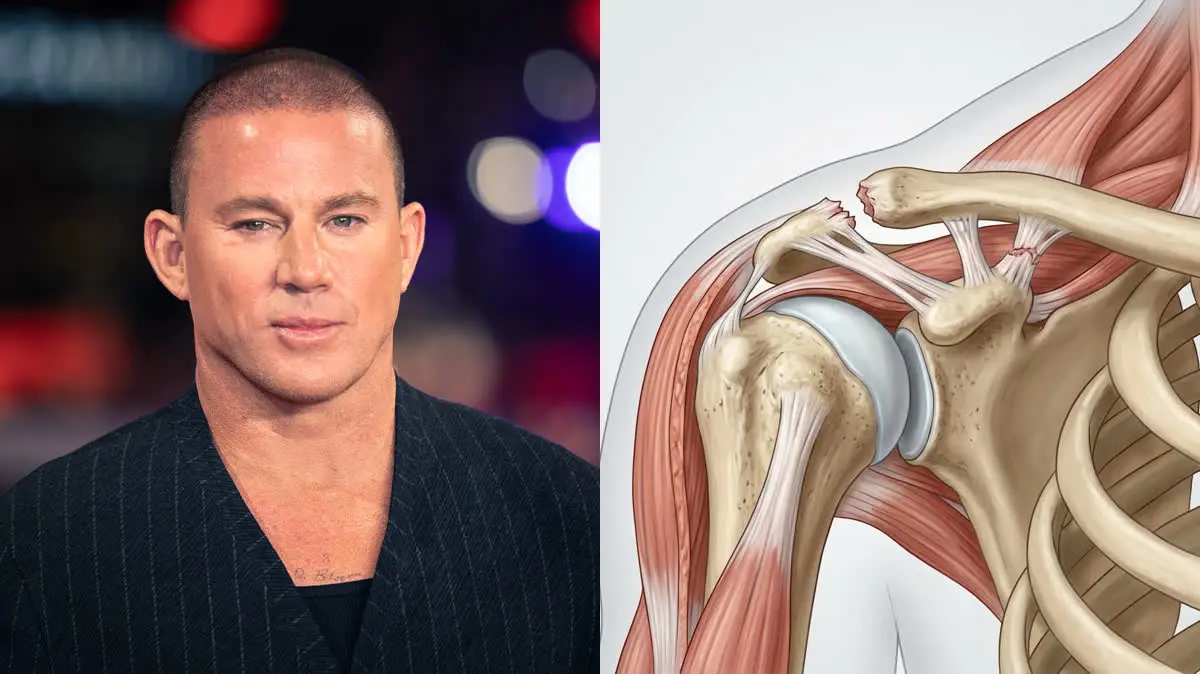
"A dislocated shoulder is like a high-speed train jumping off its tracks completely. A separated shoulder is like the suspension bridge collapsing directly above the train—the track is actually untouched, but the structural connection holding the roof up is totally severed."
Hollywood action star Channing Tatum made headlines in early 2026 when it was revealed that he recently underwent major orthopedic surgery. The physical nature of his dance routines and stunt work has taken a cumulative toll, and this latest medical update confirmed a severe, acute injury sustained while filming.
The headline was quick to sweep across social media feeds, stating that the actor required corrective intervention for a "separated shoulder." For many fans and weekend athletes reading the news, there was immediate confusion over the terminology. Many assumed this meant the actor popped his arm bone entirely out of its socket—the typical, dramatic cinematic injury seen in action movies.
But in the realm of clinical sports medicine, a separated vs dislocated shoulder are two completely distinct anatomical emergencies. They involve entirely different joints, different ligament structures, and require drastically different shoulder rehab protocols.
Understanding the exact biomechanics behind the Channing Tatum separated shoulder news is critical for anyone who has ever landed hard on the tip of their shoulder and felt a sudden, sharp pop followed by a strange physical deformity.
The Pathophysiology: Spraining the Suspension Bridge
To understand a separated shoulder, we must first look at the Acromioclavicular (AC) joint. This is the small joint on the very top of your shoulder, where your collarbone (clavicle) meets the highest point of your shoulder blade (the acromion).
Unlike the glenohumeral joint (the ball-and-socket), which allows you to rotate your arm, the AC joint is essentially a structural strut. It suspends your entire shoulder blade and arm from your rib cage. It is held in place by two critical ligament complexes: the Acromioclavicular ligaments and the Coracoclavicular (CC) ligaments.
A shoulder separation almost always occurs from a Direct Blow—typically falling onto the ground with your arm tucked, landing directly on the hard, outer tip of your shoulder. The downward force drives the shoulder blade down, while the collarbone remains fixed, tearing the suspending ligaments.
In sports medicine, we classify these separations using the Rockwood Classification Scale (Grades I through VI).
Clinical epidemiology reveals that over 85% of all AC joint separations are Grade I or II, meaning the ligaments are merely stretched or partially torn, which can be fully managed without surgery.
However, a Grade III to VI separation represents a complete rupture of both the AC and CC ligaments. In these severe cases, the collarbone pops visibly upward, creating a classic clinical Step-Off Deformity—a hard, bony bump visible through the skin.
For highly active individuals and professional performers like Tatum, a high-grade rupture often demands AC joint separation surgery to mechanically anchor the collarbone back down to the coracoid process using synthetic cables or tendon grafts.
Why Popping a Separated Shoulder "Back In" is a Dangerous Myth
When someone injures their shoulder, their immediate instinct is often influenced by movies: they want a companion to yank on their arm to 'pop it back into place'. They believe the joint is simply out of alignment.
My authoritative clinical opinion as a lead sports therapist is that attempting to manually manipulate or pull on an acute AC joint separation is incredibly dangerous and can cause permanent neurological damage. In a separation, the main ball-and-socket joint is still 100% intact inside its capsule. Pulling aggressively on the arm only increases the downward traction on the already-ruptured coracoclavicular ligaments, worsening the tear and potentially stretching the delicate brachial plexus nerves running right beneath the collarbone.
If you have a visible bump on top of your shoulder, you must immobilize the arm in a tight sling and seek professional radiological imaging before performing any physical adjustments.
This precise, mechanical care is just as crucial here as it is in eccentric strengthening for rotator cuff tendinopathy, where tissue management dictates long-term success.
Three Self-Assessments for Top-of-Shoulder Pain
If you have suffered an impact injury to your arm, use these three clinical checks to assess if your issue is structural:
-
1Visual Inspection (The Step-Off Deformity) Stand in front of a mirror with both arms hanging naturally. Compare the height of both shoulders. If the injured side has an obvious, hard, bony bump right at the tip of the collarbone that is not present on the healthy side, this is a classic sign of an AC joint ligament rupture.
-
2The Cross-Body Adduction Test Raise your painful arm forward to 90 degrees (shoulder height). Gently use your other hand to pull your elbow across your chest toward the opposite shoulder. If this compression produces a sharp, localized pain directly on top of the shoulder tip, the AC joint is highly likely to be involved.
-
3Scapular Control Activation (Early Stage Rehab) Once cleared for movement, focus on your foundations. Stand against a wall and gently slide your shoulder blades downward and together, holding for 5 seconds without moving your actual arm. Rebuilding your scapular stability is the first essential step in the sports injury recovery pipeline.
Sustaining an acute structural trauma requires patience and precise progression. Much like the rigorous post-op milestone protocols for an ACL tear, rebuilding a shoulder after surgery requires respecting biological healing timelines before trying to return to high-intensity training.
Treat Your Structure with Clinical Respect
Channing Tatum's journey back to the big screen will require careful, progressive rehabilitation to ensure his reconstructed suspension bridge can handle the physical loads of high-impact choreography once again. By understanding that a separated shoulder is a structural ligament crisis rather than a simple alignment issue, you can make the right choices for your own physical health. Are you ready to stop ignoring the pop and start properly stabilizing the bridge of your upper body today?
Featured image attribution: "Channing Tatum at the 2026 Berlin International Film Festival" by Harald Krichel, licensed under CC BY-SA 4.0. Modified by cropping and compositing.
Dr. Dhanushika Dilshani
Expert Ayurvedic Wellness Doctor. Specialized in modern holistic wellness, optimizing dermal resilience, cosmetic radiance, and systematic diagnosis driven by traditional and evidence-based medical logic.
Medical Disclaimer
The information provided by AyurPhysio is for general educational and informational purposes only. It is not intended as a substitute for professional medical advice, diagnosis, or treatment. Always seek the advice of your physician or other qualified health providers with any questions you may have regarding a medical condition. Never disregard professional medical advice or delay in seeking it because of something you have read on this website.
Trending Guides
Luka Modrić's Daily Routine: Low-Impact Resistance Training and Midfield Longevity
4 min readHarry Kane's Daily Routine: Hamstring Preservation and Anti-Inflammatory Nutrition
4 min readKarim Benzema's Daily Routine: Cupping Therapy (Hijama) and HIIT Conditioning
4 min readNeymar Jr.'s Daily Routine: Joint Stabilization and Hyperbaric Oxygen Therapy
4 min readMohamed Salah's Daily Routine: Early Morning Conditioning and Hyperbaric Recovery
4 min readWeekly Wellness
Don't miss the next guide
Get holistic health tips and new guides delivered to your inbox.
Related Healing Guides
View All Guides →
Luka Modrić's Daily Routine: Low-Impact Resistance Training and Midfield Longevity
Harry Kane's Daily Routine: Hamstring Preservation and Anti-Inflammatory Nutrition