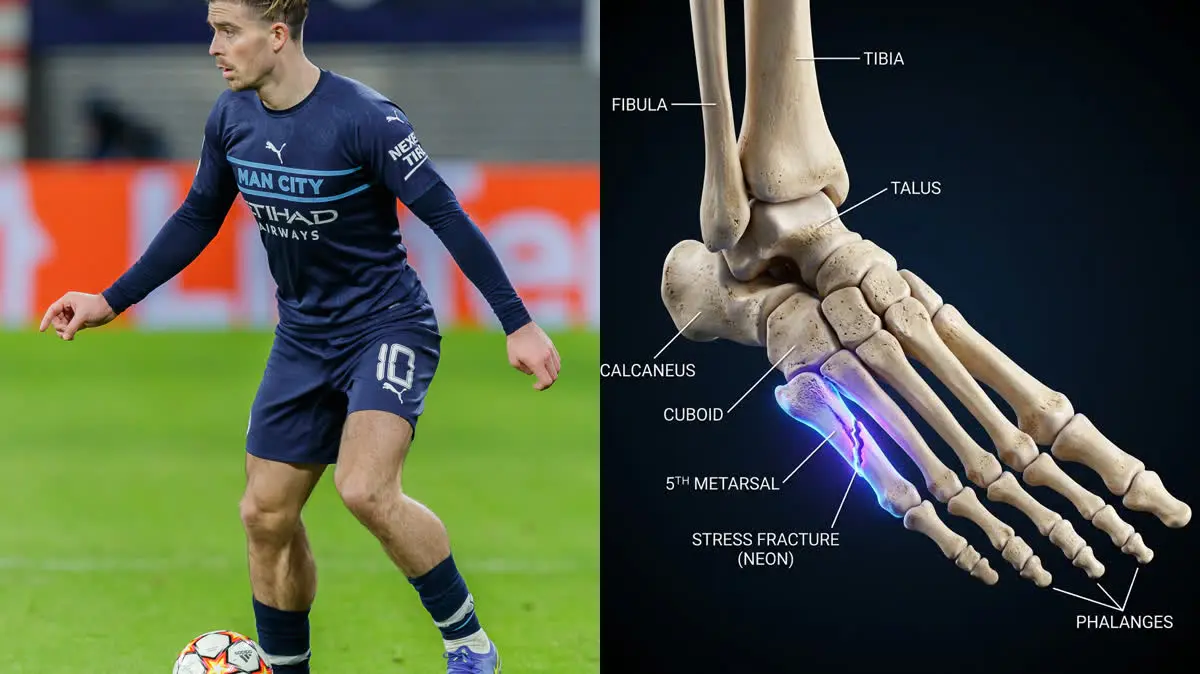
"A stress fracture of the fifth metatarsal is one of the most stubborn injuries in soccer — high-speed pivots concentrate massive lateral forces on the outer edge of the foot, where blood supply is notoriously limited."
The sports media was filled with concern following reports that Manchester City's creative winger suffered a setback during training. The official news of the Jack Grealish injury instantly focused attention on the physical demands placed on modern football players. An injury to the foot skeleton is particularly disruptive for a player whose style relies on rapid, unpredictable pivots.
Unlike sudden bone breaks, a stress fracture develops gradually over time due to repeated loading that exceeds the bone's repair capacity. In elite soccer, the foot must absorb massive force while navigating artificial turf and tight cleats. If the mechanical stress exceeds the bone's remodeling rate, micro-cracks form, eventually leading to a true fracture.
Successfully managing a stress fracture of the foot requires a clear understanding of fifth metatarsal loading and bone healing timelines. It is a complex rehabilitation journey that requires careful monitoring to prevent long-term damage or non-union. Let us analyze the biomechanics of foot stress injuries and outline the rehabilitation protocols needed to return to the pitch.
The Pivot Point: Biomechanics of the Fifth Metatarsal
The fifth metatarsal is the long bone on the outer edge of the foot, connecting the midfoot to the little toe. It serves as a major attachment point for tendons that support the foot arch and control ankle movement. During lateral movement, this bone serves as the main pivot point for the entire body.
When a player executes a sharp cut, the foot is planted, and the body's momentum shifts laterally. This movement subjects the fifth metatarsal to high bending and twisting forces. Biomechanical studies show that these pivots load the outer foot with forces up to three times body weight.
Additionally, the blood supply to the base of the fifth metatarsal is quite poor compared to other bones. This region, known as the watershed zone, receives very limited blood flow, making healing difficult. Consequently, a fifth metatarsal fracture carries a high risk of delayed healing or non-union if loaded too early.
- High-speed pivots and lateral cutting maneuvers load the fifth metatarsal with forces up to 3 times body weight.
- A critical bone remodeling lag occurs at day 14 to 21 post-load, where bone absorption temporarily outpaces new bone formation.
- The non-union rate of fifth metatarsal stress fractures is up to 25% if managed without surgical screw fixation.
- Elite athletes face average bone stress recovery times of 8 to 12 weeks before returning to competitive matches.
Why Training Through Minor Foot Pain is Dangerous
Athletes are often praised for playing through discomfort, but when it comes to bone stress, pushing through pain is highly dangerous. A dull ache on the outer edge of the foot is often the first sign of bone fatigue. Ignoring this warning signal converts a treatable stress reaction into a full bone fracture.
My clear clinical perspective is that allowing an athlete to train through outer foot pain is a severe mistake. Bone tissue adaptively remodels in response to load, but it requires rest to complete the cycle. If you continue to apply load during the bone remodeling lag, the micro-cracks will expand, resulting in a complete fracture that may require surgery.
Instead of pushing through pain, training must be modified immediately. Non-impact conditioning, such as swimming or cycling, maintains fitness while removing stress from the foot. This allows the bone to heal without compromising the athlete's aerobic capacity.
"When treating stress fractures in football players, we must carefully evaluate their running style and foot mechanics. If an athlete has tight calves or restricted ankle movement, they will overload the outer edge of the foot during pivots. In Grealish's case, we focus heavily on restoring calf flexibility and ankle joint mobility. We also work with podiatrists to optimize boot selection and orthotic support, ensuring that lateral forces are distributed evenly across the foot."
Rebuilding the Foundation: Bone Loading Protocols
Restoring bone strength requires a structured rehabilitation program tailored to bone stress recovery times. Once the bone has healed sufficiently, we must introduce weight-bearing activities slowly to stimulate bone density. This progressive loading is essential to prepare the foot for the demands of running.
Rehab begins with non-weight-bearing exercises, moving to swimming and pool running to maintain joint movement. As healing progress is confirmed by imaging, we introduce walking in a protective boot, gradually transitioning to normal athletic shoes.
Finally, we introduce running drills on soft surfaces, slowly increasing distance and speed. We focus on training the intrinsic foot muscles to support the arch and absorb impact. This comprehensive approach is the key to preventing re-injury and ensuring a safe return to competitive play.
Step-by-Step Foot Stabilization Protocol
Execute this progressive loading sequence under clinical supervision. Stop immediately if you feel localized aching, tenderness, or swelling on the outer edge of the foot:
-
1Phase 1: Intrinsic Foot Dome (Short Foot Exercise) (3 sets of 15 repetitions) Sit with your foot flat on the floor. Without curling your toes, pull the ball of your foot toward your heel, contracting the arch muscles to lift the midfoot. This basic exercise strengthens the internal foot muscles, helping to support the arch and reduce the bending load on the metatarsals.
-
2Phase 2: Single-Leg Calf Raises with Neutral Alignment (3 sets of 12 repetitions) Stand on a flat floor near a wall for balance. Slowly raise your heel, keeping your weight distributed across the ball of your foot, avoiding rolling outward onto the little toe, then lower under control. This exercise strengthens the calf and deep ankle muscles, improving control during running.
-
3Phase 3: Progressive Lateral Hops (3 sets of 8 repetitions per side) Once cleared for impact, perform light sideways hops on a soft turf surface, focusing on landing softly and maintaining knee and foot alignment. This plyometric movement prepares the foot to absorb lateral forces, reducing soccer foot biomechanics stress during quick cuts.
Sustaining Athletic Foot Health
True athletic longevity requires keeping the entire lower body strong and flexible. For a detailed look at foot arch rehabilitation, check out our guide on plantar-fasciitis and posterior chain mechanics. If you want to improve your running alignment, read our analysis of shin splints rehabilitation and tibial mechanics. To learn more about muscle injury prevention, view our guide on hamstring strain rehabilitation for sprinters.
Your feet are the foundation of your athletic performance. Protect them by keeping your calves flexible, choosing proper footwear, and managing bone loads.
Are you training your foot muscles to actively support your arch, or are you expecting rigid footwear to absorb all the impact of your movements?
Featured image attribution: Left portrait "Jack Grealish 2021" by Steffen Prößdorf, licensed under CC BY-SA 4.0. Right graphic is a clinical 3D rendering of the foot skeletal structure showing a stress fracture in the fifth metatarsal bone. Composited and modified for AyurPhysio.
Dr. Dhanushika Dilshani
Expert Ayurvedic Wellness Doctor. Specialized in modern holistic wellness, optimizing dermal resilience, cosmetic radiance, and systematic diagnosis driven by traditional and evidence-based medical logic.
Medical Disclaimer
The information provided by AyurPhysio is for general educational and informational purposes only. It is not intended as a substitute for professional medical advice, diagnosis, or treatment. Always seek the advice of your physician or other qualified health providers with any questions you may have regarding a medical condition. Never disregard professional medical advice or delay in seeking it because of something you have read on this website.
Trending Guides
Luka Modrić's Daily Routine: Low-Impact Resistance Training and Midfield Longevity
4 min readHarry Kane's Daily Routine: Hamstring Preservation and Anti-Inflammatory Nutrition
4 min readKarim Benzema's Daily Routine: Cupping Therapy (Hijama) and HIIT Conditioning
4 min readNeymar Jr.'s Daily Routine: Joint Stabilization and Hyperbaric Oxygen Therapy
4 min readMohamed Salah's Daily Routine: Early Morning Conditioning and Hyperbaric Recovery
4 min readWeekly Wellness
Don't miss the next guide
Get holistic health tips and new guides delivered to your inbox.
Related Healing Guides
View All Guides →
Luka Modrić's Daily Routine: Low-Impact Resistance Training and Midfield Longevity
Harry Kane's Daily Routine: Hamstring Preservation and Anti-Inflammatory Nutrition