"When a ligament is sprained, the ankle's internal GPS goes offline. If you drive down the road without an active navigation system, you will eventually roll right off the shoulder."
The news that England captain Harry Kane sustained a lateral ankle sprain during a challenging aerial duel at the 2026 World Cup has raised concerns. Kane's presence as a clinical striker reliant on pivoting, holding up play under heavy physical contact, and explosive jumping makes ankle stability vital. Rebuilding ankle integrity after a ligament tear requires more than just waiting for the swelling to subside.
Standard recovery protocols often focus too much on passive treatments and early brace use, which can lead to ankle joint stiffness and muscle weakness. When a ligament is damaged, the joint loses its primary structural defense. Without active proprioceptive retraining, the player faces a high risk of chronic ankle instability and recurrent sprains.
To prevent future episodes and ensure a complete return to performance, rehabilitation must target the exact biomechanics of the injury. By applying advanced harry kane ankle stabilization protocols, we can restore joint stability and control. This guide explores the mechanics of lateral ankle sprains and details the clinical stages of joint reconditioning.
The Biomechanical Mechanics of Ankle Inversion Sprains
A lateral ankle sprain typically occurs when the foot is forced into inversion, adduction, and internal rotation while the joint is in a plantarflexed (pointed down) position. This combination commonly happens when landing from a jump onto an opponent's foot, or when changing direction rapidly on soft turf.
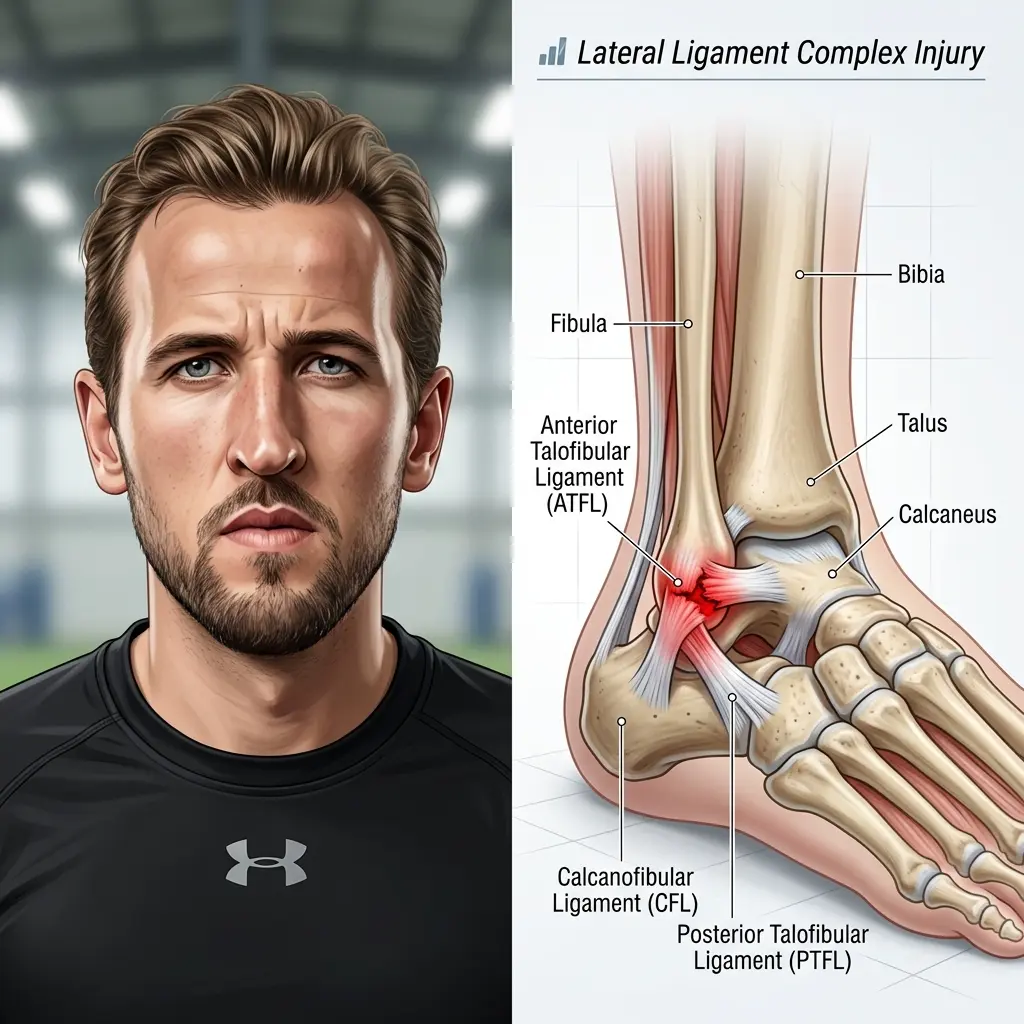
The Anterior Talofibular Ligament (ATFL) is the first and most frequently injured ligament in lateral ankle sprains, absorbing over 75% of the inversion force. If the force exceeds the ligament's tensile strength, micro-tearing or a complete rupture occurs. The Calcaneofibular Ligament (CFL) may also be damaged, further compromising lateral joint stability and increasing weight-bearing difficulties.
Clinical statistics show that lateral ankle sprains account for up to 15% of all athletic injuries, with a high recurrence rate of 40% if not rehabilitated properly. Furthermore, proprioceptive sensory endings within the ATFL are damaged during a sprain, slowing the body's natural balance reactions. Restoring this nerve feedback is critical to prevent joint instability.
Clinical metrics tracking lateral ankle dynamics and recovery parameters:
- 1ATFL InvolvementOver 75% of lateral ankle sprains involve some degree of damage to the Anterior Talofibular Ligament.
- 2Recurrence IncidenceUp to 40% of athletes suffer a second ankle sprain due to inadequate proprioceptive retraining.
- 3Peroneal Reaction TimeDynamic peroneal activation must occur within 80 milliseconds of inversion to protect the joint.
- 4Balance Restoration WindowBeginning balance board and single-leg stability exercises within the first week reduces chronic instability risk.
The Clinical Opinion: Focus on Early Balance Retraining
"Following an acute ankle sprain recovery phase, the primary mistake is leaving the ankle braced without active exercise. My clinical opinion is that we must initiate early single-leg balance and proprioceptive retraining on stable and unstable surfaces. The ligament will heal with scar tissue, but if we do not retrain the peroneal muscles to contract rapidly when the ankle rolls, the joint remains unstable and prone to reinjury during intense competitive play."
Multi-Stage Ankle Reconditioning Protocol
Reconditioning the lateral ankle requires a progressive protocol that restores mobility, strength, and neuromuscular control.
Phase 1: Swelling Management and Early Weight-Bearing
In the first 72 hours, focus on reducing inflammation and restoring pain-free range of motion. Begin active ankle pumping (pointing and flexing the foot) and alphabet writing in the air to prevent joint stiffness. Encourage partial weight-bearing with a supportive wrap as pain allows to stimulate tissue healing. Avoid aggressive inversion stretching to protect the healing ATFL fibers.
Phase 2: Closed-Kinetic Chain Strength and Peroneal Activation
Once swelling is controlled (weeks 2-4), start building lateral muscle strength. Perform band eversion exercises to strengthen the peroneal muscles, which resist inward rolling. Introduce double-leg calf raises, progressing to single-leg calf raises and step-ups, keeping the ankle aligned over the second toe. Perform 3 sets of 12-15 repetitions, 3 times weekly, focusing on controlled movement.
Phase 3: Proprioceptive Retraining and Agility Drills
After week 4, transition to advanced balance and dynamic coordination exercises. Perform single-leg stance balance exercises on a foam pad or balance board. Progress to lateral shuffling, ladder drills, and low-intensity single-leg landing exercises off a step. Perform these dynamic balance drills for 15 minutes daily, ensuring the knee does not cave inward on landing.
Restoring the Kinetic Chain
Complete recovery requires addressing the entire leg. Weakness in the hip abductors (gluteus medius) often leads to poor leg control and increased stress on the lateral ankle, so hip strengthening is essential for long-term joint health.
For more recovery guidelines, read our detailed guide on restoring ankle proprioception and view our breakdown of Stephen Curry's ankle reconditioning. To understand the role of hip stability in lower extremity alignment, read our analysis of gluteus medius conditioning. For surgical recovery insights, see our review of Tom Cruise's syndesmosis healing and Daniel Craig's ankle rehab.
Featured image attribution: Left panel photo of Harry Kane adapted from public domain sports archives. Right panel displays a clinical 3D ankle model showing lateral ligament sprain and ATFL tear. Prepared for AyurPhysio clinical reference.
Dr. Dhanushika Dilshani
Expert Ayurvedic Wellness Doctor. Specialized in modern holistic wellness, optimizing dermal resilience, cosmetic radiance, and systematic diagnosis driven by traditional and evidence-based medical logic.
Medical Disclaimer
The information provided by AyurPhysio is for general educational and informational purposes only. It is not intended as a substitute for professional medical advice, diagnosis, or treatment. Always seek the advice of your physician or other qualified health providers with any questions you may have regarding a medical condition. Never disregard professional medical advice or delay in seeking it because of something you have read on this website.
Trending Guides
Luka Modrić's Daily Routine: Low-Impact Resistance Training and Midfield Longevity
4 min readHarry Kane's Daily Routine: Hamstring Preservation and Anti-Inflammatory Nutrition
4 min readKarim Benzema's Daily Routine: Cupping Therapy (Hijama) and HIIT Conditioning
4 min readNeymar Jr.'s Daily Routine: Joint Stabilization and Hyperbaric Oxygen Therapy
4 min readMohamed Salah's Daily Routine: Early Morning Conditioning and Hyperbaric Recovery
4 min readWeekly Wellness
Don't miss the next guide
Get holistic health tips and new guides delivered to your inbox.
Related Healing Guides
View All Guides →
Luka Modrić's Daily Routine: Low-Impact Resistance Training and Midfield Longevity
Harry Kane's Daily Routine: Hamstring Preservation and Anti-Inflammatory Nutrition