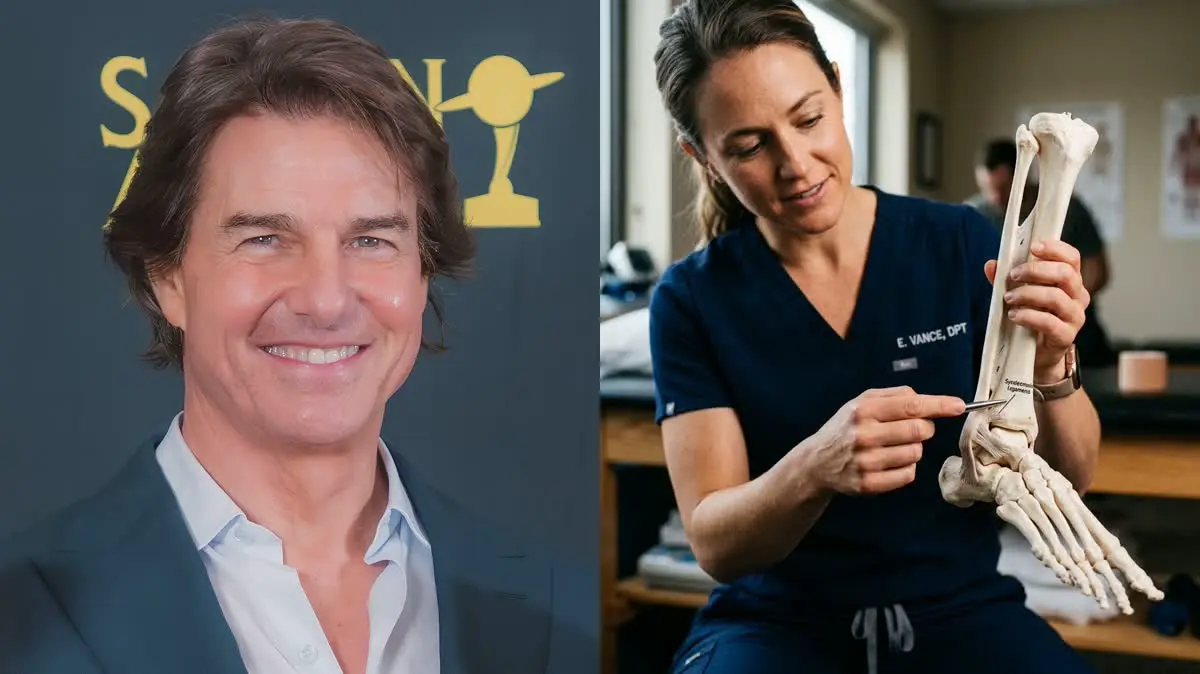
"Expecting your ankle to survive a miscalculated leap between two buildings is like expecting a car's suspension to survive being dropped from a helicopter. The human talus bone is incredibly resilient, but it has absolute biomechanical limits."
When the footage leaked of Tom Cruise slamming into the side of a building during the filming of Mission: Impossible - Fallout, the collective gasp from the public was deafening. The slow-motion replay showed a violent, unnatural angle of the foot as his body weight continued forward while his foot remained stubbornly planted against the concrete.
This was not a simple rolled ankle. The severe trauma he sustained is known as a syndesmosis tear (commonly referred to as a high ankle sprain), combined with a forceful impact fracture of the talus. This type of trauma forces the tibia and fibula (the two bones of the lower leg) to literally split apart at the base.
How does a 55-year-old actor recover from an injury that routinely ends professional athletic careers, and return to sprinting across London rooftops just weeks later? The answer lies in the extreme precision of sports trauma rehabilitation and the aggressive management of the syndesmotic ligament complex.
The Anatomy of the Impact
Your ankle is a mortise and tenon joint. The talus bone sits inside the "mortise" created by the ends of your tibia and fibula. These two long bones are held tightly together just above the ankle by a thick, fibrous band of connective tissue called the syndesmosis.
During Cruise's jump, his foot struck the wall in forced dorsiflexion (toes pulled up) and external rotation (foot twisted outward). Because the front of the talus is wider than the back, forcing it deeply into the mortise while rotating it acts like a wedge. This wedge violently pries the tibia and fibula apart, shredding the syndesmosis ligaments.
But most people miss the hidden catalyst for this prolonged inflammation: once the syndesmosis is torn, every single step you take forces the leg bones apart, preventing the ligament from ever scarring down and healing. It is a biomechanical nightmare.
My strong clinical opinion is that conservative treatment (like standard walking boots) for a high-grade syndesmotic tear in a high-performance individual is a complete waste of time. The ligament will heal with too much laxity, resulting in a chronically unstable "sloppy" ankle.
In cases of severe trauma, surgical stabilization using a "TightRope" fixation—where a heavy-duty suture is drilled through the tibia and fibula to lash them back together—is mandatory. It immediately restores the structural integrity of the mortise, allowing the athlete to begin active weight-bearing weeks earlier than traditional screws. We must prioritize structural rigidity over passive rest.
By the Numbers: High Ankle Sprains
The recovery metrics for syndesmotic injuries are notoriously brutal compared to standard lateral ankle rolls.
- High ankle sprains account for only 11-17% of all ankle sprains, but they require more than double the recovery time (average 45 days vs 16 days for low sprains).
- Without proper syndesmotic repair, a 1-millimeter widening of the ankle mortise decreases the joint's contact area by 42%, exponentially increasing the risk of early-onset arthritis.
- Following surgical stabilization, athletes who engage in immediate anti-gravity treadmill training (like the AlterG) regain full dorsiflexion 3 weeks faster than those who remain fully non-weight-bearing.
Rebuilding the Base: The Rehab Protocol
Once the structural integrity of the mortise is restored, the physical therapy protocol must aggressively rebuild the neuromuscular control of the lower leg.
- Phase 1: Blood Flow Restriction (BFR) Therapy. By applying a tourniquet to the upper thigh, we trick the brain into thinking the leg is performing maximal exercise while only lifting 20% of the normal weight. This builds muscle without straining the healing ankle joint.
- Phase 2: Proprioceptive Overload. The severe trauma destroys the mechanoreceptors in the joint. We use unstable surfaces (BOSU balls) and eyes-closed single-leg balancing to force the brain to remap the position of the foot in space.
- Phase 3: Plyometric Deceleration. The injury occurred during a harsh landing. Rehab must eventually replicate this force. We utilize drop jumps, focusing entirely on a quiet, shock-absorbing landing mechanics to retrain the calf complex to absorb force before it reaches the bone.
Learning from the Impossible
Tom Cruise's rapid return to running on a broken ankle is a testament to the incredible capabilities of modern surgical stabilization and aggressive, science-backed physical therapy. By understanding the intense biomechanical demands placed on our joints, we can appreciate the precise engineering required to heal them.
If you are dealing with a standard ankle sprain, review our guide on Restoring Proprioception and Joint Stability to prevent it from becoming a chronic issue.
Featured image attribution: Portrait sourced from Wikimedia Commons, licensed under Creative Commons. Modified by cropping and compositing.
Dr. Dhanushika Dilshani
Expert Ayurvedic Wellness Doctor. Specialized in modern holistic wellness, optimizing dermal resilience, cosmetic radiance, and systematic diagnosis driven by traditional and evidence-based medical logic.
Medical Disclaimer
The information provided by AyurPhysio is for general educational and informational purposes only. It is not intended as a substitute for professional medical advice, diagnosis, or treatment. Always seek the advice of your physician or other qualified health providers with any questions you may have regarding a medical condition. Never disregard professional medical advice or delay in seeking it because of something you have read on this website.
Trending Guides
Luka Modrić's Daily Routine: Low-Impact Resistance Training and Midfield Longevity
4 min readHarry Kane's Daily Routine: Hamstring Preservation and Anti-Inflammatory Nutrition
4 min readKarim Benzema's Daily Routine: Cupping Therapy (Hijama) and HIIT Conditioning
4 min readNeymar Jr.'s Daily Routine: Joint Stabilization and Hyperbaric Oxygen Therapy
4 min readMohamed Salah's Daily Routine: Early Morning Conditioning and Hyperbaric Recovery
4 min readWeekly Wellness
Don't miss the next guide
Get holistic health tips and new guides delivered to your inbox.
Related Healing Guides
View All Guides →
Luka Modrić's Daily Routine: Low-Impact Resistance Training and Midfield Longevity
Harry Kane's Daily Routine: Hamstring Preservation and Anti-Inflammatory Nutrition