Medial Epicondylitis (Golfer's Elbow): Flexor Tendon Rehabilitation
"An injured tendon is like a tangled ball of dry yarn. Leaving it completely rested keeps it tangled and weak, whereas targeted, progressive tension is the comb that straightens the fibers back out."
If shaking hands with a client or lifting a morning cup of coffee triggers a sharp, burning ache on the inside of your elbow, you are experiencing the painful limits of Medial Epicondylitis. Commonly known as Golfer's Elbow, this condition is a repetitive strain injury affecting the common flexor tendon. It occurs where the muscles that curl your wrist and fingers attach to the bony bump on the inner side of your elbow.
Many sufferers are told to wear a tight brace, take anti-inflammatory medications, and rest the arm completely until the pain goes away. However, resting a damaged tendon is a recipe for long-term weakness. Wearing an elbow brace indefinitely is like putting a band-aid on a crumbling bridge; it masks the tremors but does absolutely nothing to strengthen the columns.
To achieve lasting inner elbow pain recovery, we must transition from passive avoidance to active loading. The tendon does not need rest; it needs to rebuild its structural integrity. By utilizing strategic flexor tendon eccentric loading, you can stimulate new collagen growth and restore your grip strength.
The Pathology of Tendinosis: It is Not Inflamed
Despite the "-itis" ending, chronic golfer's elbow is rarely caused by active chemical inflammation. When we look at damaged tendon tissues under a microscope, we do not find inflammatory cells. Instead, we see disorganized collagen fibers, micro-tears, and a lack of proper blood supply—a condition known as tendinosis.
This structural collapse happens when the mechanical demand placed on the tendon exceeds its capacity to repair. When you repeatedly grip, twist, or swing, the tendon fibers fray. If you simply rest, the body patches the gaps with weak, messy scar tissue that easily tears again the moment you resume your activities.
To trigger genuine grip strength tendon healing, we must apply controlled mechanical load. This loading tells the cells within the tendon to produce stronger, parallel collagen fibers that can handle the tension of daily life and sports.
My strong clinical opinion is that complete immobilization and cortisone injections are two of the worst options for chronic golfer's elbow. Cortisone may mask the pain for a few weeks, but it actively degrades the collagen matrix, making the tendon significantly weaker and more prone to a full tear.
Similarly, avoiding all lifting only causes the surrounding forearm muscles to atrophy. If your forearm is weak, your tendon has to absorb even more shock. We must move away from the outdated 'rest and wait' model. The only way to cure a tendon is to load it progressively, teaching it to tolerate the forces of your active life again.
The Eccentric Loading Blueprint: Rebuilding Collagen
Tendon rehabilitation relies heavily on the eccentric phase of muscle contraction—the phase where the muscle and tendon are lengthening under tension. During eccentric wrist flexion, the common flexor tendon is stretched while actively contracting, which applies a highly organized mechanical strain.
This specific strain is what prompts the tenocytes (tendon cells) to align new collagen fibers along the line of pull. Over several weeks, this process restores the tendon's tensile strength, making golfers elbow rehab exercises the most critical part of recovery.
During loading exercises, it is perfectly acceptable—and even expected—to feel a mild discomfort (up to a 3 or 4 out of 10 on the pain scale). This is a normal part of remodeling the tissue.
However, if the pain spikes to a sharp, stabbing sensation, or if your elbow aches significantly the next morning, you have overloaded the tendon. Adjust by reducing the weight or the range of motion, but do not stop moving entirely.
Three Progressive Exercises for Inner Elbow Recovery
Incorporate these three fundamental medial epicondylitis physical therapy exercises into your rehabilitation routine to restore tissue durability.
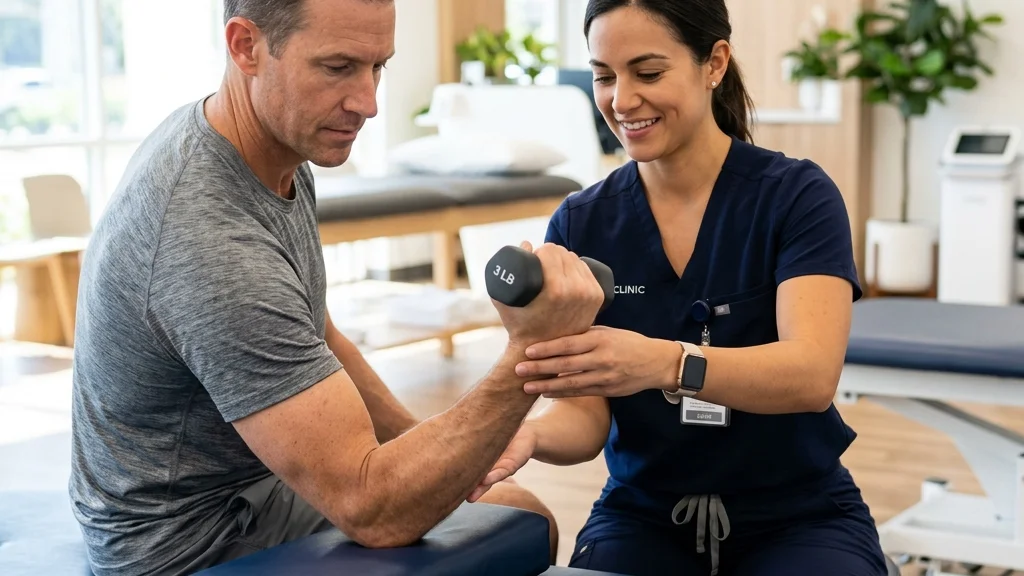
Sit with your forearm resting on a table, holding a light dumbbell. Curl the weight up using your opposite hand to assist. Once at the top, slowly lower the weight back down using only the injured arm over a 4-second count. Perform 3 sets of 15 repetitions daily.
Hold a hammer or a resistance band. Start with your palm facing up, then slowly rotate your forearm so your palm faces down over a 3-second eccentric phase. Use your other hand to assist in returning to the start. Repeat for 3 sets of 10.
To rebuild functional grip strength, use a light hand gripper. Squeeze the gripper fully, hold it closed for 5 seconds, and then release it slowly over 3 seconds. Perform 10 squeezes, holding the final squeeze to fatigue on each set.
If you are also experiencing pain on the outer side of your elbow, you may be dealing with its counterpart, tennis elbow. Explore our clinical guide on the Eccentric Tyler Twist for Lateral Epicondylitis to compare these distinct conditions.
The Patient: Dave, a 48-year-old hobbyist woodworker and golfer, suffered from chronic inner elbow pain that made it impossible to grip a golf club or hold a hand plane for more than 5 minutes.
The Mistake: Dave wore a compression strap for four months and stopped all lifting. This rest made his grip strength drop by 40% and left his tendon stiff and weak.
The Solution: We removed the compression strap and started a progressive eccentric loading program using a dumbbell, along with specific grip endurance holds and scapular stabilization drills.
The Outcome: Within six weeks, Dave's grip strength returned to normal and his elbow pain reduced by 85%. He returned to woodworking and played a full round of golf without any flare-ups.
Rebuilding Inner Arm Resilience
Golfer's elbow is a clear sign that your forearm flexor tendons have been overworked and under-supported. By focusing on active, controlled eccentric loading, you can rebuild the tendon structure and get back to the activities you enjoy.
If you want to protect your upper limbs further, look at our guidelines on scapular mechanics at Shoulder Impingement and Scapular Rhythm. Improving shoulder stability is a great way to reduce the load on your elbow.
Commit to the process, load your muscles progressively, and allow the tissues time to remodel. Strength, not rest, is the ultimate key to recovery.
Irushi Abeywardhana
Senior Physiotherapist & Founder of Physio Pulse. Senior Clinical Physiotherapist passionate about blending advanced movement science with functional resilience.
Medical Disclaimer
The information provided by AyurPhysio is for general educational and informational purposes only. It is not intended as a substitute for professional medical advice, diagnosis, or treatment. Always seek the advice of your physician or other qualified health providers with any questions you may have regarding a medical condition. Never disregard professional medical advice or delay in seeking it because of something you have read on this website.
Trending Guides
Luka Modrić's Daily Routine: Low-Impact Resistance Training and Midfield Longevity
4 min readHarry Kane's Daily Routine: Hamstring Preservation and Anti-Inflammatory Nutrition
4 min readKarim Benzema's Daily Routine: Cupping Therapy (Hijama) and HIIT Conditioning
4 min readNeymar Jr.'s Daily Routine: Joint Stabilization and Hyperbaric Oxygen Therapy
4 min readMohamed Salah's Daily Routine: Early Morning Conditioning and Hyperbaric Recovery
4 min readWeekly Wellness
Don't miss the next guide
Get holistic health tips and new guides delivered to your inbox.
Related Healing Guides
View All Guides →
Hyperlordosis: Tailoring Exercise Programs to Reduce Lumbar Shear Stress
Morning Lower Back Stiffness: The Biomechanical Causes and Quick, Safe Fixes