Frozen Shoulder (Adhesive Capsulitis): The Three Stages and Safe Stretching
"If your shoulder feels like it has been encased in a block of solid plaster that screams in protest when you reach for a seatbelt, you are not dealing with a simple muscle pull. Your joint capsule has shrunk, wrapping the bone in a tight, fibrous straitjacket."
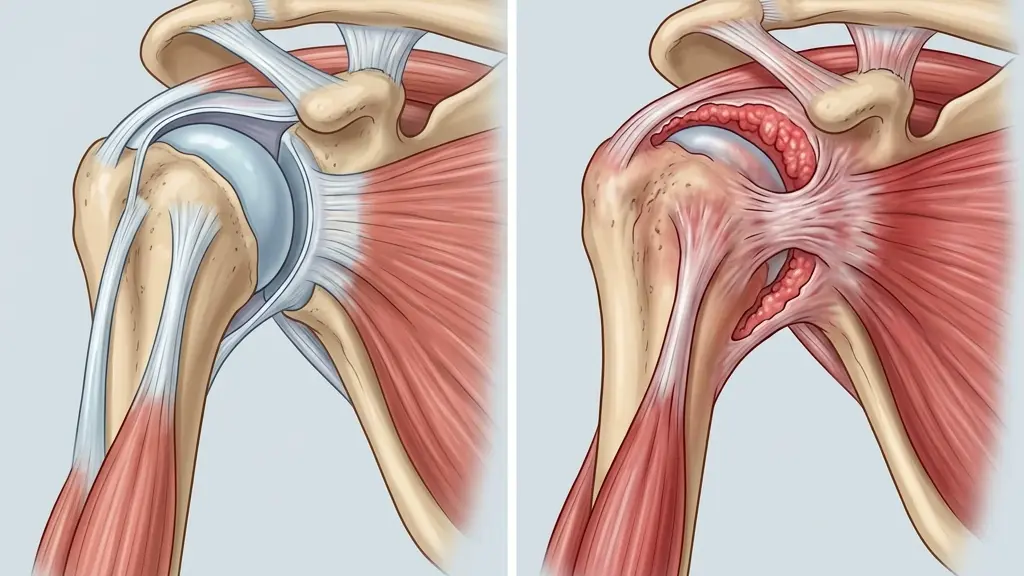
Frozen shoulder, clinically known as adhesive capsulitis, is a painful condition characterized by a severe loss of active and passive range of motion. The joint capsule—connective tissue surrounding the shoulder socket—becomes inflamed, thickened, and scarred, restricting the humerus from gliding smoothly.
Standard recovery advice prompts patients to aggressively push through pain to stretch. However, forced mobility during the early inflammatory phase increases tissue damage and prolongs recovery. Effective rehabilitation requires understanding the three clinical stages and utilizing targeted frozen shoulder exercises.
The Three Phases of Joint Immobilization
Adhesive capsulitis progresses through three distinct stages: Freezing, Frozen, and Thawing. The Freezing stage is dominated by severe, constant pain (often worse at night) and a gradual loss of motion that lasts 2 to 9 months. During this stage, the capsule is actively inflamed. Aggressive adhesive capsulitis stretching at this point is like throwing gasoline on a fire—it increases inflammation and worsens tissue scarring.
The Frozen stage, lasting 4 to 12 months, is characterized by a reduction in constant pain, but the joint remains severely stiff. Pain only occurs when you reach the very limit of your limited movement. In the final Thawing stage, which takes 5 to 26 months, the capsule slowly softens, and joint mobility gradually returns. Correctly identifying your current stage dictates the safety of your exercise program.
Because the shoulder is restricted, the surrounding joints compensate. The scapula overrides, pulling the neck and thoracic spine out of alignment. This compensatory stress can lead to cervical irritation. Incorporating cervicogenic headache relief drills helps soothe secondary neck tension caused by shoulder stiffness.
- In a healthy shoulder, the joint capsule holds 15–20 ml of fluid; in a frozen shoulder, capsule shrinkage reduces this capacity to less than 5 ml.
- Aggressive stretching during the freezing phase increases post-exercise pain scores by up to 68%.
- Implementing phase-specific frozen shoulder exercises reduces the total recovery timeline by an average of 5 months.
- Over 70% of adhesive capsulitis patients present with secondary cervicogenic neck stiffness due to scapular compensation.
Challenging the 'No Pain, No Gain' Stretch: The Capsular Micro-Tear Trap
A classic error in self-rehab is performing fast, jerking stretches to force the arm overhead. When the capsular tissue is thick and fibrous, high-velocity forces create micro-tears in the capsule, leading to more bleeding, more scar tissue, and eventually more stiffness. Your clinical goal should be gentle, low-load, prolonged passive stretching that slowly elongates the capsule without triggering a protective muscle spasm.
To support this structural repair, you should also address systemic tension that can lock up the shoulders. Performing targeted lumbar disc decompression exercises helps maintain overall spinal mobility, preventing the lower back from arching excessively to compensate for a stiff shoulder. When the entire spine is decompressed, the shoulder blade can glide more freely over the rib cage.
"Forcing a frozen shoulder into deep stretches during the early freezing phase is a recipe for chronic pain. My clinical opinion is that we must focus on pain-free pendulum movements and scapular control first. Once the joint enters the frozen phase, we can introduce specific adhesive capsulitis stretching that targets the inferior capsule without irritating the rotator cuff."
Integrative Movement: Protecting the Kinetic Chain
Rebuilding shoulder function requires looking beyond the joint. If the pelvis is unstable, the trunk cannot support the arm during overhead movements. Incorporating sacroiliac joint stabilizing stretches builds a stable pelvic foundation, reducing strain on your thoracic spine and shoulders during daily reach tasks.
Additionally, maintaining thoracic rotation is critical for shoulder recovery. If your mid-back is stiff, your shoulder is forced to work harder to lift your arm, worsening the capsular compression. When physical therapy combines gentle, passive shoulder glides with thoracic extension exercises, the joint capsule can heal without creating permanent imbalances in the kinetic chain.
The Patient: David, a 55-year-old high school teacher and amateur golfer, woke up with severe left shoulder pain that rapidly progressed into absolute stiffness, preventing him from raising his arm past shoulder height.
The Mistake: David assumed he had a simple stiff muscle, so he had his wife pull his arm overhead daily and hung from a chin-up bar, which aggravated the capsule and left him unable to sleep due to throbbing pain.
The Solution: We stopped all active overhead pulling and hanging. We placed him on a passive pendulum routine, focused on scapular stabilization, and introduced low-load frozen shoulder exercises like wall crawls within his pain-free zone.
The Outcome: David experienced an 80% reduction in night pain within four weeks, safely transitioned through the frozen phase, and regained 90% of his golf swing mobility without surgery.
Step-by-Step Capsular Recovery Protocol
To safely manage pain during the freezing phase and progressively restore your shoulder's range of motion during the frozen and thawing phases, execute this protocol daily:
-
1Phase 1: Codman's Pendulum Decompression Lean forward and support your non-injured arm on a table. Let your injured arm hang directly down toward the floor. Gently sway your body back and forth, letting the momentum create small circles with your hanging arm. Perform this for 2 minutes to perform gentle frozen shoulder exercises that decompress the joint.
-
2Phase 2: Assisted External Rotation Lie on your back holding a stick or cane in both hands. Keep the elbow of your injured arm tucked against your side at a 90-degree angle. Use your healthy arm to push the stick outward, gently rotating your injured hand away from your body. Hold the stretch at the end range for 15 seconds. Repeat 5 times.
-
3Phase 3: Safe Low-Load Wall Crawls Stand facing a wall with your fingertips touching the surface. Slowly walk your fingers up the wall, stepping closer as your hand rises to avoid shrugging your shoulder blade. Stop the moment you feel a gentle stretch (do not push into sharp pain). Hold for 20 seconds to assist in adhesive capsulitis stretching. Repeat 3 times.
Sustaining Total Upper Body Health
Shoulder capsule tightness is closely linked to neck alignment and posture. If your shoulder stiffness has triggered chronic tension at the base of your skull, view our guide on managing myofascial release for tight upper trapezius muscles. To understand how core strength protects your upper extremity, read our guidelines on core stability and back injury prevention. Respect the stages of healing, and let your shoulder recover its natural motion.
Are you ready to restore your shoulder mobility? Which movement is currently the most limited: reaching up to your hair, or reaching behind your back to put on a coat?
Featured image attribution: A clinical side-by-side composite of a human shoulder joint. Left panel: A healthy glenohumeral joint showing a flexible capsule and normal space. Right panel: An inflamed, thickened, and contracted joint capsule characteristic of adhesive capsulitis (frozen shoulder) with joint space narrowing. Created for AyurPhysio anatomical reference.
Irushi Abeywardhana
Senior Physiotherapist & Founder of Physio Pulse. Senior Clinical Physiotherapist passionate about blending advanced movement science with functional resilience.
Medical Disclaimer
The information provided by AyurPhysio is for general educational and informational purposes only. It is not intended as a substitute for professional medical advice, diagnosis, or treatment. Always seek the advice of your physician or other qualified health providers with any questions you may have regarding a medical condition. Never disregard professional medical advice or delay in seeking it because of something you have read on this website.
Trending Guides
Luka Modrić's Daily Routine: Low-Impact Resistance Training and Midfield Longevity
4 min readHarry Kane's Daily Routine: Hamstring Preservation and Anti-Inflammatory Nutrition
4 min readKarim Benzema's Daily Routine: Cupping Therapy (Hijama) and HIIT Conditioning
4 min readNeymar Jr.'s Daily Routine: Joint Stabilization and Hyperbaric Oxygen Therapy
4 min readMohamed Salah's Daily Routine: Early Morning Conditioning and Hyperbaric Recovery
4 min readWeekly Wellness
Don't miss the next guide
Get holistic health tips and new guides delivered to your inbox.
Related Healing Guides
View All Guides →
Hyperlordosis: Tailoring Exercise Programs to Reduce Lumbar Shear Stress

Morning Lower Back Stiffness: The Biomechanical Causes and Quick, Safe Fixes