"Trying to sprint on a freshly torn rectus femoris is the mechanical equivalent of driving a high-performance sports car with a snapped timing belt—you will only destroy the engine."
The football world fell into a state of shock as news broke of the sudden brazil world cup injury to striker Wesley. The clinical report confirmed a high-grade wesley thigh muscle tear that has officially ruled the forward out of the 2026 FIFA World Cup campaign. For an explosive athlete who relies on rapid acceleration and high-velocity deceleration, this injury represents a major biomechanical setback.
A severe tear of the rectus femoris muscle fiber disrupts the entire leg's force-production capacity. Recovering from a major muscle disruption requires a highly structured, scientifically guided physical rehabilitation strategy. Rushing back to the pitch without allowing the muscular tissue to heal properly is a recipe for a career-altering re-injury.
Understanding the biomechanical forces behind this tear is key to developing an effective recovery plan. Let us dissect the pathomechanics of Wesley's injury and outline the progression required for an elite muscle fiber tear recovery. We will explore how sports physical therapy can rebuild the leg's capacity to absorb dynamic load.
Understanding the Rectus Femoris Biomechanical Crisis
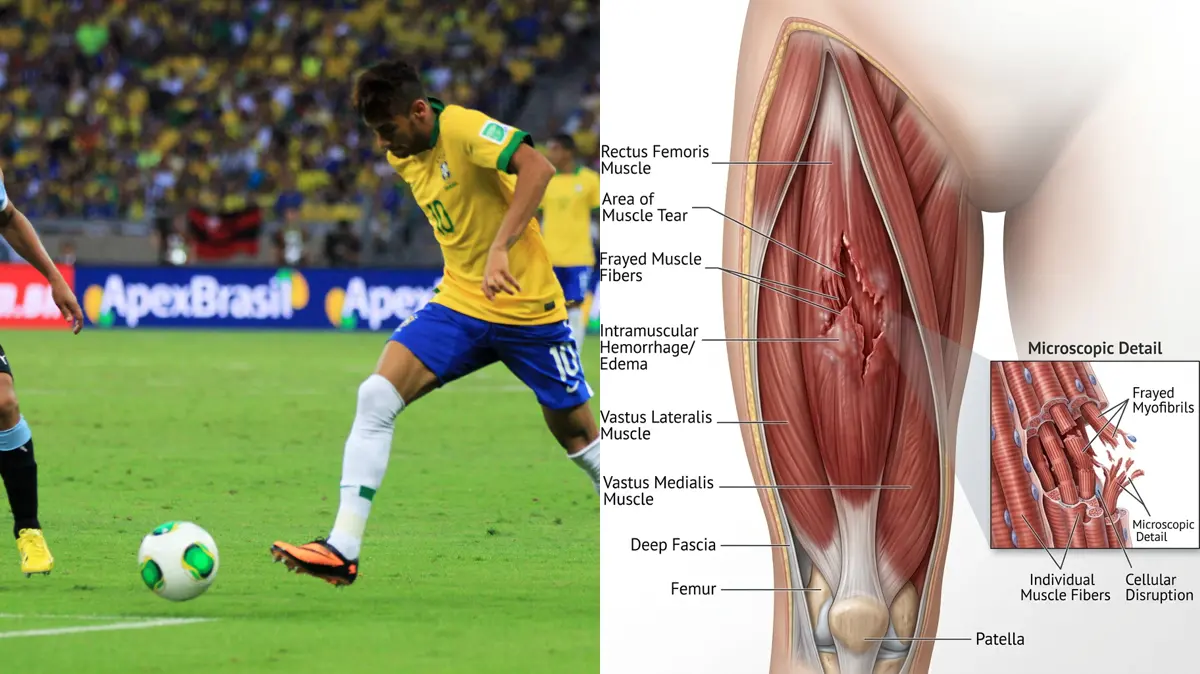
The quadriceps group consists of four muscles, but the rectus femoris is unique because it crosses both the hip and the knee. This biarticular structure makes it highly susceptible to injury during kicking and sprinting maneuvers. During explosive acceleration, the rectus femoris must shorten rapidly to flex the hip while simultaneously controlling knee extension.
The injury typically occurs during the transition from late swing phase to early foot contact, where the muscle undergoes a rapid eccentric contraction. When a player strikes a ball or decelerates suddenly, the rectus femoris is subjected to forces exceeding 3.5 times their body weight. If the tissue is fatigued, the load exceeds the elastic limit of the muscle-tendon junction, leading to a structural failure.
A high-grade muscle tear involves the disruption of myofibrils and the surrounding connective tissue sheaths, resulting in localized hemorrhage and loss of tension. Without a solid structural framework, the muscle cannot transmit force from the hip to the patellar tendon. The joint becomes vulnerable to compensations, which can lead to injuries in the surrounding muscle groups.
- The rectus femoris absorbs up to 3.5 times body weight during high-speed kicking and sprint-deceleration forces.
- Rectus femoris injuries represent over 30% of all quadriceps strains in professional soccer leagues.
- Athletes returning to competitive play with less than a 90% Limb Symmetry Index (LSI) face a 4x higher risk of recurrent muscle tears.
- The average recovery time for a grade-two rectus femoris tear ranges from 6 to 12 weeks of structured rehabilitation.
Why Static Stretching Is a Major Mistake in Early Rehab
A common myth in recreational fitness is that a tight or injured muscle must be aggressively stretched to promote healing. However, applying passive tension to a freshly torn muscle fiber is one of the worst things you can do. This practice pulls the healing margins apart, disrupting the delicate fibrin clot and delaying collagen deposition.
My clear, clinician-led perspective is that static stretching of an acute muscle tear is a counterproductive practice. Aggressive stretching during the early phases of healing is like pulling at the two ends of a fraying rope—you only succeed in widening the tear and encouraging the formation of disorganized scar tissue. Instead, the focus must be on controlled, pain-free active movement and isometric loading.
Isometrics allow us to stimulate muscle protein synthesis and maintain motor unit recruitment without stressing the structural tear. We want to guide the laying down of new collagen fibers parallel to the muscle's natural line of pull. Only when the tissue has achieved initial structural integrity can we gradually introduce eccentric stretching protocols.
"In elite soccer rehabilitation, we never rely on pain tolerance alone; instead, we use precise dynamometer testing to measure eccentric quadriceps strength. If Wesley does not demonstrate symmetrical eccentric strength, particularly in knee extension under hip extension, he cannot return to sprinting. Rushing this process causes the rectus femoris to fail when he performs his first explosive cut on the pitch."
The Phases of Rectus Femoris Strain Rehabilitation
A comprehensive rectus femoris strain rehabilitation program must progress through clear, criteria-based milestones. The early phase focuses on protecting the healing tissue while preventing muscle atrophy. We achieve this by using sub-maximal isometrics in a shortened muscle position.
As the tear heals, we transition to isotonic loading, focusing on the concentric phase of the movement. We gradually increase the range of motion, ensuring that the muscle can generate force without pain. This prepares the quad group for the higher demands of eccentric loading and speed work.
The final phase involves introducing sport-specific dynamic movements, including acceleration, deceleration, and kicking drills. We must retrain the neuromuscular system to coordinate the quadriceps and hip flexors under rapid loading. This high-velocity training is essential for a safe return to competitive play.
Step-by-Step Quadriceps Strength Progression
Execute this criteria-based exercise sequence under professional guidance. Stop immediately if you experience sharp pain, swelling, or a pulling sensation in your thigh:
-
1Phase 1: Multi-Angle Quadriceps Isometrics (3 sets of 10 repetitions, 10-second holds) Sit on a treatment table with your knees bent at 60 degrees. Press the back of your ankle against a stable resistance block without moving the joint, engaging the quad muscle at 50% effort while gradually increasing force. This protocol maintains neuromuscular pathways without stressing the muscle tear, facilitating recovery as detailed in our hamstring strain rehabilitation guide.
-
2Phase 2: Controlled Leg Press (3 sets of 12 repetitions, 3-second concentric and eccentric) Position yourself on a leg press machine with your feet placed shoulder-width apart. Perform a controlled leg press through a pain-free range of motion, avoiding deep knee flexion while keeping force distributed equally. This closed-chain loading stimulates muscle fiber alignment, similar to the protocols in our Giannis Antetokounmpo's soleus strain rehabilitation analysis.
-
3Phase 3: Spanish Squats (3 sets of 8 repetitions, 5-second holds at bottom) Loop a heavy resistance band behind your knees, securing the other end to a stable anchor. Sit back into a half-squat, keeping your shins vertical and resisting the band's pull to create high isometric tension. This exercise targets rectus femoris recruitment, which is critical for athletes recovering from major lower limb injuries like those discussed in our Achilles tendinitis recovery guide.
Restoring High-Velocity Sprint Biomechanics
Successful recovery is not just about muscle strength; it is also about kinetic chain function. The glutes and hamstrings must be strong enough to absorb ground reaction forces during deceleration. If the hamstrings are weak, the quadriceps must work harder to slow the leg down, increasing the strain on the rectus femoris.
We must also address hip extension mobility to allow the rectus femoris to stretch safely during sprinting. Incorporate mobility drills for the hip flexors while ensuring the core remains stable. This prevents the pelvis from tilting forward, which would place excessive stretch on the quadriceps fibers.
Approach your rehabilitation with patience and clinical discipline. Follow the criteria-based progression, build your tissue tolerance, and ensure your movement patterns are clean. This systematic approach is the only way to return to elite performance and protect your legs from future muscle injuries.
Will a criteria-based eccentric loading program restore Wesley's explosive sprint capacity, or will premature match play trigger a recurrent muscle fiber tear crisis?
Featured image attribution: Left slice showing action photo of Neymar in Brazil national team jersey by Filipe Araújo/Agência Brasil, licensed under Creative Commons Attribution 3.0 Brazil. Right slice is a 3D clinical rendering of quadriceps muscle tear anatomy. Composited and modified for AyurPhysio.
Dr. Dhanushika Dilshani
Expert Ayurvedic Wellness Doctor. Specialized in modern holistic wellness, optimizing dermal resilience, cosmetic radiance, and systematic diagnosis driven by traditional and evidence-based medical logic.
Medical Disclaimer
The information provided by AyurPhysio is for general educational and informational purposes only. It is not intended as a substitute for professional medical advice, diagnosis, or treatment. Always seek the advice of your physician or other qualified health providers with any questions you may have regarding a medical condition. Never disregard professional medical advice or delay in seeking it because of something you have read on this website.
Trending Guides
Luka Modrić's Daily Routine: Low-Impact Resistance Training and Midfield Longevity
4 min readHarry Kane's Daily Routine: Hamstring Preservation and Anti-Inflammatory Nutrition
4 min readKarim Benzema's Daily Routine: Cupping Therapy (Hijama) and HIIT Conditioning
4 min readNeymar Jr.'s Daily Routine: Joint Stabilization and Hyperbaric Oxygen Therapy
4 min readMohamed Salah's Daily Routine: Early Morning Conditioning and Hyperbaric Recovery
4 min readWeekly Wellness
Don't miss the next guide
Get holistic health tips and new guides delivered to your inbox.
Related Healing Guides
View All Guides →
Luka Modrić's Daily Routine: Low-Impact Resistance Training and Midfield Longevity
Harry Kane's Daily Routine: Hamstring Preservation and Anti-Inflammatory Nutrition