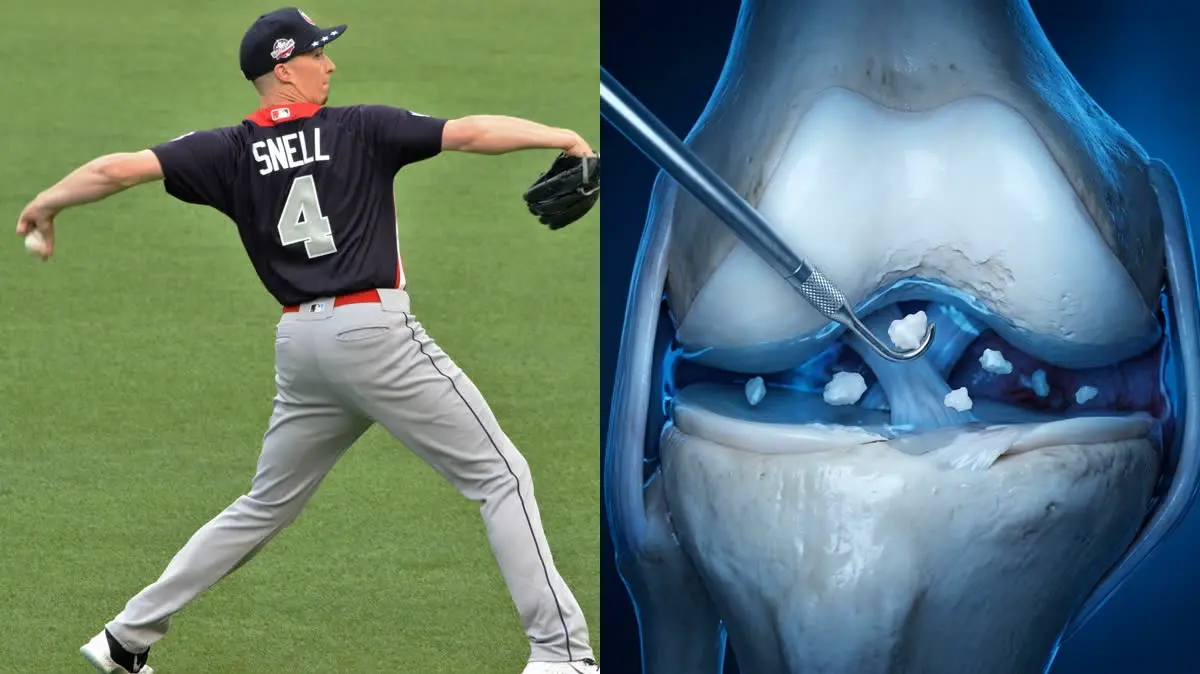
"Minimally invasive arthroscopy has reached its peak with the NanoNeedle. By removing loose joint bodies through a 2-millimeter portal, we can preserve the surrounding soft tissues, minimize postoperative scar tissue, and significantly accelerate return-to-play timelines for elite pitchers."
On May 19, 2026, Los Angeles Dodgers ace and two-time Cy Young Award winner Blake Snell underwent cutting-edge NanoNeedle Scope surgery to remove loose cartilage bodies from his throwing elbow. The breaking news represents a critical moment for the Dodgers' rotation, but it also highlights a massive technological shift in sports medicine: the transition from traditional arthroscopy to ultra-minimally invasive needle endoscopy.
For elite pitchers, elbow joint irritation is a common consequence of chronic valgus stress. When bone fragments or cartilage chips break free and float within the joint space, they cause painful catching, swelling, and range-of-motion limits. In this clinical reconstruction, we will analyze the biomechanics of elbow loose bodies, compare NanoNeedle technology with traditional surgery, and outline the eccentric rehabilitation protocol required to get Snell back on the mound.
The Pathology: Why Pitchers Form Elbow 'Loose Bodies'
The throwing motion in baseball is one of the most violent actions in professional sports. During the late cocking and early acceleration phases of pitching, the elbow is subjected to extreme valgus torque—averaging over 64 Newton-meters. This force creates massive tensile stress on the medial side of the joint (stretching the ulnar collateral ligament, or UCL) and simultaneously compresses the lateral side of the joint (where the radial head collides with the humeral capitellum).
This chronic lateral compression leads to localized micro-fractures of the articular cartilage, a condition known as osteochondritis dissecans (OCD) or shear-induced microtrauma. Over time, small fragments of bone or cartilage break off from the joint surface. These "loose bodies" float within the joint capsule. When a loose body becomes wedged between the articulating surfaces of the humerus and ulna, it acts like a wedge under a door, causing acute pain, swelling, and sudden joint locking.
| Feature | Traditional Arthroscopy | NanoNeedle Scope |
|---|---|---|
| Portal Size | 4.0mm to 5.0mm diameter | 1.9mm to 2.2mm diameter |
| Anesthesia | General anesthesia required | Local anesthesia with sedation |
| Tissue Trauma | Sutures needed, portal scarring | Sutureless, needle puncture entry |
| Typical Return | 6 to 10 weeks for throwers | 4 to 6 weeks to throwing |
NanoNeedle Surgery: The Surgical Breakthrough
Traditional elbow arthroscopy requires multiple 4mm to 5mm incisions. While still minimally invasive, accessing the tight elbow joint space with a standard scope requires significant fluid distension and carries a risk of stretching the nearby ulnar or radial nerves. It also leaves portal scar tissue that must heal before full extension is regained.
The Arthrex NanoScope system uses a 1.9mm chip-on-the-tip camera, allowing the surgeon to enter the joint capsule using a small needle cannula. Because the camera is so thin, the surgeon can navigate the tight compartments of the elbow with minimal disruption to the surrounding ligaments and joint capsule. The loose cartilage bodies are visualized, captured with micro-forceps, and extracted through the needle tract. Postoperatively, there are no stitches to remove; the puncture sites are closed with adhesive strips, resulting in negligible joint swelling and a dramatic reduction in pain.
"The biggest challenge after elbow surgery in pitchers is not the bone healing—it is regaining terminal elbow extension. If a pitcher loses even 3 to 5 degrees of extension due to scar tissue in the joint capsule, it alters their release point, increases stress on the shoulder, and significantly elevates the risk of UCL failure. The NanoNeedle scope minimizes capsular trauma, which means we can begin passive range-of-motion work within 48 hours of surgery, completely avoiding the stiffening phase that occurs with traditional arthroscopy."
The Elite Pitcher's Elbow Rehabilitation Protocol
Regaining the explosive force required for a 95mph fastball requires a meticulous rehabilitation plan focused on joint mobility, eccentric forearm strength, and kinetic chain integration.
- 1Phase 1: Regaining Mobility and Calming Inflammation (Days 1–7)Regaining full elbow extension is the primary goal. Passive and active-assisted range-of-motion exercises are performed daily. Soft tissue mobilization targets the pronator teres and wrist flexor group to reduce protective muscle guarding. Cryotherapy controls localized swelling.
- 2Phase 2: Closed-Chain Strength and Scapular Stability (Weeks 2–3)Regaining scapular control is critical to reduce the load on the elbow. We implement scapular retraction/protraction exercises, rotator cuff strengthening (internal and external rotation at 90 degrees), and light closed-kinetic-chain exercises (such as wall slides and quadruped stabilization). Forearm strengthening begins with low-load wrist flexion and extension.
- 3Phase 3: Eccentric Pronation and Plyometric Drills (Weeks 4–5)We introduce eccentric wrist pronation and flexion exercises to build dynamic support for the medial elbow. Light plyometric training (such as chest passes and overhead throws using a 2-pound medicine ball) prepares the upper extremity for explosive force. The athlete begins a structured interval throwing program on flat ground at 45 feet, progressing to 60 feet.
- 4Phase 4: Mound Progression and Bullpen Sessions (Weeks 6+)The throwing program progresses to 120 feet, followed by sub-maximal bullpen sessions. High-speed video analysis ensures correct mechanics, verifying that the shoulder and hip rotate in sequence to prevent elbow extension velocity lag. Return to game play is permitted when bullpen sessions are completed pain-free at maximum intensity.
Featured image: Clinical side-by-side composite showing Blake Snell pitching (left) and an anatomical 3D rendering of an arthroscopic elbow view showing floating loose osteochondral fragments (right). Created for AyurPhysio editorial use. Wikimedia Commons attribution: Blake Snell image from 2018 licensed under CC BY-SA 2.0.
Dr. Dhanushika Dilshani
Expert Ayurvedic Wellness Doctor. Specialized in modern holistic wellness, optimizing dermal resilience, cosmetic radiance, and systematic diagnosis driven by traditional and evidence-based medical logic.
Medical Disclaimer
The information provided by AyurPhysio is for general educational and informational purposes only. It is not intended as a substitute for professional medical advice, diagnosis, or treatment. Always seek the advice of your physician or other qualified health providers with any questions you may have regarding a medical condition. Never disregard professional medical advice or delay in seeking it because of something you have read on this website.
Trending Guides
Luka Modrić's Daily Routine: Low-Impact Resistance Training and Midfield Longevity
4 min readHarry Kane's Daily Routine: Hamstring Preservation and Anti-Inflammatory Nutrition
4 min readKarim Benzema's Daily Routine: Cupping Therapy (Hijama) and HIIT Conditioning
4 min readNeymar Jr.'s Daily Routine: Joint Stabilization and Hyperbaric Oxygen Therapy
4 min readMohamed Salah's Daily Routine: Early Morning Conditioning and Hyperbaric Recovery
4 min readWeekly Wellness
Don't miss the next guide
Get holistic health tips and new guides delivered to your inbox.
Related Healing Guides
View All Guides →
Luka Modrić's Daily Routine: Low-Impact Resistance Training and Midfield Longevity
Harry Kane's Daily Routine: Hamstring Preservation and Anti-Inflammatory Nutrition