"The knee joint of an 84-year-old who has spent sixty years performing, traveling, and standing on stage has earned every millimeter of its wear. The clinical challenge is not to restore the knee to its 1960s condition — it is to keep its owner mobile, pain-managed, and independent on her own terms."
On May 17, 2026, legendary EGOT winner Barbra Streisand announced she would be unable to attend the Cannes Film Festival, where she was set to receive an Honorary Palme d'Or — one of cinema's highest distinctions. The reason, delivered on medical advice, was a knee injury preventing her from traveling.
For a woman whose six-decade career has been defined by absolute mastery and presence, missing this milestone is significant. But for the 84-year-old performer, it also opens a window into a conversation that millions of aging adults are navigating privately: what does knee osteoarthritis actually look like at this stage of life, and what are the real clinical options when a knee fails you at the worst possible moment?
What Is Gonarthrosis — And Why It Escalates at 80+
Gonarthrosis is the technical clinical term for knee osteoarthritis — the progressive erosion of the articular cartilage that cushions the tibiofemoral joint. Think of healthy cartilage as a perfectly lubricated shock absorber between your thighbone and shinbone. Gonarthrosis is what happens when that absorber slowly disintegrates, leaving two increasingly rough bone surfaces grinding directly against each other.
In adults over 80, the prevalence of radiographically visible gonarthrosis exceeds 65%. By this age, the cartilage loss is rarely isolated — it is accompanied by osteophyte (bone spur) formation, synovial membrane inflammation, subchondral bone sclerosis, and periarticular muscle weakness. The knee, in other words, is no longer just a cartilage problem. It is a whole-joint systemic degeneration.
- Adults over 80 with symptomatic gonarthrosis lose an average of 12–18% of quadriceps strength per year of disease progression, accelerating functional decline.
- Radiographic Grade 3–4 gonarthrosis (severe bone-on-bone) is present in approximately 30% of adults over age 80.
- The tibiofemoral joint space narrows at a clinically significant rate of 0.2–0.3mm per year in moderate OA — faster in patients with BMI over 30 or a history of meniscal pathology.
- At 84, the risk of perioperative complication from total knee replacement surgery increases by 40% compared to patients aged 65–70, making conservative management the gold-standard first line.
Why Travel Is the Worst Possible Trigger
Streisand's decision — made explicitly on medical advice — to cancel international travel deserves clinical context. For a person with advanced gonarthrosis, a transatlantic flight is biomechanically equivalent to sitting in a small, poorly cushioned chair for 10–12 hours while your knees are locked at 90 degrees, with minimal opportunity to extend, unload, or circulate blood through the already-compromised synovial tissue.
The consequences are predictable and severe: gravity-driven fluid pooling into the joint capsule (causing significant post-flight swelling), decreased venous return (which in itself can trigger deep vein thrombosis in a knee already compromised by poor circulation), and articular cartilage that receives no nutritive pumping from normal ambulation. A knee that is borderline manageable at home often becomes acutely painful for 3–5 days following long-haul travel.
"Total knee replacement is frequently positioned as the inevitable endpoint of severe gonarthrosis. But at 84, it is almost never the right first — or even second — option. The post-operative rehabilitation from TKR demands 12 weeks of intensive daily physiotherapy, significant cardiovascular reserve, and the ability to safely bear full weight within 24 hours. For an elderly patient, the perioperative risks — cardiac events, pulmonary embolism, cognitive decline under general anesthesia — frequently outweigh the benefits. Conservative management done excellently is a superior treatment path for the vast majority of octogenarians with OA."
The Conservative Management Protocol for Advanced Gonarthrosis
- 1Hyaluronic Acid ViscosupplementationIntra-articular injections of high-molecular-weight hyaluronic acid restore synovial fluid viscosity — essentially re-lubricating the grinding joint. Clinical trials show 40–60% pain reduction in Grade 2–3 OA, with effects lasting 6–12 months. This is likely the intervention allowing Streisand to manage her condition at home.
- 2Neuromuscular Quadriceps ActivationA 10% increase in quadriceps strength is associated with a 28% reduction in knee pain in gonarthrosis. Seated leg press, terminal knee extensions with theraband, and neuromuscular electrical stimulation (NMES) are clinically validated in patients where traditional squatting is too painful.
- 3Aquatic PhysiotherapyThe viscosity and buoyancy of water unloads the tibiofemoral joint by up to 60% of bodyweight, allowing pain-free range-of-motion and strengthening exercises impossible on land. Warm-water hydrotherapy (34–35°C) additionally reduces periarticular muscle spasm and synovial inflammation simultaneously.
- 4Medial Unloader Knee BraceMechanically offloads the most commonly affected medial compartment by shifting load to the intact lateral compartment. Reduces pain by an average of 3.1 points on an 11-point scale and improves walking distance by 42% in controlled trials — a significant functional gain for everyday mobility.
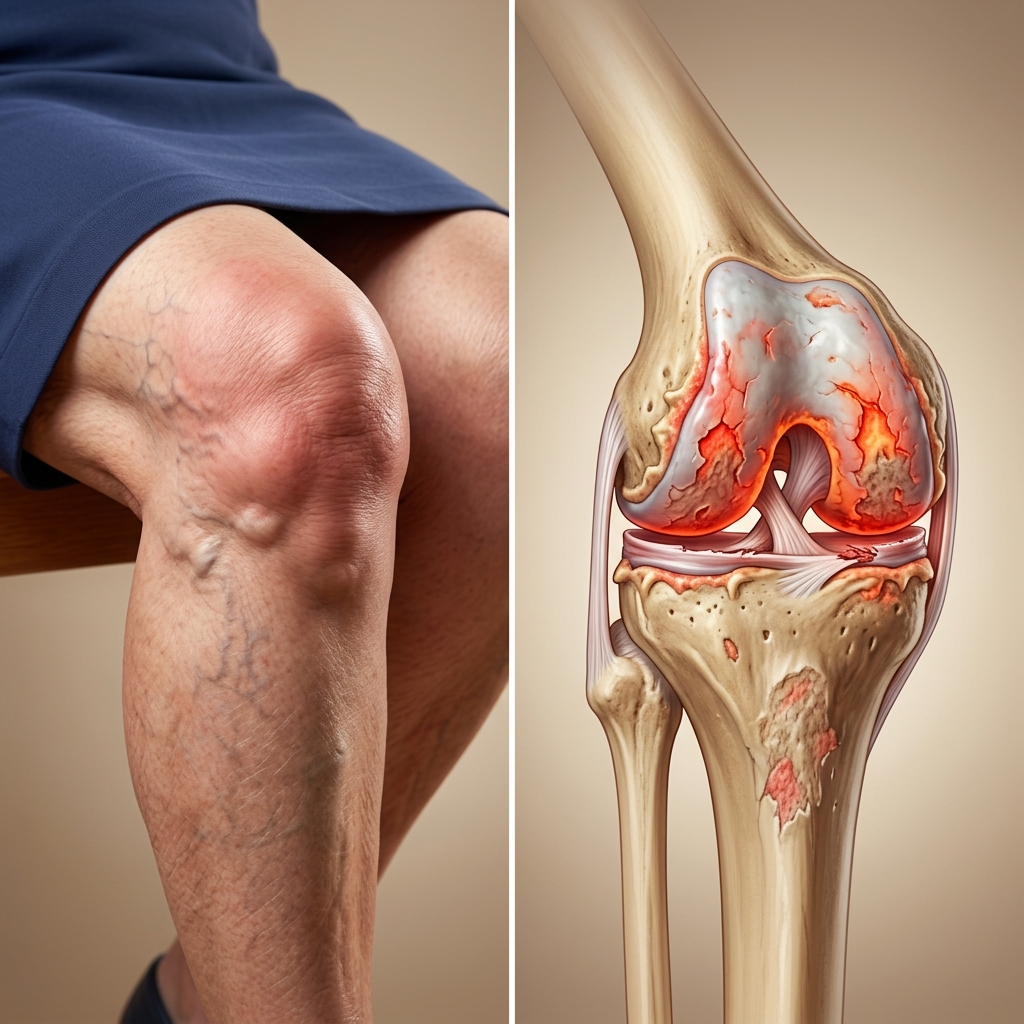
Featured image: Clinical composite showing knee osteoarthritis with swollen joint (left) and anatomical cross-section of Grade 4 gonarthrosis with cartilage erosion (right). Created for AyurPhysio editorial use.
Dr. Dhanushika Dilshani
Expert Ayurvedic Wellness Doctor. Specialized in modern holistic wellness, optimizing dermal resilience, cosmetic radiance, and systematic diagnosis driven by traditional and evidence-based medical logic.
Medical Disclaimer
The information provided by AyurPhysio is for general educational and informational purposes only. It is not intended as a substitute for professional medical advice, diagnosis, or treatment. Always seek the advice of your physician or other qualified health providers with any questions you may have regarding a medical condition. Never disregard professional medical advice or delay in seeking it because of something you have read on this website.
Trending Guides
Luka Modrić's Daily Routine: Low-Impact Resistance Training and Midfield Longevity
4 min readHarry Kane's Daily Routine: Hamstring Preservation and Anti-Inflammatory Nutrition
4 min readKarim Benzema's Daily Routine: Cupping Therapy (Hijama) and HIIT Conditioning
4 min readNeymar Jr.'s Daily Routine: Joint Stabilization and Hyperbaric Oxygen Therapy
4 min readMohamed Salah's Daily Routine: Early Morning Conditioning and Hyperbaric Recovery
4 min readWeekly Wellness
Don't miss the next guide
Get holistic health tips and new guides delivered to your inbox.
Related Healing Guides
View All Guides →
Luka Modrić's Daily Routine: Low-Impact Resistance Training and Midfield Longevity
Harry Kane's Daily Routine: Hamstring Preservation and Anti-Inflammatory Nutrition