"A health scare at 78 is not a punishment — it is an overdue notification. The body has been sending quieter messages for years. The scare is the moment it finally decides to send the message as a telegram rather than a whisper."
On May 6, 2026, actor Ted Danson — beloved for decades as Sam Malone in Cheers and Michael in The Good Place — disclosed on his podcast that he had recently experienced an unexpected "health scare" that he described as "shocking" and "humbling." At 78 years old, Danson emphasized that he is "totally fine" but that the episode profoundly shifted his priorities. He and his wife, Mary Steenburgen, now meditate together twice daily.
While the specific nature of his health event has not been disclosed, Danson's instinctive pivot toward twice-daily meditation is a clinically significant response — one that modern neuroscience can now fully explain through the vagus nerve, and that Ayurveda predicted through the concept of Sadhaka Pitta over five thousand years ago.
The Vagus Nerve: Your Body's Built-In Emergency Brake
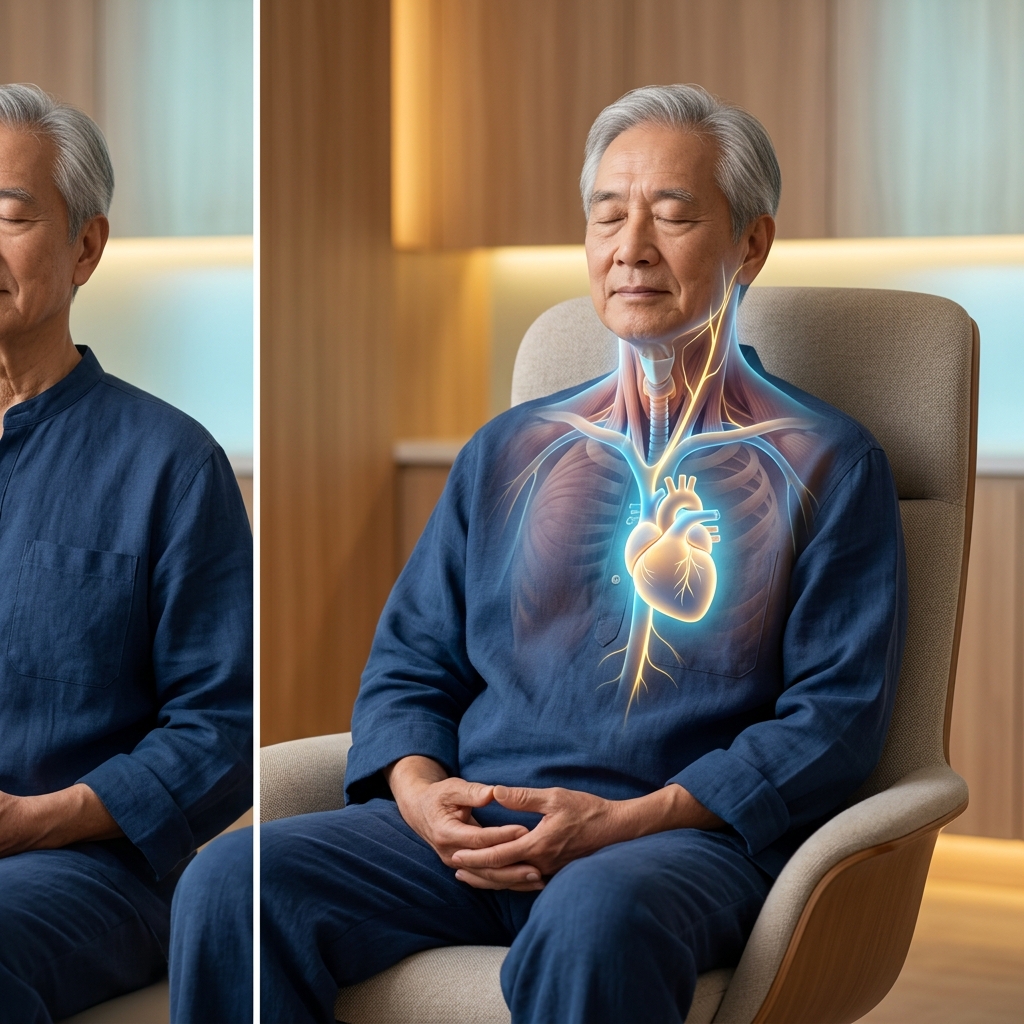
The vagus nerve — Latin for "wandering" — is the longest cranial nerve in the human body, originating in the brainstem and descending through the neck, chest, and abdomen to reach virtually every major organ: the heart, lungs, stomach, liver, kidneys, and intestines. It is the anatomical highway of the parasympathetic nervous system — the biological "rest and digest" counterforce to the sympathetic "fight or flight" cascade.
When the vagus nerve is functioning optimally, it maintains what physiologists call high vagal tone — a state in which the body efficiently cycles between arousal and recovery, keeps heart rate variability (HRV) high, maintains anti-inflammatory cytokine balance, and preserves immune surveillance. Think of vagal tone as your body's signal-to-noise ratio: a high-tone vagal nerve filters out unnecessary physiological alarm signals, while a low-tone nerve allows every minor stressor to cascade into a systemic inflammatory response.
- Adults with high heart rate variability (HRV) — the primary clinical marker of vagal tone — have a 34% lower all-cause cardiovascular mortality risk compared to those with low HRV.
- A 2023 meta-analysis confirmed that regular meditation practice increases HRV measurably within 8 weeks, with gains of 15–25% in resting HRV being consistently documented.
- Chronic low vagal tone is associated with elevated TNF-α and IL-6 inflammatory markers — the same biomarkers linked to increased risk of cardiovascular events, depression, autoimmunity, and cognitive decline.
- Diaphragmatic breathing at 5–6 breaths per minute (the resonance frequency breathing pattern used in meditation) produces the greatest acute vagal activation of any non-pharmacological intervention, reducing systolic blood pressure by an average of 8–12mmHg in hypertensive subjects.
The Ayurvedic Framework: Sadhaka Pitta and the Heart-Mind Axis
In Ayurvedic physiology, the heart (Hridaya) is not merely a pump. It is the seat of Sadhaka Pitta — the subtle form of Pitta dosha that governs intelligence, emotional processing, memory, and the integration of experience into wisdom. When Sadhaka Pitta is in balance, the heart functions as a coherent center of clarity, resilience, and emotional regulation. When it is depleted or aggravated — by chronic stress, insufficient sleep, excessive professional demands, or the shock of a sudden health event — the heart loses its role as a stabilizing center and becomes a site of anxiety, palpitations, and vulnerability.
A significant health scare is, in Ayurvedic terms, precisely the kind of shock that momentarily collapses the Sadhaka Pitta field — creating the very instability that drives Danson's reported feelings of mortality awareness and the urgent need to re-establish stillness through meditation.
"Ted Danson's instinctive response to his health scare is one of the most clinically intelligent decisions a 78-year-old man can make. Twice-daily meditation at this stage of life does something that no pharmaceutical can: it systematically rebuilds vagal tone, reduces chronic sympathetic overdrive, and allows the Sadhaka Pitta field to stabilize. The research is unambiguous — meditation at this intensity, practiced consistently, extends functional healthspan by measurable biological markers. Telomere length, inflammatory cytokines, cortisol rhythms, and cognitive processing speed all respond favorably to regular deep contemplative practice in the aging adult."
How to Build Vagal Tone and Restore Sadhaka Pitta: The Complete Protocol
- 1Resonance Frequency Breathing (5–6 breaths/min)The single most powerful acute vagal activator. Inhale for 5 seconds, exhale for 5 seconds. Practice for 20 minutes twice daily — precisely what Danson has adopted. This pattern synchronizes baroreflex activity and cardiac oscillations, producing the greatest measurable increase in HRV of any breathing technique.
- 2Shirodhara — Ayurvedic Vagal ActivationThe Ayurvedic treatment of continuously streaming warm medicated oil (Brahmi taila or Ksheerabala taila) over the forehead directly stimulates the trigeminal nerve and its vagal connections. Clinical studies at Ayurvedic research institutes document significant increases in parasympathetic dominance following Shirodhara, with patients reporting deep calm and measurably reduced salivary cortisol levels post-treatment.
- 3Brahmi (Bacopa monnieri) for Sadhaka Pitta NourishmentThe premier Ayurvedic nootropic herb. Clinical trials confirm that Brahmi supplementation (300mg twice daily) significantly improves information processing speed, reduces anxiety, and lowers cortisol levels in adults over 65 — all markers of improved Sadhaka Pitta function and enhanced vagal tone. Dr. Dilshani considers it the most clinically supported Ayurvedic intervention for aging heart-mind health.
- 4Cold Facial Immersion (Dive Reflex Activation)Submerging the face in cold water (10–15°C) for 30 seconds activates the mammalian dive reflex — one of the most powerful direct vagal activators in human physiology, dropping heart rate by 10–25% within seconds. As a brief morning practice, it provides an immediate, measurable parasympathetic reset.
- 5Humming and Chanting — Glottal Vagal StimulationThe vagus nerve innervates the muscles of the larynx (voice box). Humming, chanting (including Ayurvedic mantras like Om), and sustained vocalization directly stimulate vagal afferents through glottal vibration, producing documented increases in HRV and reduction of sympathetic arousal markers — the physiological basis for Nada Yoga's millennia of healing use.
The Wisdom Hidden in the Scare
Ted Danson described his health event as "calming" — a paradox that only makes sense when you understand what a brush with mortality actually does to the nervous system of a conscious, reflective person. It removes the ambient noise of routine anxiety and forces a recalibration toward what is actually important.
In Ayurvedic terms, it cleared the Sadhaka Pitta field. Danson's pivot to twice-daily meditation is not a life hack — it is a biological necessity that his body is now enforcing through lived experience rather than intellectual persuasion.
For the complete Ayurvedic framework for nervous system and mind-body health, our guide to managing Vata and the nervous system provides the constitutional foundation. The Shirodhara therapy he would benefit most from is explored in depth in our head therapy and sleep guide. And for the Brahmi-Shankhapushpi nootropic protocol, our Ayurvedic mental health guide covers the clinical detail.
The body sends a health scare to get your undivided attention. What Danson chose to do with that attention — twice a day, sitting still, breathing with intention — is perhaps the most clinically sophisticated response available to any 78-year-old. The question the rest of us must ask is: do we need our own scare to make the same choice?
Featured image: Clinical composite of elderly man meditating with vagus nerve pathway and heart illuminated, showing parasympathetic activation. Created for AyurPhysio editorial use.
Dr. Dhanushika Dilshani
Expert Ayurvedic Wellness Doctor. Specialized in modern holistic wellness, optimizing dermal resilience, cosmetic radiance, and systematic diagnosis driven by traditional and evidence-based medical logic.
Medical Disclaimer
The information provided by AyurPhysio is for general educational and informational purposes only. It is not intended as a substitute for professional medical advice, diagnosis, or treatment. Always seek the advice of your physician or other qualified health providers with any questions you may have regarding a medical condition. Never disregard professional medical advice or delay in seeking it because of something you have read on this website.
Trending Guides
Luka Modrić's Daily Routine: Low-Impact Resistance Training and Midfield Longevity
4 min readHarry Kane's Daily Routine: Hamstring Preservation and Anti-Inflammatory Nutrition
4 min readKarim Benzema's Daily Routine: Cupping Therapy (Hijama) and HIIT Conditioning
4 min readNeymar Jr.'s Daily Routine: Joint Stabilization and Hyperbaric Oxygen Therapy
4 min readMohamed Salah's Daily Routine: Early Morning Conditioning and Hyperbaric Recovery
4 min readWeekly Wellness
Don't miss the next guide
Get holistic health tips and new guides delivered to your inbox.
Related Healing Guides
View All Guides →
Luka Modrić's Daily Routine: Low-Impact Resistance Training and Midfield Longevity
Harry Kane's Daily Routine: Hamstring Preservation and Anti-Inflammatory Nutrition