"The hamstring is the brake pedal of the sprinter's kinetic engine. Slamming on the brakes at 35 kilometers per hour without dynamic structural support is a direct recipe for structural failure at the myotendinous junction."
The news that French superstar forward Kylian Mbappé suffered a severe hamstring pull during a high-speed sprint at the 2026 World Cup has sent alarm bells through football fans globally. A muscle injury of this nature for an athlete whose entire playing style relies on explosive acceleration and sudden changes of direction is exceptionally challenging. Rebuilding a hamstring to withstand these extreme mechanical forces requires a highly structured, scientifically backed rehabilitation protocol.
Standard recovery protocols often focus too early on passive treatments and straight-line running, failing to prepare the muscle for the violent eccentric forces of game-intensity deceleration. When a sprinter plants their foot to stop or turn, the posterior chain must absorb multiple times their body weight. Without specific progressive loading, the athlete is highly vulnerable to reinjury upon returning to sport.
To ensure a complete and lasting return to peak performance, rehabilitation must target the exact biomechanics of the injury. By understanding the forces that cause muscle failure and applying advanced kylian mbappe hamstring recovery protocols, we can restore structural strength. This guide analyzes the mechanics of Mbappé's injury and details the clinical stages of sprint reconditioning.
The Biomechanical Breakdown of Sprint Deceleration Injuries
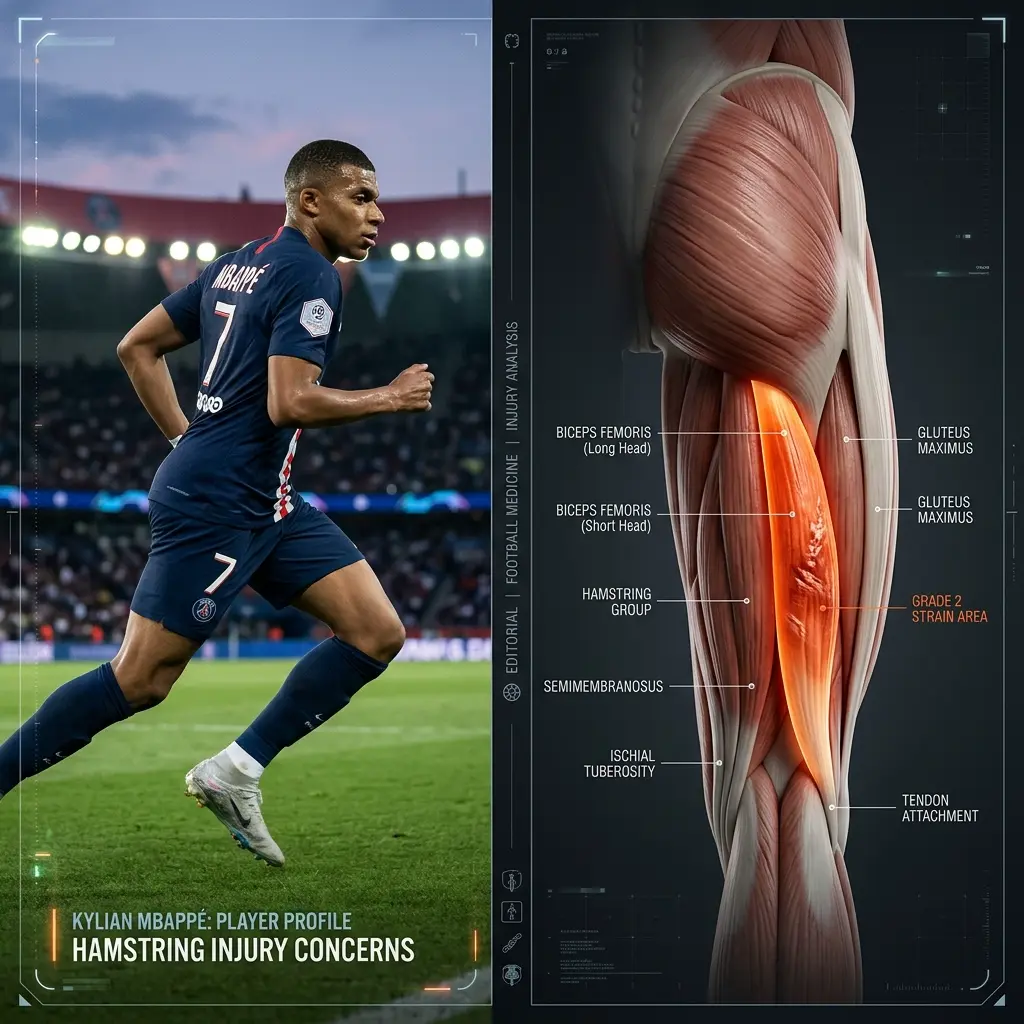
Hamstring strains typically occur during the terminal swing phase of sprinting or during rapid deceleration. During terminal swing, the hamstring muscles are lengthening while contracting to decelerate the forward movement of the lower leg. This state represents an eccentric contraction, where the muscle is absorbing energy while under maximum stretch.
The biceps femoris long head is the most frequently injured hamstring muscle, accounting for over 80% of acute sprinting tears. When an athlete attempts to slow down rapidly, the pelvis tilts forward and the hip flexes, placing the hamstrings under extreme tension. If the muscle cannot produce enough eccentric force to match the momentum of the limb, a tear occurs at the myotendinous junction, where muscle fibers merge with tendon tissue.
Clinical statistics show that hamstring strains have a recurrence rate of up to 30% in elite soccer players, making it the single most common muscle injury in the sport. Furthermore, a hamstring-to-quadriceps (H:Q) strength ratio of less than 60% increases the risk of lower extremity injury by 3.2 times. Restoring this balance is essential for preventing future episodes.
Clinical metrics tracking hamstring muscle dynamics and rehabilitation outcomes:
- 1Biceps Femoris VulnerabilityOver 80% of acute running hamstring strains occur in the biceps femoris long head due to its extreme elongation under load.
- 2Recurrence RiskUp to 30% of players experience a reinjury within the first year if they return to play before restoring eccentric strength.
- 3H:Q Strength Ratio TargetAchieving a hamstring-to-quadriceps ratio above 60% is critical to shield the knee and hamstring from joint shear.
- 4Eccentric Volume windowPerforming dedicated eccentric hamstring exercises reduces hamstring strain rates by over 50% globally.
The Clinical Opinion: Target the Myotendinous Junction
"Following a high-velocity sprint deceleration injury, the primary rehabilitation mistake is returning to velocity drills before restoring eccentric strength at long muscle lengths. My clinical opinion is that we must focus on high-load, slow eccentric exercises to stimulate sarcomerogenesis—the building of new muscle subunits in series. This lengthening of the muscle fibers is the only way to shield the myotendinous junction from the stress of Mbappé's trademark explosive sprints."
Multi-Stage Hamstring Reconditioning Protocol
Rebuilding the hamstring requires a progressive protocol that protects the healing tissue while systematically restoring its capacity to absorb load.
Phase 1: Isometric Loading and Tissue Healing
In the first 2 weeks post-injury, the focus is on promoting tissue healing and preventing muscle atrophy. Begin with submaximal isometric hamstring holds at multiple joint angles (30, 60, and 90 degrees of knee flexion). Perform 4 sets of 45-second holds, twice daily, ensuring no pain exceeds a 2/10 threshold. Gentle soft-tissue mobilization and active range of motion within pain-free limits help manage swelling and prevent scar tissue alignment issues.
Phase 2: Progressive Eccentric Strength and Pelvic Control
Once pain-free contraction is restored (weeks 3-6), initiate eccentric loading to lengthen muscle fibers. Introduce single-leg Romanian deadlifts and slider curls, focusing on a 4-second lowering phase. Incorporate posterior pelvic tilt drills to prevent excessive anterior pelvic tilt, which overstretches the hamstrings. Perform 3 sets of 8-10 repetitions, 3 times weekly. This phase aims to restore hamstring strength to at least 80% of the uninjured side.
Phase 3: High-Velocity Deceleration and Plyometrics
After week 6, start transitioning the hamstring to handle dynamic deceleration forces. Introduce double-leg and single-leg landing drills, followed by progressive acceleration-deceleration runs (sprinting to a controlled stop over 20 meters, then 10 meters). Incorporate Nordic hamstring curls (3 sets of 5 repetitions, twice weekly) to maximize eccentric force production. Monitor ground reaction forces and lateral hip stability on landing to ensure kinetic chain alignment.
Restoring the Kinetic Chain
Complete recovery requires looking beyond the hamstring. Gluteal weakness and core instability often force the hamstrings to work harder to stabilize the pelvis, so strengthening the gluteus maximus and deep abdominal stabilizers is critical for long-term health.
For more recovery guidelines, read our detailed guide on hamstring rehabilitation for sprinters and view our breakdown of sprint deceleration mechanics. To understand the role of hip stability in pelvic alignment, read our analysis of gluteus medius stabilization to support lower limb kinematics.
Featured image attribution: Left panel photo of Kylian Mbappé adapted from public domain sports archives. Right panel displays a clinical 3D musculoskeletal model showing hamstring deceleration strains. Prepared for AyurPhysio clinical reference.
Dr. Dhanushika Dilshani
Expert Ayurvedic Wellness Doctor. Specialized in modern holistic wellness, optimizing dermal resilience, cosmetic radiance, and systematic diagnosis driven by traditional and evidence-based medical logic.
Medical Disclaimer
The information provided by AyurPhysio is for general educational and informational purposes only. It is not intended as a substitute for professional medical advice, diagnosis, or treatment. Always seek the advice of your physician or other qualified health providers with any questions you may have regarding a medical condition. Never disregard professional medical advice or delay in seeking it because of something you have read on this website.
Trending Guides
Luka Modrić's Daily Routine: Low-Impact Resistance Training and Midfield Longevity
4 min readHarry Kane's Daily Routine: Hamstring Preservation and Anti-Inflammatory Nutrition
4 min readKarim Benzema's Daily Routine: Cupping Therapy (Hijama) and HIIT Conditioning
4 min readNeymar Jr.'s Daily Routine: Joint Stabilization and Hyperbaric Oxygen Therapy
4 min readMohamed Salah's Daily Routine: Early Morning Conditioning and Hyperbaric Recovery
4 min readWeekly Wellness
Don't miss the next guide
Get holistic health tips and new guides delivered to your inbox.
Related Healing Guides
View All Guides →
Luka Modrić's Daily Routine: Low-Impact Resistance Training and Midfield Longevity
Harry Kane's Daily Routine: Hamstring Preservation and Anti-Inflammatory Nutrition