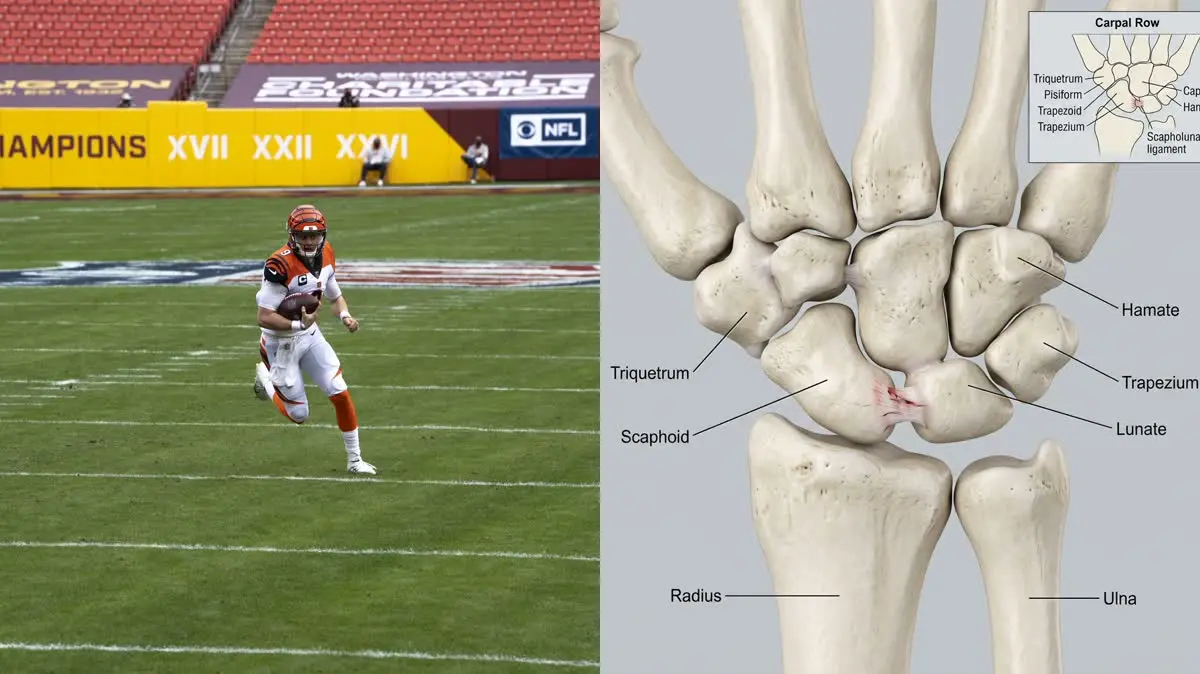
"When the scapholunate ligament fails, the carpal bones lose their collective unity. The scaphoid flexes forward while the lunate tilts backward, separating like structural columns slipping from their base under heavy load."
The biomechanics of throwing an American football require an intricate blend of kinetic transfer, wrist stability, and explosive grip release. When Cincinnati Bengals quarterback Joe Burrow suffered a season-ending wrist injury, the public was introduced to one of the most critical structural links in the hand: the scapholunate ligament. A tear here is not just a standard sprain; it is a disruptive mechanical failure that halts grip force transmission and compromises the entire wrist joint.
Many athletes attempt to play through wrist soreness by taping the joint tightly. However, without a functional scapholunate link, axial loading of the wrist pushes the hand bones apart. This carpal instability spikes localized joint friction, leading to early cartilage wear, chronic pain, and a complete collapse of throwing accuracy.
To recover from a scapholunate ligament tear recovery, you must understand the bone kinematics at play. This guide outlines the biomechanical consequences of the tear and provides a structured pathway for carpal bone stabilization exercises and grip rehabilitation.
The Scapholunate Complex: The Wrist's Central Keystone
The human wrist is composed of eight small carpal bones arranged in two rows. In the proximal row, the scaphoid and the lunate sit side-by-side, serving as the bridge to the radius bone of the forearm. Binding these two bones is the scapholunate interosseous ligament (SLIL). This C-shaped ligament consists of dorsal, membranous, and volar regions, with the thick dorsal region providing the primary mechanical resistance against bone separation.
During a high-impact fall on an outstretched hand (FOOSH), or during extreme wrist torque while holding a heavy grip, the wrist is forced into hyperextension and ulnar deviation. This loads the scaphoid bone, forcing it into flexion while the lunate remains tethered. If the force exceeds the ligament's tensile limit, the SLIL tears. The scaphoid tilts forward (volar flexion) and the lunate tilts backward (dorsal extension), a condition known as Dorsal Intercalated Segment Instability (DISI).
Clinical orthopedic databases show that a complete scapholunate diastasis (widening) of more than 3 millimeters is a primary indicator of joint instability, often referred to as the "Terry Thomas sign." Left unrepaired, this widening alters contact stress on the radius, reducing the weight-bearing area by over 50% and causing a progressive degenerative condition known as Scapholunate Advanced Collapse (SLAC) within several years.
Biomechanical studies demonstrate the impact of scapholunate dissociation on hand performance:
- 1Ligament Tear Grip LossA complete SLIL disruption reduces peak hand grip force by up to 60% due to unstable carpal transfer.
- 2Scapholunate Gap LimitsA normal scapholunate gap is 1 to 2 millimeters. A gap exceeding 3 millimeters indicates mechanical dissociation.
- 3Load Concentration SpikesCarpal dissociation shifts 80% of the wrist's axial load onto the radioscaphoid facet, accelerating arthritis.
- 4Surgical Healing TimelinePost-surgical ligament reconstruction requires 8 to 12 weeks of strict immobilization before loading begins.
The Clinical Opinion: Avoid Early Passive Stretching
"In my clinic, I frequently see patients who try to restore wrist range of motion early by performing aggressive passive wrist extension stretches. My decisive opinion is that this is highly damaging. Stretched extension drives the scaphoid and lunate apart, directly stressing the healing fibers of the scapholunate ligament. You must prioritize isometric carpal stabilization and dynamic control of the wrist flexors before attempting to regain end-range extension."
The 3-Phase Carpal Stabilization Protocol
Rehabilitating a scapholunate ligament injury requires a transition from rigid protection to targeted isometric activation and kinetic chain integration.
Phase 1: Splinting and Swelling Management
The primary goal is protecting the joint from separation. The wrist is immobilized in a custom thermoplastic splint or cast, holding it in slight flexion and neutral deviation to minimize stress on the dorsal ligament fibers. Hand swelling is managed with gentle retrograde massage and active finger movement. Avoid all grasping, lifting, or twisting activities. This phase lasts 4 to 6 weeks for non-surgical cases, and up to 8 to 12 weeks post-surgery.
Phase 2: Isometric Grip and Carpal Control
Once cleared for active movement, introduce isometric wrist activation to stabilize the carpal rows. Rest your forearm on a flat table with your wrist in a neutral position. Gently squeeze a soft foam block or putty, holding for 5 seconds without allowing the wrist to bend. This muscle contraction activates the flexor carpi radialis (FCR), which naturally pulls the scaphoid back into alignment. Perform 3 sets of 10 squeezes twice daily.
Phase 3: Dart-Thrower's Motion and Proprioception
To rebuild functional mobility without stressing the scapholunate joint, utilize the "dart-thrower's motion." This diagonal movement pathway goes from wrist extension/radial deviation to flexion/ulnar deviation. Hold a light hammer or a water bottle. Move your wrist along this diagonal track, avoiding pure flexion or extension. Progress to single-leg balance ball-catching drills to restore reactive wrist proprioception. Perform 3 sets of 15 repetitions daily.
Long-Term Hand and Wrist Preservation
Rebuilding a strong hand grip requires patience. To protect your carpal bones from future trauma, perform regular wrist-strengthening routines and avoid repetitive, unassisted heavy lifting. It is also beneficial to maintain flexibility in the forearm pronators and supinators, as muscle tightness in these compartments directly increases the rotational torque placed on the carpal joints during high-speed athletic movements.
Additionally, athletes should pay attention to their elbow and shoulder biomechanics. A weak kinetic chain forces the wrist to compensate, increasing the shear stresses transmitted through the hand. Incorporate forearm stabilization exercises into your upper body workouts to protect your joints. Keep in mind that ligament fibers take up to a full year to mature completely, meaning progressive conditioning is your best defense against re-injury.
For more detailed guidelines on upper extremity rehabilitation, read our post on carpal tunnel nerve glides and check our analysis of myofascial release for tight shoulders. To understand forearm tendon mechanics, view our guide on wrist surgery recovery and grip torque to balance your upper body workouts.
Featured image attribution: "Joe Burrow 2020" by All-Pro Reels, licensed under CC BY-SA 2.0. Modified by cropping and compositing with an anatomical render.
Dr. Dhanushika Dilshani
Expert Ayurvedic Wellness Doctor. Specialized in modern holistic wellness, optimizing dermal resilience, cosmetic radiance, and systematic diagnosis driven by traditional and evidence-based medical logic.
Medical Disclaimer
The information provided by AyurPhysio is for general educational and informational purposes only. It is not intended as a substitute for professional medical advice, diagnosis, or treatment. Always seek the advice of your physician or other qualified health providers with any questions you may have regarding a medical condition. Never disregard professional medical advice or delay in seeking it because of something you have read on this website.
Trending Guides
Luka Modrić's Daily Routine: Low-Impact Resistance Training and Midfield Longevity
4 min readHarry Kane's Daily Routine: Hamstring Preservation and Anti-Inflammatory Nutrition
4 min readKarim Benzema's Daily Routine: Cupping Therapy (Hijama) and HIIT Conditioning
4 min readNeymar Jr.'s Daily Routine: Joint Stabilization and Hyperbaric Oxygen Therapy
4 min readMohamed Salah's Daily Routine: Early Morning Conditioning and Hyperbaric Recovery
4 min readWeekly Wellness
Don't miss the next guide
Get holistic health tips and new guides delivered to your inbox.
Related Healing Guides
View All Guides →
Luka Modrić's Daily Routine: Low-Impact Resistance Training and Midfield Longevity
Harry Kane's Daily Routine: Hamstring Preservation and Anti-Inflammatory Nutrition