The Biomechanics of Sitting: Why Your Lower Back Aches After 4 Hours
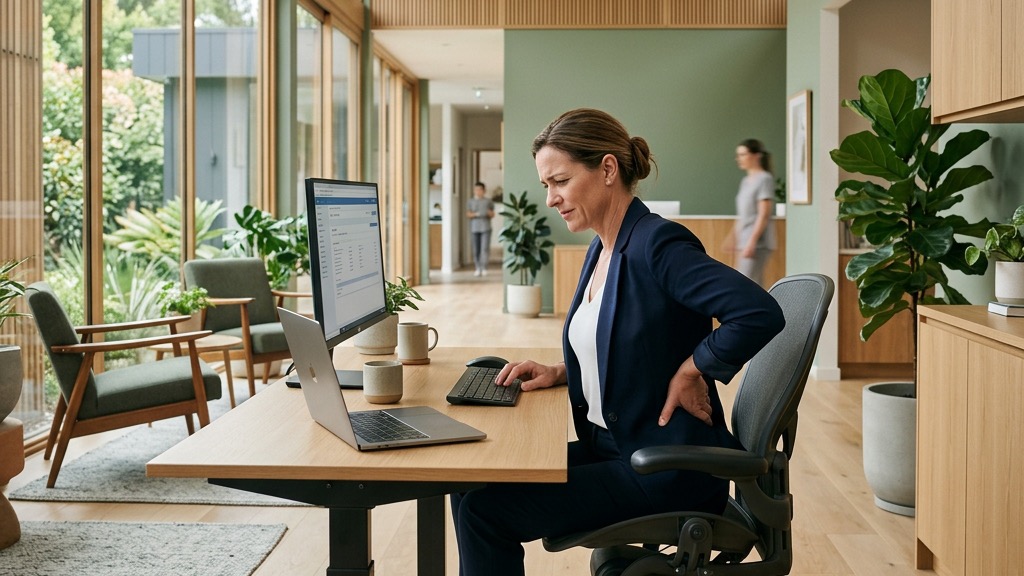
"When we sit, we tend to believe we are resting. Biomechanically, however, we are placing our spinal structures under a dynamic, concentrated load that can exceed standing pressure by over 150%."
If you work a desk job, you are likely intimately familiar with the "4-hour ache"—the dull, nagging tightness in your lower back that reliably appears midway through your workday. To the average office worker, this is just a minor annoyance of office life. To a physiotherapist, it is a clear warning sign of muscular fatigue and micro-structural spinal overload.
Understanding the exact biomechanical triggers of sitting pain is the first and most crucial step to reversing postural damage and achieving long-term, pain-free physical comfort.
The Spinal Physics of Sitting vs. Standing
When you are standing in a neutral, healthy posture, your spine naturally maintains an elegant "S" shape. This curves inward at your lower back (lumbar lordosis) and outward at your mid-back (thoracic kyphosis). This curvature functions like a natural, high-performance suspension system, distributing your body weight evenly across your skeletal system.
When you sit, however, the pelvic girdle rotates posteriorly (backwards). This rotation instantly flattens your lumbar lordosis, converting your elegant "S" curve into a rigid, compromised "C" shape.
In a neutral standing posture, the pressure on your lumbar discs is rated at approximately 100%. When you sit down with poor posture, that pressure spikes to 140% to 185%. If you lean forward over your keyboard, the load on your lower lumbar discs climbs to an astronomical 220%. This persistent loading pushes the gel-like nucleus pulposus of your discs backward, significantly increasing your risk of disc bulges and herniations over time.
Why MUSCULAR Fatigue Occurs After 4 Hours
Your body relies on two primary muscular systems to maintain postural control:
- Phasic Muscles: Designed for rapid, powerful movements (like your quadriceps or gluteus maximus). They fatigue quickly.
- Postural Muscles: Designed for low-intensity, long-duration endurance (like your multifidus and transversus abdominis).
When you sit for hours on end, your postural core stabilizers are forced to contract statically without rest. After approximately 3 to 4 hours, these core stabilizers experience cellular energy depletion and fatigue. Once they shut down, your nervous system is forced to rely on passive spinal ligaments and bony structures to keep you upright. This transfer of load triggers acute, localized inflammation, leading to that characteristic deep, dull ache.
Your lower back does not operate in isolation. If your head drifts forward by just 2 inches to look at a monitor, the effective weight of your head on your neck increases from 12 lbs to over 32 lbs. This forward head posture pulls on your entire posterior fascial chain, creating a secondary anchor of tension that pulls directly on your lower lumbar spine.
Three Actionable Steps to Decompress Your Spine
If you cannot avoid sitting for your job, you can protect your spine by implementing these three clinical physiotherapy interventions:
-
1The 30-Minute Micro-Break Protocol Set a timer for 30 minutes. Every time it goes off, perform a 15-second standing lumbar extension stretch. Merely standing up and arching your lower back backwards immediately reverses disc pressure from 150% back down to 100%, rehydrating your spinal tissues.
-
2Pelvic Tilt Re-education Practice sitting with an anterior pelvic tilt. Rock your hips forward so you sit directly on your "sit bones" (ischial tuberosities) rather than slouching back onto your tailbone. This instantly restores your healthy lumbar curve and offloads active joint pain.
-
3Under-Desk Iliopsoas Release When you sit, your hip flexors (iliopsoas) are kept in a shortened position. When you stand, they pull your lumbar spine forward, creating a deep ache. Perform a half-kneeling hip flexor stretch twice a day to maintain absolute pelvic mobility.
Rebuild Postural Resilience
Ultimately, ergonomics is only half the battle. To achieve true, permanent relief, you must actively strengthen your deep core muscles—focusing on your transversus abdominis and multifidus through movements like "Dead Bugs" and "Plank Pull-throughs". By building active muscular support, your spine remains protected even during long, demanding desk sessions.
Irushi Abeywardhana
Senior Physiotherapist & Founder of Physio Pulse. Senior Clinical Physiotherapist passionate about blending advanced movement science with functional resilience.
Medical Disclaimer
The information provided by AyurPhysio is for general educational and informational purposes only. It is not intended as a substitute for professional medical advice, diagnosis, or treatment. Always seek the advice of your physician or other qualified health providers with any questions you may have regarding a medical condition. Never disregard professional medical advice or delay in seeking it because of something you have read on this website.
Trending Guides
Luka Modrić's Daily Routine: Low-Impact Resistance Training and Midfield Longevity
4 min readHarry Kane's Daily Routine: Hamstring Preservation and Anti-Inflammatory Nutrition
4 min readKarim Benzema's Daily Routine: Cupping Therapy (Hijama) and HIIT Conditioning
4 min readNeymar Jr.'s Daily Routine: Joint Stabilization and Hyperbaric Oxygen Therapy
4 min readMohamed Salah's Daily Routine: Early Morning Conditioning and Hyperbaric Recovery
4 min readWeekly Wellness
Don't miss the next guide
Get holistic health tips and new guides delivered to your inbox.
Related Healing Guides
View All Guides →
Hyperlordosis: Tailoring Exercise Programs to Reduce Lumbar Shear Stress

Morning Lower Back Stiffness: The Biomechanical Causes and Quick, Safe Fixes