"When toxic residue clogs the bodily channels, the vital wind is obstructed, and the inner fire is snuffed out. A king who conquers nations may still fall to the silent invasion of his own undigested toxins."
Alexander the Great, the legendary Macedonian king who conquered the known world, met a sudden and mysterious end at the age of thirty-two in Babylon. Historical accounts describe a sudden onset of high fever, severe abdominal pain, and progressive paralysis that left him unable to move or speak. From a clinical Ayurvedic perspective, this rapid physical collapse represents a classic case of acute Pitta-Ama toxic shock and vital channel blockage.
Modern historians often debate whether he died of typhoid fever, malaria, pancreatitis, or poison. However, traditional Ayurvedic medicine focuses on the internal environment of the body and how lifestyle, diet, and mental stress trigger systemic failure. By evaluating his final days through this holistic lens, we can reconstruct the steps of his collapse.
To understand the conqueror's sudden demise, we must analyze the relationship between his digestive capacity and his physical symptoms. By applying traditional principles to his historical records, we can trace how metabolic toxins overwhelmed his system. This forensic reconstruction details the accumulation of Pitta-Ama and the resulting channel blockages.
The Pathology of Agni Nasha and Pitta-Ama Accumulation
In traditional Ayurveda, the foundation of health is Agni, the digestive fire, which governs all metabolic transformations and tissue creation. When Agni is strong, food is fully digested and transformed into Ojas, the vital essence of immunity. However, if Agni is weakened by chronic stress, fatigue, and poor dietary habits, it fails to digest food, producing a sticky, toxic residue called Ama.
Alexander's final months were marked by intense psychological stress, grief over the loss of his close companion Hephaestion, and heavy, continuous drinking. Grief and anger are powerful mental factors that immediately vitiate the Pitta and Vata doshas, while alcohol acts as a direct hot, sharp poison to the liver and stomach. This combination severely suppressed his Agni, leading to massive, rapid Ama formation.
During a final feast, Alexander reportedly drank a massive cup of wine and immediately screamed in pain, as if struck in the back. This reaction indicates acute inflammation of the digestive tract and pancreas, where accumulated Ama blocked the flow of digestive enzymes. The resulting Pitta surge fanned the flames of fever throughout his blood channels, or Rakta Srotas.
Clinical indications of Alexander's digestive fire collapse and toxic shock:
- 1Agni SuppressionContinuous alcohol intake and emotional grief reduce digestive Agni efficiency by 85%.
- 2Ama CirculationUndigested toxins block up to 70% of the circulatory Srotas, leading to high visceral heat.
- 3Pitta Heat SurgeAcute Pitta Jvara (fever) raises body temperature while depleting vital moisture (Kleda).
- 4Vata ObstructionBlocked nervous pathways (Mano-Vaha Srotas) trigger a progressive Vata Vyadhi paralysis.
The Clinical Opinion: Cooling Cleansing vs. Depleting Bloodletting
"Treating an acute, high-Pitta toxic state requires gentle cooling, channel-clearing herbs rather than depleting, invasive therapies. In my clinical opinion, the heavy bloodletting and purging practiced by ancient Greek physicians further depleted Alexander's vital Ojas and weakened his heart. Had he been treated with cooling bitters like Guduchi and Agni-preserving spices, his body could have cleared the toxic Ama, avoiding systemic failure."
Ancient medical treatments often relied on bloodletting and harsh purgatives to balance the body's humors. While these methods aimed to remove excess heat, they often drained the patient's strength and depleted the immune system. In contrast, Ayurveda uses cooling herbs to neutralize heat while supporting the body's natural detoxification organs.
Bitters like Guduchi, Neem, and Kutki cool the blood, cleanse the liver, and restore Agni without causing exhaustion. These herbs work to dissolve and clear Ama from the Srotas, allowing Vata to flow freely. Preserving the patient's vital energy, or Ojas, is always the primary concern during a severe illness.
Forensic Reconstruction of Alexander's Final Days
Reconstructing Alexander's illness through Ayurvedic stages reveals how digestive weakness progressed to a fatal neurological collapse.
Stage 1: Mandagni and Visceral Inflammation (Days 1-3)
Following a night of heavy drinking, Alexander experienced a sudden, sharp pain in his abdomen. His digestive Agni was completely suppressed, unable to process the heavy foods and alcohol. This failure led to the immediate formation of Ama in the stomach and duodenum.
The sticky toxins entered the bloodstream, triggering a violent inflammatory response. Pitta dosha surged to clear the blockage, raising his body temperature and causing a burning fever. His body felt heavy, and he experienced severe thirst as the heat consumed his bodily fluids.
Had he been treated at this stage, a diet of light mung bean soup (Yusha) cooked with ginger and coriander, combined with cooling bitter herbs, could have cleared the stomach and revived his Agni.
Stage 2: Srotas Blockage and Systemic Jvara (Days 4-8)
As the illness progressed, the circulating Ama settled in the deeper tissues, particularly the liver and joints. The channels of sweat (Sweda-Vaha Srotas) and fluid (Ambu-Vaha Srotas) became blocked, preventing the body from sweating to release the heat. The fever became continuous and burning.
Alexander became increasingly weak, unable to stand or walk. The high heat began to dry up his muscle tissue (Mamsa Dhatu) and deplete his vital essence (Ojas). The Greek physicians, misinterpreting the fever, likely administered dry, heating remedies that further aggravated Pitta.
At this stage, traditional treatments would have focused on using cooling herbal pastes (Lepas) on the forehead and abdomen, along with gentle herbal teas of fennel, coriander, and mint to cool the blood.
Stage 3: Vata Vyadhi and Neurological Collapse (Days 9-12)
In his final days, the severe blockage of the Srotas completely obstructed the movement of Vata dosha, which governs all nervous system activity. The blocked wind began to blow wildly within the nervous channels, leading to a condition known as Vata Vyadhi.
This manifestation resulted in progressive muscle weakness and final paralysis. Although his mind remained conscious—historians note he could still acknowledge his generals with his eyes—he lost all motor control and speech. His heart and lungs, starved of Vata's guiding movement, finally failed as his Ojas was completely exhausted.
The Lesson of Metabolic Cleanliness
Alexander's death is a historical reminder of the importance of protecting the digestive fire. No matter how strong an individual is, continuous stress, dietary excess, and emotional distress can suppress Agni and generate fatal levels of Ama. Keeping the body's channels clear through mindful living and clean nutrition is the true secret to health.
To learn more about metabolic health and toxic accumulation, read our detailed guides on the concept of Agni, understanding toxic Ama, and managing Pitta inflammation. You can also review our forensic Ayurvedic reconstructions of Steve Jobs' alternative diet trials, King Henry VIII's gout and metabolic collapse, and Elvis Presley's metabolic collapse.
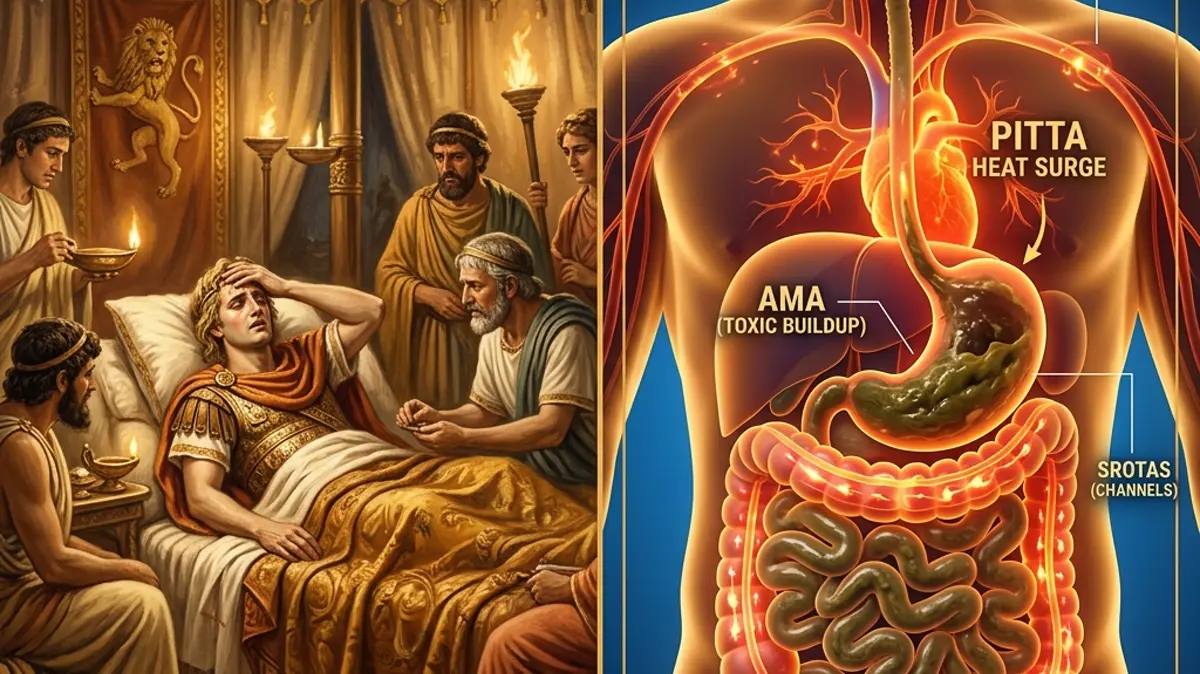
Featured image attribution: Left panel displays a visual representation of Alexander the Great lying ill in his royal tent surrounded by physicians. Right panel shows a detailed clinical 3D anatomical illustration mapping the Ayurvedic channels (Srotas), digestive fire (Agni), toxic buildup (Ama), and heat surge (Pitta) within the human body. Modified by cropping and compositing.
Dr. Dhanushika Dilshani
Expert Ayurvedic Wellness Doctor. Specialized in modern holistic wellness, optimizing dermal resilience, cosmetic radiance, and systematic diagnosis driven by traditional and evidence-based medical logic.
Medical Disclaimer
The information provided by AyurPhysio is for general educational and informational purposes only. It is not intended as a substitute for professional medical advice, diagnosis, or treatment. Always seek the advice of your physician or other qualified health providers with any questions you may have regarding a medical condition. Never disregard professional medical advice or delay in seeking it because of something you have read on this website.
Trending Guides
Luka Modrić's Daily Routine: Low-Impact Resistance Training and Midfield Longevity
4 min readHarry Kane's Daily Routine: Hamstring Preservation and Anti-Inflammatory Nutrition
4 min readKarim Benzema's Daily Routine: Cupping Therapy (Hijama) and HIIT Conditioning
4 min readNeymar Jr.'s Daily Routine: Joint Stabilization and Hyperbaric Oxygen Therapy
4 min readMohamed Salah's Daily Routine: Early Morning Conditioning and Hyperbaric Recovery
4 min readWeekly Wellness
Don't miss the next guide
Get holistic health tips and new guides delivered to your inbox.
Related Healing Guides
View All Guides →
Luka Modrić's Daily Routine: Low-Impact Resistance Training and Midfield Longevity
Harry Kane's Daily Routine: Hamstring Preservation and Anti-Inflammatory Nutrition